 MineArchive
Skye Marble Quarry
| Location | Torrin, Strath Suardal, Isle of Skye, Highland — 57.2081, -6.0024 (exact) |
|---|---|
| Commodity | Marble |
| Type | Stone |
| Worked | At least 1703–1907-13 |
| Operators | Skye Marble Company (1907–1913), Leiths (Scotland) Ltd |
Overview
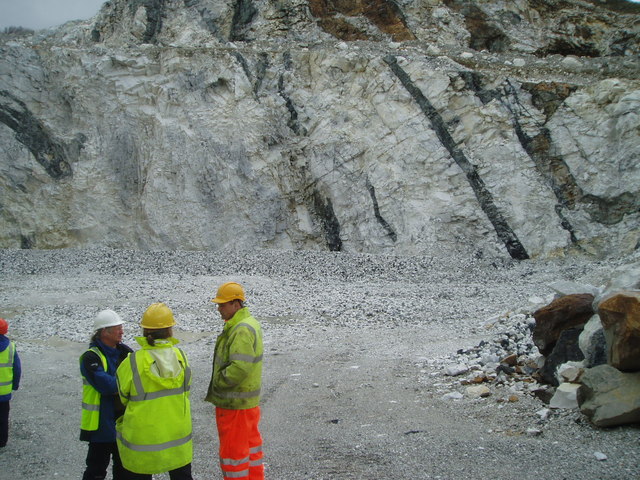
Britain's only true marble deposit, at Torrin in Strath Suardal, Skye — limestone metamorphosed by heat from a nearby Tertiary granite intrusion, rather than the merely polishable limestone marketed as 'marble' elsewhere in Britain. Hand-worked from at least 1703, it was industrialised in 1907-13 by the Skye Marble Company, served by its own narrow-gauge railway to Broadford pier, before the venture failed. A separate quarry has operated at Torrin since 1960, though today it produces mostly aggregate and agricultural lime rather than decorative marble.
History
Small-scale hand-working of marble in Strath Suardal is recorded as early as 1703, when the traveller Martin Martin noted quarries on the south side of the valley; workings developed further through the 18th and 19th centuries. From 1907 the Skye Marble Company began actively developing deposits at Kilchrist, building a marble-cutting and polishing factory beside the quarry and a narrow-gauge railway to Broadford pier — sources disagree on the exact construction dates, with some giving the line as opened in 1908 and others stating construction was completed in 1910, possibly reflecting two phases of work. The company, trading as Skye Marble Ltd from 1911, exported finished marble via Broadford to destinations including Antwerp. A serious workplace accident struck the railway in late October 1910, when Lachlan Macleod of Raasay, working a service train between Broadford and the quarry, jumped from a wagon that had run out of control on an incline and suffered a fatal skull fracture.
The venture proved unsuccessful and was in liquidation by 1913, with its locomotive, around 500 tons of rail and 9,000 creosoted sleepers put up for sale; quarrying at Kilchrist itself appears to have continued in reduced form for some years afterward, with a closure date recorded variously as 1914 (for the original railway-served quarry) and 1939 (for the wider workings). A separate, smaller quarry, Cnoc Slapin, opened at the other end of Torrin village in 1951, extracting rock mainly for agricultural lime, before later closure and partial landscaping in 2001.
The quarry working today, at the Broadford end of Torrin, was established in 1960 by William Thomson Forsyth, a Glasgow paint manufacturer, and was producing around 3,500 tonnes a year by 1965. It is operated today by Leiths (Scotland) Ltd, employing around 5 people, and is a physically distinct site from the historic, long-abandoned Kilchrist workings served by the old railway.
Geology
The host rock is the Durness Group, a Cambrian-Ordovician dolomitic limestone and dolostone that crops out extensively across the Broadford anticline and Strath Suardal. This limestone was contact-metamorphosed by the nearby Beinn an Dubhaich granite, a Palaeogene intrusion roughly 55-60 million years old, recrystallising it into true marble — distinguishing it from the many British stones loosely marketed as 'marble' that are in fact unmetamorphosed, merely polishable limestone. Samples from Kilchrist quarry specifically are described in the British Geological Survey's own North-West Highlands memoir as fine-grained to compact marble 'flecked with black patches', closely resembling the Tyrolean stone predazzite, with a metamorphic mineral assemblage of brucite, forsterite, calcite, dolomite, diopside, serpentine and tremolite produced by heat from the Tertiary intrusion reacting with the original dolomite.
Workings
The 1907-13 Skye Marble Railway ran roughly 4 miles (some sources give up to 6 miles) on 3ft gauge from Broadford pier north along the shore, then inland to a junction serving the marble works and quarries at Kilchrist, ending in a rope-worked incline up to the upper quarry. It was worked by a single Hunslet Engine Company 0-4-0ST steam locomotive, built 1892, bought second-hand by the contractor building the line and sold to the Skye Marble Company in 1911; originally named 'Dilworth', it was renamed 'Skylark' by 1913 and was scrapped in 1925 after passing through two further contractor owners. Marble blocks were finished at the on-site Kilchrist works before being hauled by rail to Broadford pier for shipment. The trackbed survives today as a waymarked footpath, with a footbridge abutment, a loading platform and the ruined marble works building among the visible remains.
Closure
The historic Kilchrist quarry and its railway are long abandoned, the trackbed surviving as a waymarked footpath.
What remains
The historic Kilchrist quarry and railway are long abandoned, with the trackbed surviving as a waymarked footpath and the marble works building in ruins. The separate, currently working quarry at the Broadford end of Torrin, established in 1960 and now operated by Leiths (Scotland) Ltd, remains active, though its output today is overwhelmingly aggregate, agricultural lime and ready-mix concrete rather than the decorative dimension marble the historic operation was built around.
What's uncertain
Points where sources disagree or the record could not be settled; both accounts are kept. All open questions in the archive.
- Closure of the historic quarry is recorded variously as 1914, for the original railway-served quarry, and 1939, for the wider Kilchrist workings; the two figures may refer to different parts of the site and are not reconciled. (disputed) 1,3
Recorded claims
Individual factual claims, each attached to the source(s) that support it below. Where sources disagree, both are kept.
- Small-scale hand-working of marble in Strath Suardal is recorded as early as 1703, when the traveller Martin Martin noted quarries on the south side of the valley. 1
- In late October 1910, Lachlan Macleod of Raasay, working a service train on the Skye Marble Railway, jumped from a wagon that had run out of control on an incline and suffered a fatal skull fracture. 2
- The Skye Marble Company was in liquidation by 1913, with its locomotive, around 500 tons of rail and 9,000 creosoted sleepers put up for sale. 3,4
- Closure of the historic quarry is recorded variously as 1914, for the original railway-served quarry, and 1939, for the wider Kilchrist workings; the two figures may refer to different parts of the site and are not reconciled. (disputed) 1,3
- The quarry working today, at the Broadford end of Torrin, was established in 1960 by Glasgow paint manufacturer William Thomson Forsyth and was producing around 3,500 tonnes a year by 1965. 1
- The quarry is operated today by Leiths (Scotland) Ltd, whose listed products are aggregates, agricultural lime, ready-mixed concrete and related materials rather than decorative marble. 5
- The Durness Group limestone at Kilchrist was contact-metamorphosed into true marble by heat from the nearby Beinn an Dubhaich granite, a Palaeogene intrusion roughly 55-60 million years old. 6
Sources
- (secondary) Torrin — Wikipedia
- (secondary) Skye Marble Railway — Wikipedia
- (secondary) The Railways of Skye & Adjacent Islands — Part 3 — The Skye Marble Railway — Roger Farnworth (independent railway historian)
- (secondary) Skye Marble Railway (line data) — Hebridean Light Railway
- (secondary) Torrin Quarry — Agg-Net (aggregates industry directory)
- (primary) Chapter 31: Contact metamorphism of the Cambrian dolomites and limestones (NW Highlands Memoir) — British Geological Survey Memoir, via Scottish Geology Trust GeoGuide
Record created: 26 August 2026 · Last researched: 26 August 2026