 MineArchive
Preseli Bluestone Quarries
| Also known as | Carn Goedog, Craig Rhos-y-felin |
|---|---|
| Location | Carn Goedog and Craig Rhos-y-felin, Preseli Hills, Pembrokeshire — 51.9653, -4.7253 (approximate) |
| Commodities | Bluestone, Rhyolite |
| Type | Quarry |
| Worked | Around 3000 BC–c. 3000 BC (no later working) |
Overview
Not a quarry in the ordinary sense of this archive at all, but its oldest site by nearly five thousand years — a pair of Welsh hilltop outcrops that a growing body of archaeological evidence identifies as the actual source of Stonehenge's bluestones, quarried by hand with wedges and levers long before metal tools existed.
History
The Preseli Hills of Pembrokeshire have long been recognised as the geological source region for Stonehenge's smaller 'bluestones' — a mixed group of igneous rocks quite different from the monument's giant sarsens — first identified through petrological work in the early 20th century. Excavation from 2011 at two specific outcrops, Carn Goedog and Craig Rhos-y-felin on the northern edge of the hills, went further, proposing that these were not merely the geological source but genuine prehistoric quarries: sites where Neolithic people deliberately extracted natural stone pillars rather than simply collecting loose boulders from the surface. Excavators reported recesses in the rock face consistent with quarrying, artificial platforms apparently built to lower extracted pillars down from the outcrop, and radiocarbon dates from campfire charcoal at both sites clustering around 3000 BC — the same period as the first stage of Stonehenge's construction, roughly 140 to 180 miles away. Carn Goedog has been identified as the dominant source of Stonehenge's spotted dolerite, at least five of the monument's stones probably coming from it, while Craig Rhos-y-felin is linked to one of the rhyolite types found in the debris at Stonehenge. The quarry interpretation is not universally accepted: sceptical geologists have argued that Neolithic people wanting standing stones could simply have collected them from the glacial erratics already scattered across the landscape, without any need to quarry bedrock at all, and have published counter-arguments favouring natural, glacially-transported origins for at least some of the bluestones over deliberate human quarrying and haulage.
A further, more specific proposal followed in 2021: excavation of a partially preserved stone circle at Waun Mawn, on the northern edge of the Preseli Hills and close to both quarry sites, found it had originally been some 110 metres in diameter — matching the diameter of the ditch enclosing Stonehenge itself — and was aligned, like Stonehenge, on the midsummer solstice sunrise. Dating of charcoal and sediment in its emptied stoneholes placed its construction around 3400 BC, centuries before Stonehenge's first stage, and one of Stonehenge's own bluestones has an unusual cross-section that precisely matches one of the abandoned holes at Waun Mawn, with rock chippings recovered from that hole matching the Stonehenge stone's own rock type. On this evidence, the excavation team, led by Professor Mike Parker Pearson, proposed that Waun Mawn may have been a 'proto-Stonehenge' — an earlier stone circle later dismantled, its stones hauled on to Salisbury Plain and re-erected as part of Stonehenge itself, with as many as 80 bluestones potentially moved this way in total. As with the quarrying interpretation more broadly, this specific claim is not settled: it rests on a single matching stone-hole among many empty sockets, and, like the quarrying question itself, remains a live subject of academic debate rather than an established fact.
Geology
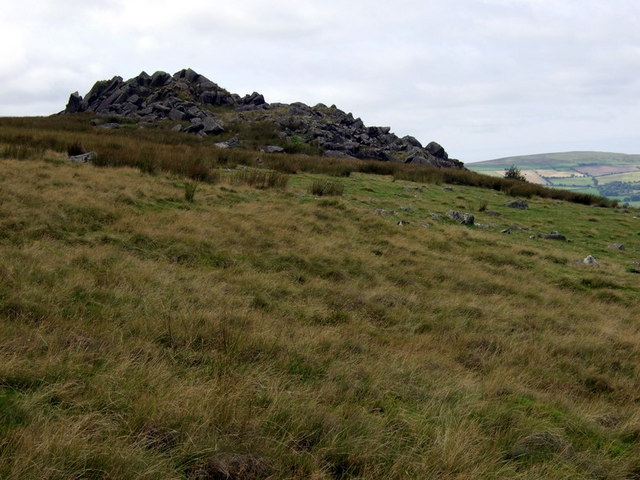
Carn Goedog exposes spotted dolerite, an igneous rock with visible white feldspar spots in a darker groundmass, while Craig Rhos-y-felin in the valley below is a foliated rhyolite, a different igneous rock type. Both outcrops naturally form long, vertical, pillar-like columns separated by joints in the rock, a fracture pattern the quarrying interpretation holds made them unusually easy to extract as more or less ready-made standing stones, needing only to be broken free along their existing natural joints rather than cut from a solid mass.
Workings
No metal tools existed in Neolithic Britain, so the proposed extraction method relied entirely on the rock's own natural jointing: wooden and stone wedges driven into existing cracks to lever pillars free, and, at Craig Rhos-y-felin, an engineered platform of packed rubble apparently built against the outcrop to control the descent of a freed pillar down to the valley floor rather than letting it fall and shatter. Excavators there also identified a hollowed-out track leading away from the foot of this loading platform, interpreted as a route along which an extracted pillar, lowered onto a wooden sledge, was hauled away from the outcrop — though critics of the quarrying interpretation point out that no sledge, roller, rope or similar transport evidence has itself ever actually been recovered, only features interpreted as consistent with their use. How the resulting stones then travelled the considerable distance to Stonehenge — hauled overland by a large Neolithic workforce, moved at least partly by water, or carried by glacial ice long before any human quarrying took place at all — remains genuinely contested among archaeologists and geologists.
Closure
Not applicable in the usual sense — there was no formal closure of a Neolithic quarry; the sites were used briefly around 3000 BC and never developed into any later industry.
What remains
Both outcrops survive as natural rock formations on open moorland in the Preseli Hills, with the excavated evidence for quarrying now reburied rather than left as a visible dig site. They are known today chiefly as a striking landscape and archaeological site rather than as a mine in any conventional sense.
The natural rock outcrops themselves, their jointed pillar formations, and (now reburied) the excavated recesses and platform remains documented by archaeologists.
Redevelopment
None — the sites remain open moorland, part of the Mynydd Preseli common land.
Nearby mines
- Bellstone Quarry — 3.6 miles (5.7 km) SW
- Rosebush Slate Quarry — 4.7 miles (7.5 km) SW
- Cilgerran Quarries — 7.5 miles (12.0 km) NE
Straight-line distance, within 9 miles (15 km). Show on the map.
What's uncertain
Points where sources disagree or the record could not be settled; both accounts are kept. All open questions in the archive.
- The quarrying interpretation is disputed: sceptical geologists argue Neolithic people could have collected standing stones from glacial erratics without quarrying bedrock, and that glacial transport rather than human haulage may explain at least some of the bluestones. (disputed) 3
Recorded claims
Individual factual claims, each attached to the source(s) that support it below. Where sources disagree, both are kept.
- Excavation from 2011 at Carn Goedog and Craig Rhos-y-felin proposed both as genuine prehistoric quarries rather than merely the geological source region for Stonehenge's bluestones, reporting quarrying recesses, an engineered lowering platform, and radiocarbon dates around 3000 BC. 1,2
- Carn Goedog exposes spotted dolerite, identified as the dominant source of at least five of Stonehenge's bluestones; Craig Rhos-y-felin exposes a foliated rhyolite linked to another bluestone type at the monument. 2
- The quarrying interpretation is disputed: sceptical geologists argue Neolithic people could have collected standing stones from glacial erratics without quarrying bedrock, and that glacial transport rather than human haulage may explain at least some of the bluestones. (disputed) 3
- A 2021 excavation of the Waun Mawn stone circle, near the quarry sites, found it had originally been about 110 metres in diameter, matching the diameter of Stonehenge's enclosing ditch, and shared its solstice alignment; one Stonehenge bluestone's unusual cross-section precisely matches an empty stonehole at Waun Mawn, whose rock chippings match that stone's type, leading the excavation team to propose Waun Mawn as a dismantled 'proto-Stonehenge' whose stones were later moved to Salisbury Plain. 4
- Excavators at Craig Rhos-y-felin identified a hollowed-out track leading from the foot of the loading platform, interpreted as a route for hauling an extracted pillar away on a wooden sledge, though no sledge, roller or rope has itself been physically recovered. 1
Sources
- (primary) Craig Rhos-y-felin: a Welsh bluestone megalith quarry for Stonehenge — Bournemouth University (academic paper)
- (secondary) Quarrying Of Stonehenge Bluestones Dated To 3000 BC — University of Southampton
- (secondary) Craig Rhos-y-felin — Wikipedia
- (secondary) Stonehenge may be dismantled Welsh stone circle — UCL (University College London)
Record created: 24 August 2026 · Last researched: 27 August 2026