 MineArchive
Tyrch Quarry
| Also known as | Tyrch Slate Quarries |
|---|---|
| Location | Mynachlog-ddu, Pembrokeshire — 51.9345, -4.6832 (exact) |
| Commodity | Slate |
| Type | Slate |
| Worked | By 1896–before 1953 |
| Operators | Tyrch Silver Grey Slate Quarries Ltd (1899–?, owner) — Registered in 1899 to acquire and work the quarries |
A slate quarry on Foel Dyrch near Mynachlog-ddu in the Preseli hills, revived in the late 1890s with plans for 500 men and a £20,000 company, and disused by 1953.
Location
Recorded location. The large pin is this mine; the small round markers are the nearest mines on record. Click one for its page. View on full map
History
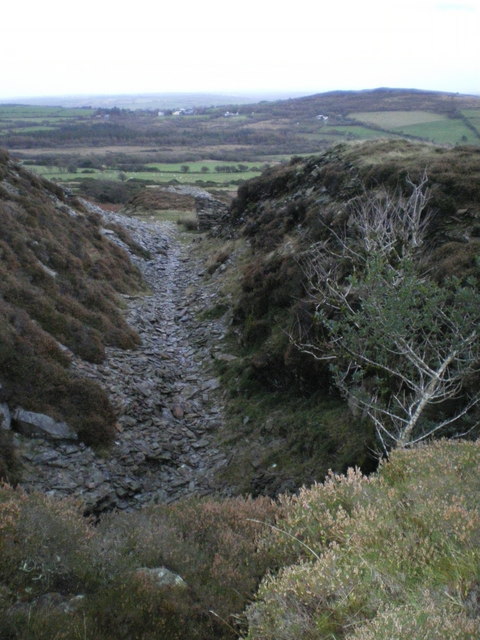
Tyrch slate quarry lies on the southern slopes of Foel Dyrch, south-east of Mynachlog-ddu in the Preseli hills. Its main opencast, about 55 by 40 metres, is set into the hillside amid spoil heaps, with linear quarries beside it and smaller workings to the west and north-east, and a trackway ran east from it to the farms below. Local people claimed in 1898 that it was ancient, that Roman picks had been found there and that slates on the old Tower of London had come from it.
After a long period of neglect, a local proprietor took the quarry on about 1896 and put some sixty men to work. During the Penrhyn dispute of 1897 some of the locked-out Bethesda quarrymen found work at Rosebush, Glogue and Tyrch. In August 1898 a newspaper described plans to work the 300-acre property on a large scale, concentrating on the Lower Tyrch quarry, diverting the road, driving machinery by a turbine on the Eastern Cleddau and building cottages, with talk of 500 men. In March 1899 the Tyrch Silver Grey Slate Quarries Ltd was registered in Bristol with a capital of £20,000 to take the quarries over. The quarry was worked in the later 19th century and was disused before 1953.
Geology
Slate of Foel Dyrch, sold as silver grey slate.
Workings
A main opencast about 55 by 40 metres in a south-facing hillside, with linear quarries, spoil dumps about 180 by 140 metres, small stone buildings and smaller workings nearby.
Closure
Disused before 1953.
What remains
Disused, with the opencast, spoil heaps and ruined stone buildings on the open moor.
The main opencast, linear quarries, spoil dumps and at least four small stone-built structures with a larger one by the southern quarry.
Related mines
- Glogue Quarries — Both Tyrch and Glogue took on Penrhyn quarrymen who came south during the 1897 lock-out (Carnarvon and Denbigh Herald, 1 January 1897).
- Rosebush Slate Quarry — Rosebush and Tyrch both took on Penrhyn quarrymen who came south during the 1897 lock-out (Carnarvon and Denbigh Herald, 1 January 1897).
Nearby mines
- Gilfach Slate Quarry — 2.3 miles (3.8 km) SW, Carmarthenshire
- Preseli Bluestone Quarries — 2.8 miles (4.5 km) NW
- Glogue Quarries — 4.3 miles (7.0 km) NE
- Bellstone Quarry — 4.8 miles (7.7 km) W
- Rosebush Slate Quarry — 5.8 miles (9.4 km) W
Straight-line distance, within 9 miles (15 km).
Further reading
The Royal Commission's record of the opencast, spoil and buildings on Foel Dyrch, worked in the later 19th century.
View sourceThe 1898 account of plans to develop the Tyrch slate quarries on a large scale.
View sourceSources
- (primary) Tyrch Quarry (Coflein, NPRN 308722) — RCAHMW
- (secondary) Haverfordwest and Milford Haven Telegraph, 24 August 1898: Another new local industry (Welsh Newspapers Online) — Welsh Newspapers Online, National Library of Wales
- (secondary) Carnarvon and Denbigh Herald, 1 January 1897: The Penrhyn dispute (Welsh Newspapers Online) — Welsh Newspapers Online, National Library of Wales
- (secondary) Western Mail, 8 March 1899: Local finance, Tyrch Slate Quarries (Welsh Newspapers Online) — Welsh Newspapers Online, National Library of Wales
- (observational) Tyrch slate quarry (Geograph) — Geograph
- (primary) Tyrch Quarry (Coflein, NPRN 412706) — RCAHMW
Record created: 20 November 2026 · Last researched: 20 November 2026