 MineArchive
Glogue Quarries
| Also known as | Glogue Quarry, Cwm-Gigfran Quarry |
|---|---|
| Location | Glogue, near Crymych, Pembrokeshire — 51.9642, -4.5938 (exact) |
| Commodity | Slate |
| Type | Slate |
| Worked | 17th century–1927 |
| Operators | John Owen (?–1853, owner) — Proprietor; offered the quarries on lease in 1853 Glogue Brick and Slate Works Company Ltd (owner) — Owners in the 1904 accident return |
A large slate and slab quarry east of Crymych in north Pembrokeshire, held back by poor transport until the railway came in 1873, and closed in 1927 when its slate-dust bricks failed.
Location
Recorded location. The large pin is this mine; the small round markers are the nearest mines on record. Click one for its page. View on full map
History
The Glogue quarries lie east of Crymych, in the upper Taf valley in north Pembrokeshire, where two early workings, perhaps of the 17th century, grew together into one large quarry. In 1853 the proprietor, John Owen, who had worked them profitably himself but could no longer attend to them, offered the Glogue slate and flag quarries to let on lease, claiming their slates and flags were unsurpassed in South Wales. A correspondent in 1859 called them in full work.
Transport was the problem. Slate was carted to Blackpool on the Eastern Cleddau and, after 1853, to Narberth Road station, where in 1860 the quarry's agent kept a constant supply of slate and of paving flags sawn and planed by machinery. Only when a siding on the Whitland and Cardigan Railway was laid in 1873 could it really expand. Material was lowered by two inclines, the upper later replaced by a tunnel to the head of the lower one, and the mill was driven by steam and later electricity. The slates were of good colour but heavy, so slab was the main product; in 1889 Cardigan's corporation was waiting on paving stones from the quarry.
By 1904 the Glogue Brick and Slate Works Company owned it, and that January a quarryman was killed when a slab of slate eight feet long fell on him as he barred its neighbour. In the 1920s the company tried making bricks from slate dust, but when the Great Western Railway imposed a premium for their weight in 1927 they could no longer compete, and the quarry closed. A terrace of houses the company built for its workers was still lived in in 1991.
Geology
Slate of the Preseli foothills, good in colour but heavy, worked mostly for slab and paving flags.
Workings
A large open quarry formed from two merged workings, with two inclines (the upper later replaced by a tunnel), a steam and later electric mill and a railway siding.
Closure
Closed in 1927, when a railway weight premium made its slate-dust bricks uncompetitive.
What remains
Bulk working has removed most of the old quarry; slate waste is now taken from the site, and little survives beyond traces of the mill buildings and the stone-built lower incline.
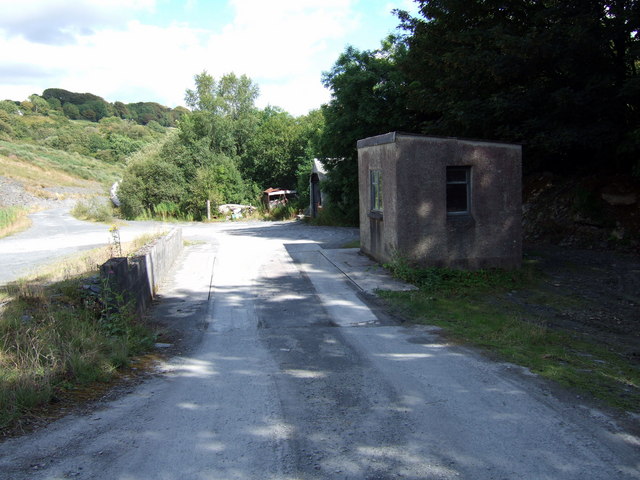
Vestiges of buildings in the mill area, the stone-built lower incline, a weighbridge and the company's terrace of workers' houses.
Redevelopment
Slate waste is now quarried for agricultural use.
Related mines
- Tyrch Quarry — Both Tyrch and Glogue took on Penrhyn quarrymen who came south during the 1897 lock-out (Carnarvon and Denbigh Herald, 1 January 1897).
Nearby mines
- Tyrch Quarry — 4.3 miles (7.0 km) SW
- Preseli Bluestone Quarries — 5.6 miles (9.0 km) W
- Cilgerran Quarries — 6.4 miles (10.3 km) N
- Gilfach Slate Quarry — 6.6 miles (10.6 km) SW, Carmarthenshire
- Bellstone Quarry — 8.8 miles (14.2 km) W
Straight-line distance, within 9 miles (15 km).
Further reading
The Royal Commission's record: the merged quarries, inclines and tunnel, transport, the 1873 siding, slate-dust bricks and closure in 1927.
View sourceJohn Owen's 1853 advertisement offering the Glogue slate and flag quarries on lease.
View sourceSources
- (primary) Glogue Quarries; Cwm-Gigfran Quarry (Coflein, NPRN 114990) — RCAHMW
- (secondary) The Welshman, 2 September 1853: The Glogue Slate Quarries to be let (Welsh Newspapers Online) — Welsh Newspapers Online, National Library of Wales
- (secondary) The Welshman, 16 March 1860: Glogue Slate Quarry advertisement (Welsh Newspapers Online) — Welsh Newspapers Online, National Library of Wales
- (secondary) NMRS deaths and injuries database: Glogue Quarry, 1904 — Northern Mine Research Society
- (observational) Glogue Quarry entrance (Geograph) — Geograph
- (secondary) Cardigan Observer, 19 October 1889: Cardigan council, paving stones (Welsh Newspapers Online) — Welsh Newspapers Online, National Library of Wales
- (secondary) The Welshman, 4 November 1859: letter on a railway by the Glogue slate quarries (Welsh Newspapers Online) — Welsh Newspapers Online, National Library of Wales
Record created: 20 November 2026 · Last researched: 20 November 2026