 MineArchive
Rosebush Slate Quarry
| Location | Rosebush, Preseli Hills, Pembrokeshire — 51.9311, -4.8201 (exact) |
|---|---|
| Commodity | Slate |
| Type | Slate |
| Worked | 1842–1914 |
| Operators | Edward Cropper (1870–1876) |
Overview
A Preseli Hills slate quarry, with its smaller neighbour Bellstone Quarry, opened in 1842 and expanded in the 1870s by railway director Edward Cropper, who built a purpose-built branch railway to move its slate to market. Reported, with some hedging even in the sources, to have supplied slate for the roof of the rebuilt Palace of Westminster, the quarry's owners tried unsuccessfully to reinvent the village as a Victorian holiday resort once the slate boom faded. The flooded former workings are now a public wild-swimming and exploration site.
History
Bellstone Quarry was worked in a small way from the 1820s; Rosebush Quarry itself opened in 1842, and by 1835 the site and 67 acres of surrounding land had already been advertised for auction as 'celebrated and profitable.' Both quarries reached full production over the last thirty years of the 19th century, at peak employing around 100 men, many housed in the 26 cottages of Rosebush Terrace built for quarrymen and their families. An 1889 Ordnance Survey map annotation records that the quarry 'had provided slate for the roof of the Palace of Westminster, presumably during the post-fire rebuild' begun in 1840 — though the same source notes Rosebush and Bellstone slate was reportedly not of especially good quality for roofing, but excellent for building blocks, so the claim should be read as reported tradition rather than a settled documented contract.
The quarry was expanded by Edward Cropper, a London and North Western Railway director, supported by Sir Hugh Owen of Goodwick, owner of Bellstone Quarry; Cropper's stepson Joseph Macaulay managed the quarry and its new railway. Cropper died shortly after the railway's opening ceremony in September 1876. Rosebush Quarry and its railway were auctioned in 1889 and bought by Colonel Joseph Okell, who extended the railway toward Letterston and brought in a new locomotive, 'Margaret', now preserved at Scolton Manor; Okell went bankrupt in 1896. When the market for slate declined, the quarry's owners tried to sell Rosebush as a holiday resort instead, publicising the Preseli air and the facilities of the corrugated-iron Prescelly Hotel — a scheme that ultimately failed, leaving the hotel to survive only as a pub, today's Tafarn Sinc. Both quarries had effectively gone out of business by 1908, when a relative of Sir Hugh Owen bought the whole Rosebush estate — quarry, village and station — and quarrying ceased for good in 1914.
Geology
Slate of the Preseli Hills, worked with the smaller neighbouring Bellstone Quarry.
Workings
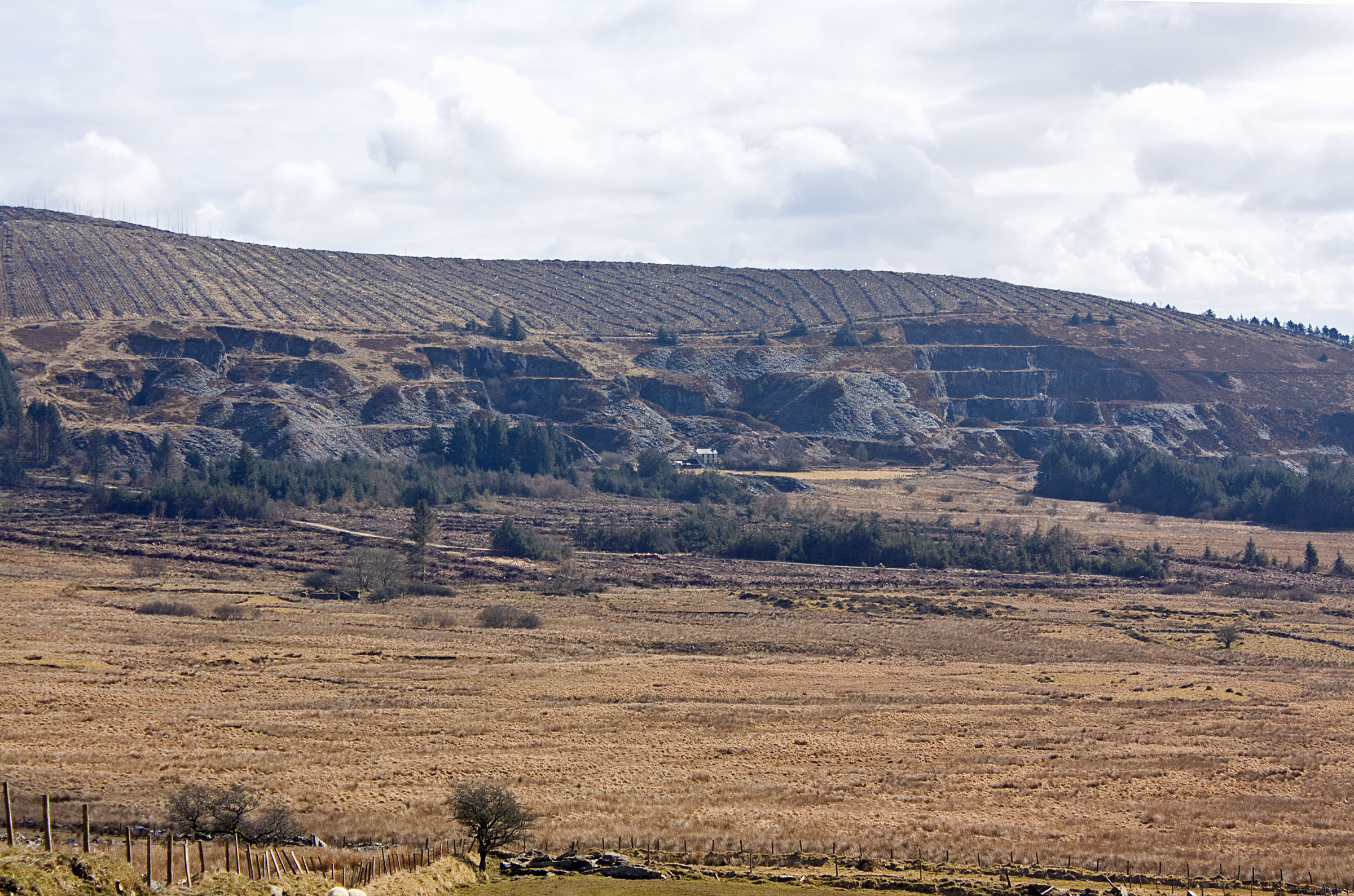
Slate was lowered from the upper levels by a railway incline, with a short tunnel leading to the lower levels; galleries and heaps of waste rock remain clearly visible today. The purpose-built Maenclochog Railway, an 8-mile line from the quarry to the Great Western Railway main line at Clunderwen, cost around £130,000 to build alongside re-equipping the quarry; it opened in 1876, closed at the end of 1882, and was rebuilt and reopened as the North Pembrokeshire and Fishguard Railway in 1895, later extended to Goodwick near Fishguard Harbour in 1899, realising Cropper's original vision. The Great Western Railway took the line over in 1898; its passenger service closed in 1937 and freight in 1949.
Closure
Both quarries had effectively gone out of business by 1908, when the Rosebush estate changed hands.
What remains
The flooded former quarry, roughly 200 feet from lowest to highest point with extensive underground passages running into the hillside, is now publicly accessible and a popular wild-swimming and informal exploration site, with several stone quarry buildings surviving on the surface in varying states of decay; some entrances are blocked by landslide debris or deliberately. Loose slate and significant drops around the quarry faces present a genuine modern hazard to visitors.
Related mines
- Bellstone Quarry — Contiguous workings on the same Preseli hillside, Bellstone the northern and Rosebush the southern, always under separate ownership but sharing the Maenclochog Railway that Edward Cropper built in 1876 with Sir Hugh Owen of Bellstone among his backers.
Nearby mines
- Bellstone Quarry — 1.1 miles (1.8 km) NE
- Preseli Bluestone Quarries — 4.7 miles (7.5 km) NE
Straight-line distance, within 9 miles (15 km). Show on the map.
What's uncertain
Points where sources disagree or the record could not be settled; both accounts are kept. All open questions in the archive.
- An 1889 Ordnance Survey map annotation records that the quarry had provided slate for the roof of the Palace of Westminster, presumably during the post-fire rebuild begun in 1840, though the same source notes the slate was reportedly not of especially good quality for roofing. (uncertain) 1
Recorded claims
Individual factual claims, each attached to the source(s) that support it below. Where sources disagree, both are kept.
- An 1889 Ordnance Survey map annotation records that the quarry had provided slate for the roof of the Palace of Westminster, presumably during the post-fire rebuild begun in 1840, though the same source notes the slate was reportedly not of especially good quality for roofing. (uncertain) 1
- At peak the quarries employed around 100 men, many housed in the 26 cottages of Rosebush Terrace built for quarrymen and their families. 2
- The purpose-built Maenclochog Railway, an 8-mile line to the Great Western Railway main line at Clunderwen, cost around £130,000 to build alongside re-equipping the quarry and opened in 1876. 3
- When the slate market declined, the quarry's owners tried to sell Rosebush as a holiday resort, publicising the Preseli air and the corrugated-iron Prescelly Hotel; the scheme failed and the hotel survives today only as the pub Tafarn Sinc. 2
- Both quarries had effectively gone out of business by 1908, and quarrying ceased for good in 1914. 3,2
- The flooded former workings are recorded by Coflein as NPRN 410912, classified as a reservoir feature, with aerial photographs taken in 2004, 2007 and 2011. 4
Sources
- (secondary) Remains of Rosebush slate quarry — History Points
- (primary) Rosebush web walk — Pembrokeshire Coast National Park Authority
- (secondary) North Pembrokeshire & Fishguard Railway — Brief History — Disused Stations (Nick Catford)
- (primary) Rosebush Quarry (NPRN 410912) — Royal Commission on the Ancient and Historical Monuments of Wales (Coflein)
Record created: 26 August 2026 · Last researched: 26 August 2026