 MineArchive
Iron Age
| Category | Periods |
|---|
The period from about 800 BC, when iron took over from bronze as the working metal, to the Roman conquest in AD 43. Iron was smelted from local ores in small furnaces across southern Britain, Cornish tin was traded to the Continent, and the first written account of mining in Britain, of the tin of west Cornwall, dates from this time.
Historical usage
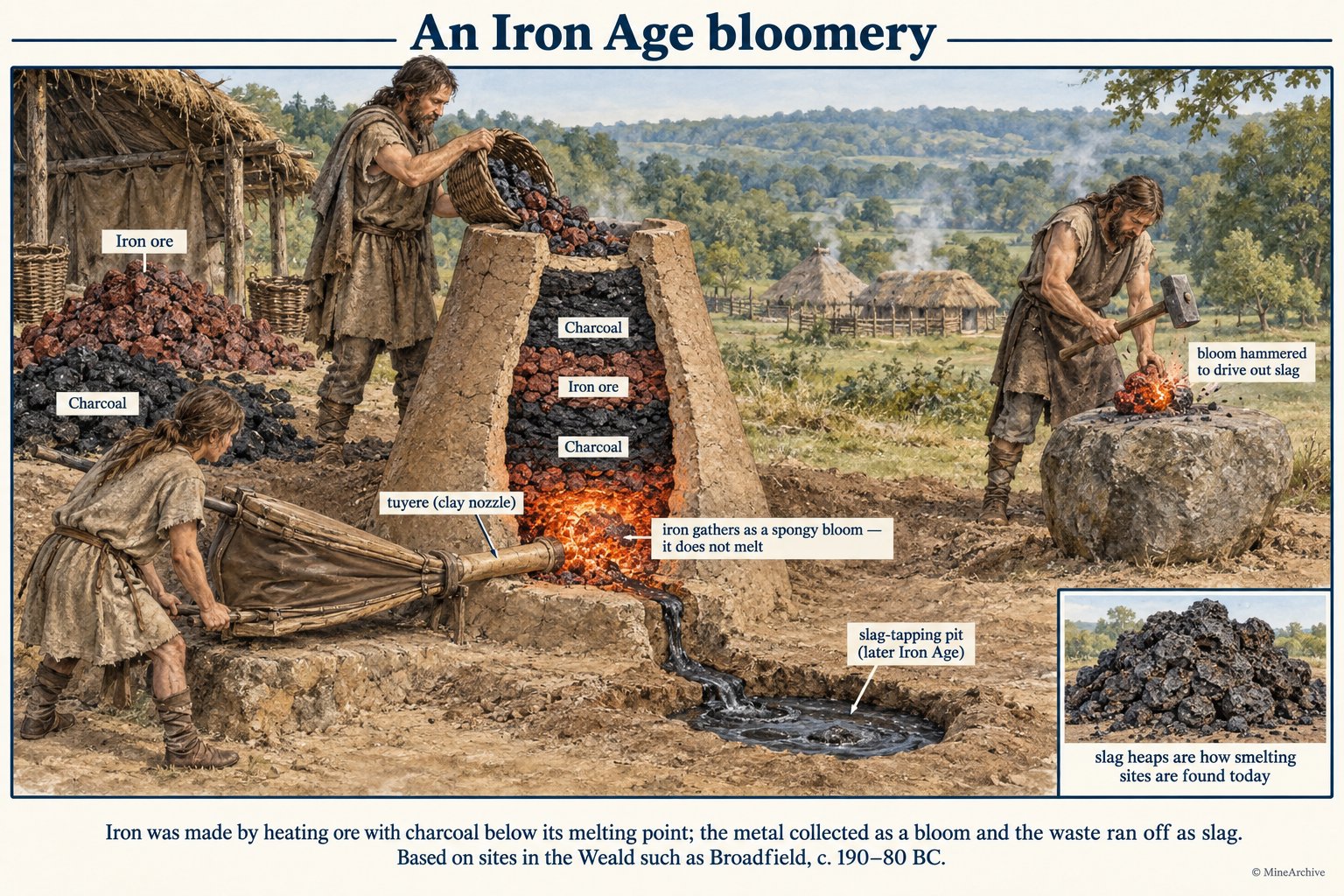
As new ideas from central and north-western Europe reached Britain after 800 BC, the Bronze Age gave way to the age of iron. Iron ore is widespread, and Iron Age smelting has been found across southern England: shaft furnaces of about 190-80 BC with slag-tapping pits at Broadfield near Crawley, using local Wealden ore; furnace bases and a bloom of about 200 BC to AD 150 at Purberry Shot near Ewell; and bloomery sites in the Weald at Crowhurst Park, Bardown and Chitcomb. In Cornwall the tin trade revived. Excavations at Chun Castle showed tin being smelted there in the 3rd and 2nd centuries BC, and the Greek explorer Pytheas of Massilia described the preparing of west Cornish tin around 325 BC, in an account preserved two centuries later by Diodorus Siculus and the first written description of Cornwall: merchants bought the tin, carried it over to Gaul and took it about thirty days overland to the mouth of the Rhône. Other metals were worked too. A Middle Iron Age copper-smelting site with thirteen furnaces has been found at Four Crosses, a few kilometres from the ancient copper mines of Llanymynech, and pre-Roman lead mining has been suggested at Charterhouse on Mendip from a Greek coin of the 3rd century BC, a denarius of Julius Caesar and Iron Age pottery found in trenches across its opencuts. Radiocarbon dates from the deeper parts of the Great Orme suggest that copper was still being got there, on an unknown scale, into the Iron Age.
How it worked
Iron was made in a bloomery: ore and charcoal were heated together in a small furnace below the melting point of iron, so that the metal gathered into a spongy bloom while the waste ran off as slag, and the bloom was then hammered to drive out what slag remained. By the later Iron Age some furnaces were built with pits for tapping the slag. Cornish tin was prepared by working the tin-bearing ground with care and smelting it, and the metal moved in ingots to the merchants.
Why it was used
Iron ores are found almost everywhere, and where there was woodland for charcoal they could be smelted locally. Tin, still needed for bronze and prized abroad, gave Cornwall a trade that reached the Mediterranean through Gaul.
Risks & limitations
The evidence is mostly of smelting rather than of mining: furnaces, slag and blooms survive, but the pits and opencuts that supplied them are hard to date and were usually reworked later. Claims for Iron Age mining at particular sites, such as Charterhouse, rest on a few coins and sherds.
Regional variation
Iron came from the Weald and other southern ores, tin from west Cornwall, copper from the Welsh borders, and salt from the brine springs of Droitwich; at Kimmeridge in Dorset oil shale was turned on lathes into armlets.
Related terminology
Mines associated with this term
Included only where MineArchive's own research gives a reasonable evidential basis — not every mine where this might plausibly apply.
- Kimmeridge Oil Shale Workings — Dorset (surviving physical example)
Iron Age workshops turned Kimmeridge shale on lathes into armlets. - Droitwich Salt Wells — Worcestershire (historical documentary reference)
Salt production on an industrial scale from around 300 BC, brine being collected in large storage pits.
Sources
- (secondary) Cornwall in the Iron Age — Cornwall Heritage Trust
- (secondary) Mining archaeology in the British Isles — Wikipedia
- (secondary) Mining in Roman Britain — Wikipedia
- (secondary) Research Framework for the Archaeology of the Extractive Industries in England: the Prehistoric and Roman Periods (assessment, 2013) — National Association of Mining History Organisations
Record created: 18 September 2026 · Last researched: 18 September 2026