 MineArchive
Gads
| Category | Structures & Machinery |
|---|
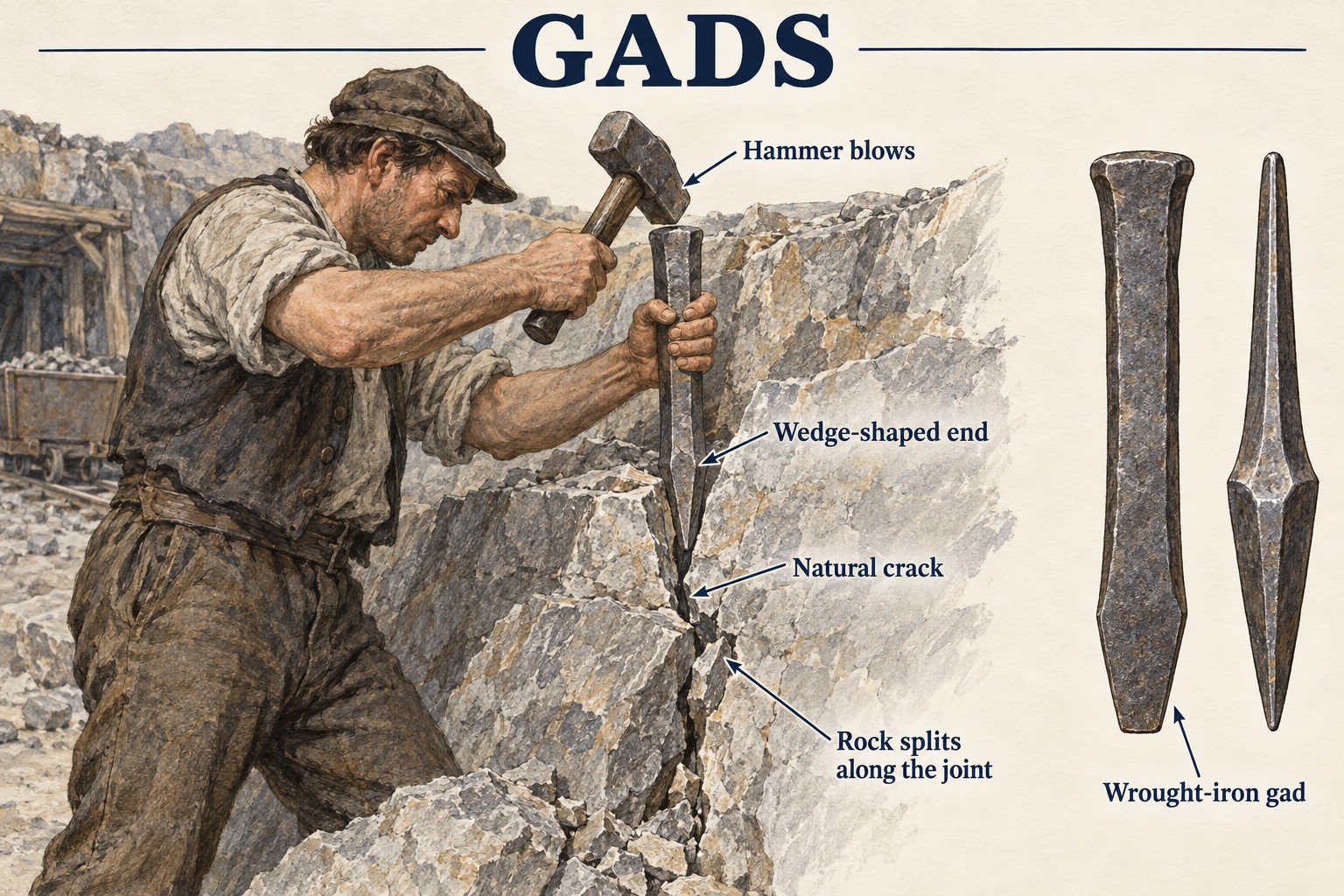
A simple wrought-iron hand tool — part wedge, part chisel — driven with a hammer to split or break rock by hand, before power drilling and explosives made the job faster.
Historical usage
Gads were standard equipment in British metal mines for centuries, alongside picks and hammers, used to work loose or split rock away from the face by hand; examples survive in mining museum collections such as the Peak District Lead Mining Museum's own wrought-iron gad. The technique goes back further still — Roman and medieval quarrymen used the related method of fire-setting, heating a rock face and then rapidly cooling it with water to crack it, before prising the shattered rock apart with wedges and bars much like a gad.
How it worked
A miner drove the gad's wedge-shaped end into an existing crack, joint or drilled hole with repeated hammer blows, using leverage and the wedge's shape to force the rock apart along its natural weaknesses; the tool's pointed end could also be used more like a chisel, to pick and break rock directly.
Why it was used
Before compressed-air drills and dynamite became widely available, hand tools like the gad were often the only practical way to break rock too hard, or too close to a working face, for blasting alone — cheap, portable, and requiring no fuel or machinery beyond a hammer and muscle.
Risks & limitations
Working rock by hand with a gad was slow and physically exhausting compared with drilling and blasting, and became increasingly uneconomic once mechanised alternatives spread through British mining from the mid-19th century onward — though it never entirely disappeared, remaining useful for delicate work close to timbering or in confined spaces where blasting was impractical.
Related terminology
Mines associated with this term
Included only where MineArchive's own research gives a reasonable evidential basis — not every mine where this might plausibly apply.
- Grogwynion Mine — Ceredigion (well documented example)
The mine's own recorded history explicitly describes ancient galleries reportedly cut by hand with gads.
Sources
- (primary) Mineral extraction — Peak District Lead Mining Museum
- (secondary) Gad (mining) — Wisconsin Historical Society
Record created: 22 August 2026 · Last researched: 22 August 2026