 MineArchive
Panning
| Category | Prospecting & Exploration |
|---|
A manual technique for separating gold, or other dense minerals, from loose stream sediment using a shallow pan and water — the simplest and oldest form of placer mining, and usually the first thing any prospector actually does before committing to anything more elaborate.
Historical usage
Panning has been practised since antiquity, used by Egyptian, Greek and Roman miners and later by Spanish colonial prospectors in the Americas, before becoming globally famous through the 19th-century gold rushes of California, Australia and the Klondike. Britain had its own, much smaller version of the same story: prospectors panned the Lowther Hills around Wanlockhead and Leadhills for gold as early as the 16th century, and it was the technique Robert Nelson Gilchrist used on the Helmsdale River in 1868-69, triggering the Kildonan Gold Rush — Scotland's largest.
How it worked
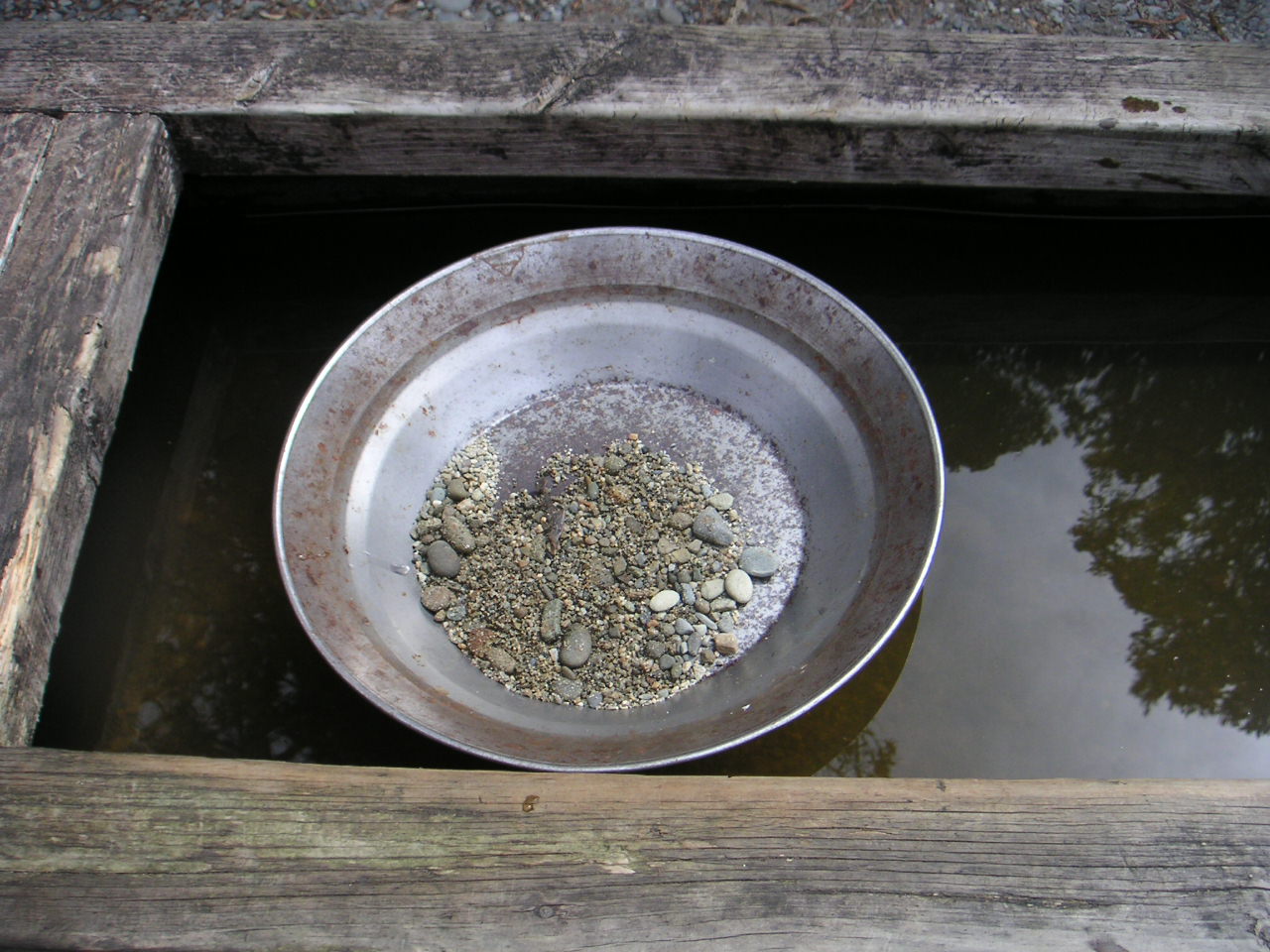
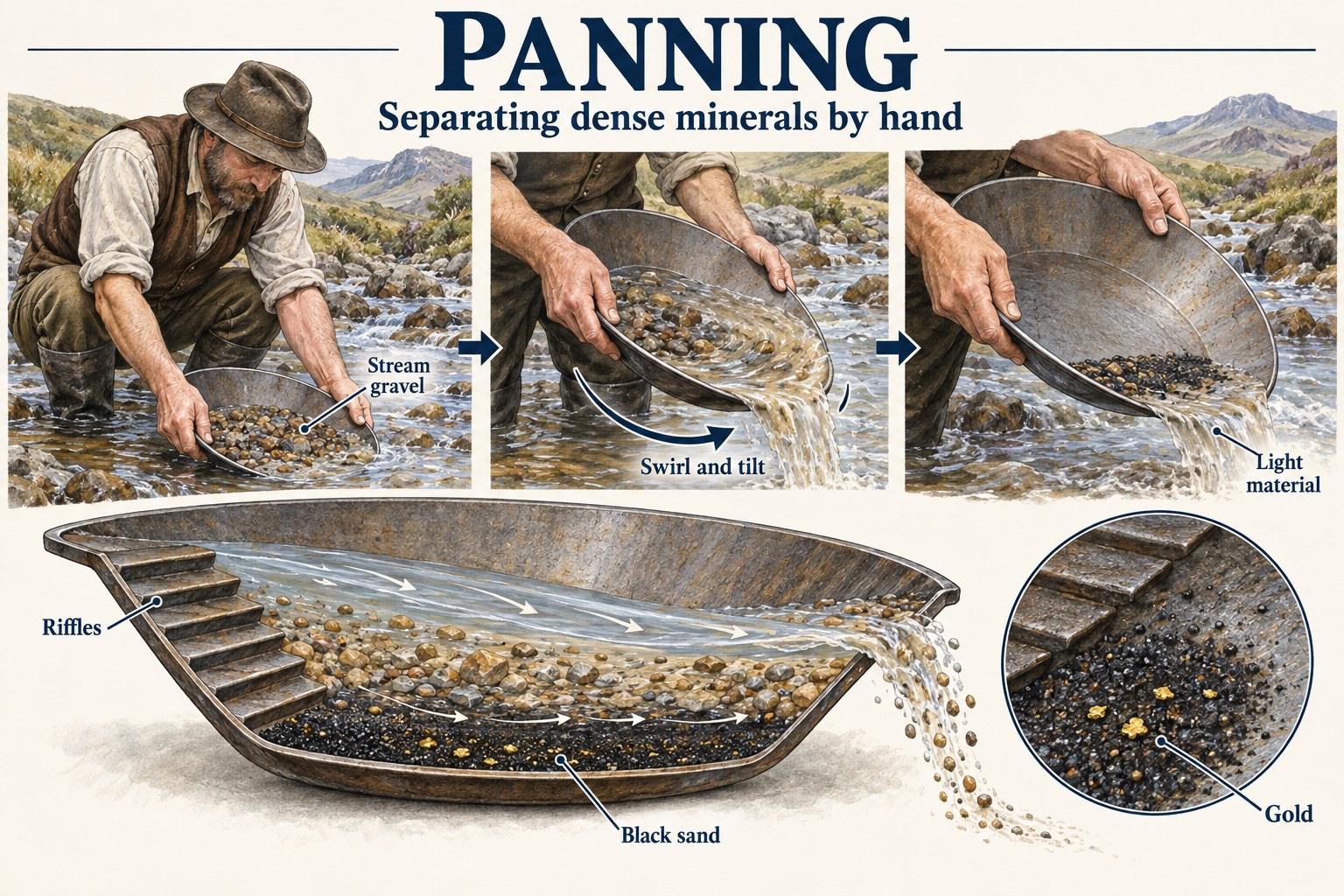
Sediment and water are loaded into a shallow, sloped-sided pan, then swirled and tilted repeatedly so the lighter sand and gravel wash out over the rim while gold — roughly nineteen times denser than water — settles to the bottom, helped by shallow ridges (riffles) moulded into the pan's edge. The process is repeated until only a small residue of gold and other heavy minerals (dark 'black sand', usually magnetite) remains.
Why it was used
It needs no equipment beyond the pan itself, is completely portable, and gives an immediate answer to whether a stretch of gravel is worth working further — historically the first, cheapest test any prospector made before investing in a sluice or a larger operation, and still the method most modern recreational panners in Scotland and Wales actually use.
Risks & limitations
Extremely labour-intensive for the volume of gravel processed: a skilled panner can only work a small fraction of what a sluice or highbanker handles in the same time, so panning alone rarely supported more than a subsistence living even during a genuine rush. It functioned historically more as a prospecting and testing method than as a production method once a worthwhile deposit had actually been confirmed.
Related terminology
Gold, Highbanking, Hydraulic Mining
Mines associated with this term
5 examples chosen from 6 linked records — the term page is not an index.
- Dolaucothi Gold Mines — Carmarthenshire (well documented example)
This record's own current_condition text describes visitors trying gold panning in the mine yard. - Gwynfynydd Gold Mine — Gwynedd (well documented example)
The mine was opened to the public for guided tours in the 1990s, gold panning included — visitors working the same ground that supplied a royal ingot in 1986. - Kildonan Gold Rush — Highland (well documented example)
Robert Nelson Gilchrist began systematically panning the Helmsdale River and its tributaries in 1868, triggering the rush. - Leadhills — South Lanarkshire (well documented example)
Leadhills is still an inhabited village rather than an abandoned site, and its burns still draw panners to ground worked for centuries. - Wanlockhead — Dumfries and Galloway (well documented example)
Groups of prospectors camped in the hills each summer to pan for gold, retreating before winter.
Sources
- (secondary) Gold Panning - History of a Prospecting Method (Tool) — 911 Metallurgist
- (secondary) Gold panning — Wikipedia
Record created: 22 August 2026 · Last researched: 22 August 2026