 MineArchive
Highbanking
| Category | Prospecting & Exploration |
|---|
A mechanised, portable form of placer mining that uses a small water pump to feed loose gravel through a sluice box away from the water's edge — a modern step up from hand panning that lets one or two people process far more material per hour. Almost entirely a recreational and small-scale technique today, not a commercial one.
Historical usage
Highbanking is fairly new. It only became possible once small portable pumps and compact engines or motors were affordable, and it grew up alongside the modern recreational-prospecting hobby in North America from the 1970s and 80s onward.
How it worked
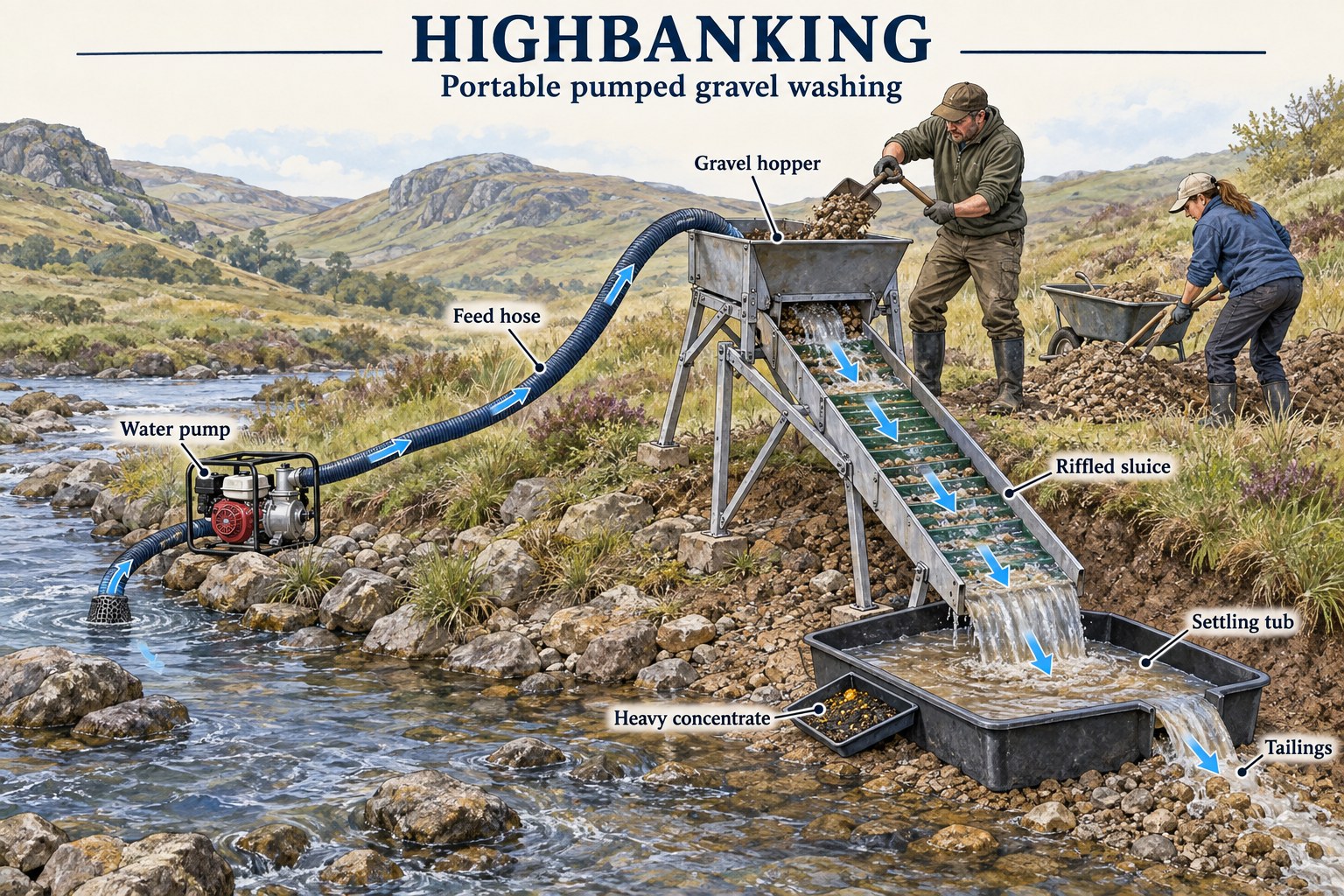
A pump draws water from the nearby stream, or from a settling tub where discharging directly into the watercourse isn't allowed, and delivers it to a hopper at the top of a sloped sluice box. Gravel shovelled into the hopper washes down the box's riffled bottom, letting the operator work a bank of gravel some distance from the water itself rather than kneeling in the stream, and process many times the volume of material a pan alone could handle in the same time.
Why it was used
It marries a sluice's much higher throughput to the portability of a pan: a unit small enough for one or two people to carry into a remote gully, but capable of processing far more gravel per hour than panning by hand, without the fixed installation a historic ground-sluice or hydraulic system needed.
Risks & limitations
In Britain highbanking has been far more tightly restricted than simple panning: watercourse abstraction and discharge are regulated (by SEPA in Scotland, Natural Resources Wales, and the Environment Agency in England), and running a pump or other powered equipment on many rivers needs permission that isn't required for hand panning alone.
Related terminology
Sources
- (secondary) Highbanking FAQ — Crux Prospecting
- (secondary) Highbanking for Gold — ICMJ's Prospecting and Mining Journal
Record created: 22 August 2026 · Last researched: 22 August 2026