 MineArchive
Lee Moor China Clay Works
| Also known as | Lee Moor Clay Works, Whitehill Yeo China Clay Works |
|---|---|
| Location | Lee Moor and Wotter, Shaugh Prior, western Dartmoor, Devon — 50.4350, -4.0121 (approximate) |
| Commodity | China Clay |
| Type | Clay |
| Worked | from 1820s-30s |
| Operators | J. and W. Phillips (1830–1862), The Martin family (1862–1919), English China Clays (1919–1999), Imerys (1999–?) |
Overview
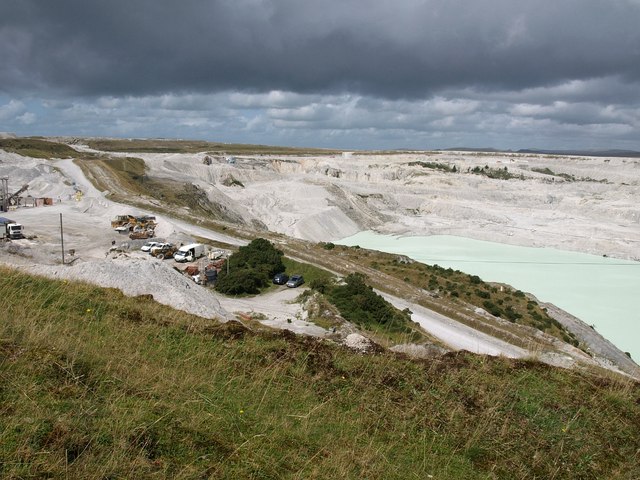
Dartmoor's answer to the Cornish clay country, and with Hensbarrow one of only two places in Britain where china clay is still worked. The pits did not so much dig the granite out as wash it away, and the white spoil they raised has rebuilt the skyline of the moor's south-west corner.
History
Kaolin was found on this edge of Dartmoor early in the 19th century — John Warrick is credited with one of the first discoveries, at Whitehill Tor in 1827 — and by the 1830s the Phillips brothers had china clay workings running at Lee Moor. Cornish clay workers were recruited to a moorland parish that had no such tradition, at first combining clay work with smallholding. The Martin family took over from Phillips in 1862 and put the industry on a modern footing, enlarging the pits, driving the adits that carried the wet clay away, and building the settling tanks and drying kilns. Five separate clay works were operating in the area by 1883, and the villages of Lee Moor and Wotter grew to house the workforce: the parish population rose from 554 in 1851 to 783 by 1906, with 400 people employed in the Lee Moor works alone by 1913. English China Clays was formed by merger in 1919 and ran the pits through the 20th century; output peaked in the 1980s. The works passed to Imerys, and are now leased and operated by Sibelco.
Geology
China clay is not a mineral that was deposited here but one the granite turned into: kaolinite formed where the feldspar of the Dartmoor granite was altered in place, leaving a soft, white, crumbling rock in which perhaps a tenth of the mass is the clay actually wanted. That ratio is the whole economics of the industry — every tonne of saleable clay leaves several tonnes of quartz sand and mica behind, which is why china clay country is defined by its white tips rather than by its holes. Dartmoor and the Hensbarrow granite near St Austell are the two British areas where the alteration went deep enough to be worth working.
Geological setting: Kaolinization and China Clay Deposits (well documented example)
Workings
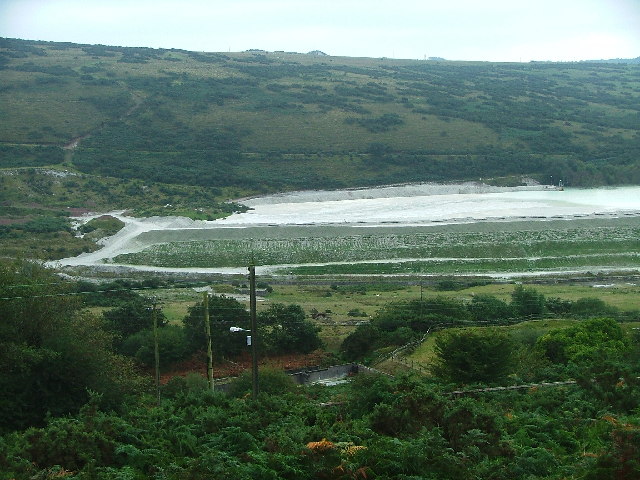
The traditional method was hydraulic: high-pressure water monitors were played against the pit face to break the softened granite down and wash the clay out in suspension, the slurry then running through settling tanks and mica dams that let the coarse waste drop out before the clay was dried in long kilns. Lee Moor changed over from hydraulic to dry mining in 2001. Getting the product off the moor was the other half of the problem, and the answer was the Lee Moor Tramway, opened about 1853 on the 4 ft 6 in 'Dartmoor gauge' to carry clay down to the quays at Plymouth. It ran on horses until 1899, then on a mixture of horse, gravity and steam — two Peckett locomotives worked the upper end, the only 4 ft 6 in gauge engines that firm ever built, while the lower end stayed horse-worked to the very end. Two self-acting rope inclines did the descending: Cann Wood, a mile and a quarter at 1 in 11, and Torycombe, rising 300 feet, both rebuilt in 1858.
Closure
Lee Moor has not closed. The tramway did — traffic fell away after the Second World War — and the industry's centre of gravity has shifted, with far fewer people employed than in the villages' heyday, but clay is still being worked.
What remains
A working site, and not one that can be visited. The wider landscape of tips, settling lagoons and mica dams is visible from the moor around it, and the boundary between the workings and the protected areas of Shaugh Moor has been the subject of long-running conservation attention.
The tramway is the most walkable survival: much of its route can still be traced, and its cast-iron bridge over the Plym is a scheduled structure.
Redevelopment
None — the site is still in production, and the villages of Lee Moor and Wotter that the clay built are still there.
Related mines
- Wheal Martyn China Clay Works — Both china clay works are held today by Imerys Minerals Ltd, which took over the English China Clays estate covering the St Austell and Dartmoor clay districts.
Nearby mines
- Hemerdon Mine — 1.7 miles (2.8 km) S
- Headon Quarry — 2.9 miles (4.7 km) S
- Cann Quarry — 3.2 miles (5.1 km) W
- Eylesbarrow Mine — 4.5 miles (7.3 km) N
- Whiteworks Mine — 7.2 miles (11.6 km) N
Straight-line distance, within 9 miles (15 km). Show on the map.
Recorded claims
Individual factual claims, each attached to the source(s) that support it below. Where sources disagree, both are kept.
- John Warrick is credited with one of the earliest china clay discoveries in the area, at Whitehill Tor in 1827. 1
- The Phillips family began the Lee Moor workings and sold the business and the tramway lease in 1862 to the Martins, who enlarged the pits and built the adits, settling tanks and drying kilns. 1
- Five clay works were operating in the area by 1883; the parish population rose from 554 in 1851 to 783 in 1906, with 400 people employed in the Lee Moor works by 1913. 1
- The Lee Moor Tramway opened about 1853 on a 4 ft 6 in gauge known locally as Dartmoor gauge, running to the quays at Plymouth. It was horse-worked until 1899, then used a mixture of horse, gravity and steam, with two Peckett locomotives on the upper section and the lower end horse-worked to the end. 2
- The tramway descended by two self-acting rope inclines, Cann Wood (a mile and a quarter at 1 in 11) and Torycombe (rising 300 feet), both rebuilt in 1858. 2
- Lee Moor changed from hydraulic mining to dry mining techniques in 2001. 3
- China clay is still worked at Lee Moor, one of only two British areas still producing it, the other being the Hensbarrow granite near St Austell. 3,4
- The Lee Moor Tramway's cast-iron bridge survives as a nationally designated structure. 5
Sources
- (secondary) The expansion of the China Clay Industry — Shaugh Prior Parish Council
- (secondary) The Lee Moor Tramway — hows.org.uk (rope-worked inclines survey)
- (secondary) Lee Moor China Clay Pit, Shaugh Prior, Devon — Mindat
- (observational) The China Clay Industry in Cornwall and Devon (September 2018) — 28DaysLater
- (primary) Lee Moor Tramway Bridge — List entry 1002637 — Historic England
Record created: 24 August 2026 · Last researched: 24 August 2026