 MineArchive
Kaolinization and China Clay Deposits
| Category | Formation Processes |
|---|
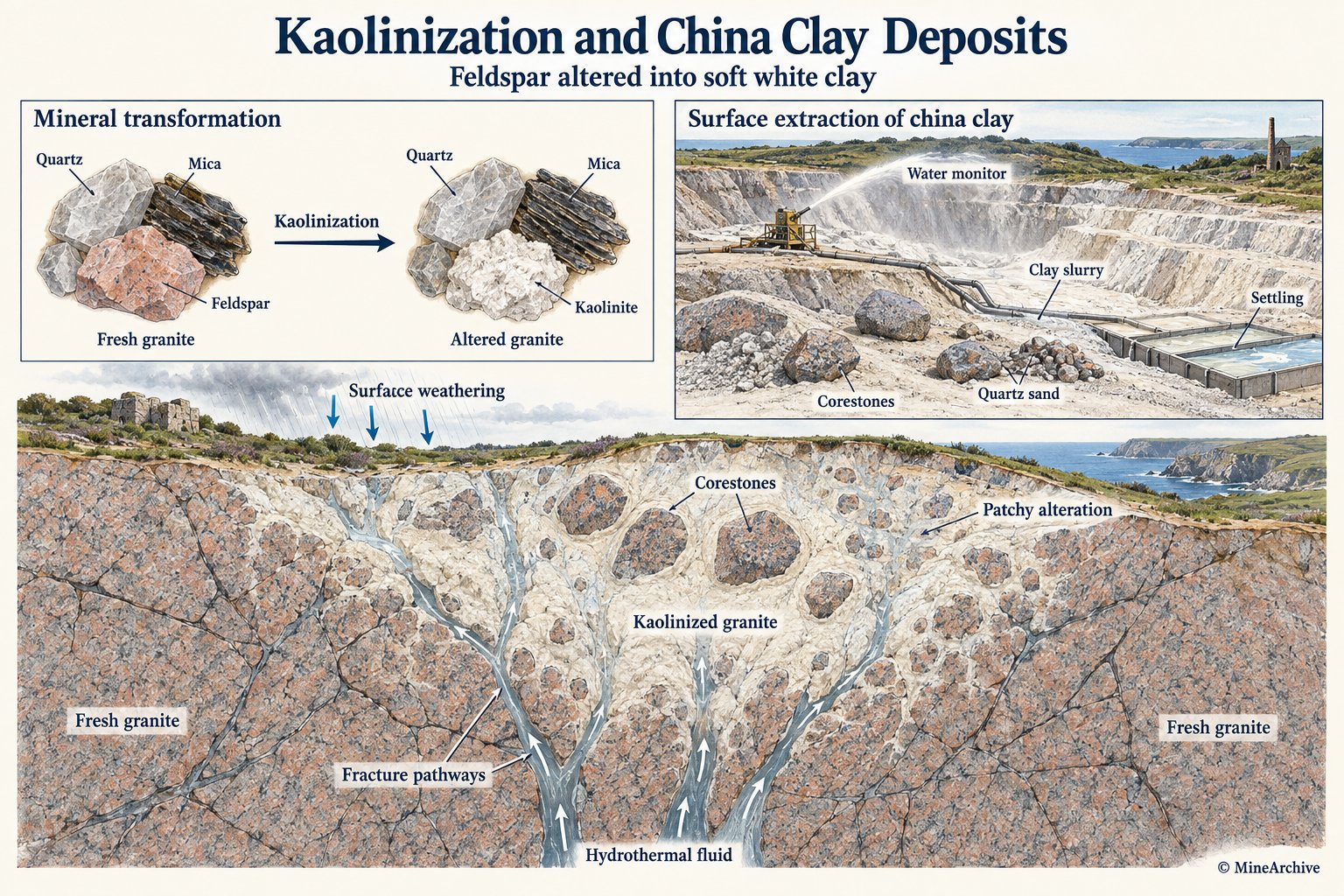
The alteration of granite's feldspar minerals into soft, white clay (kaolinite), leaving the quartz and mica largely untouched — the process behind Cornwall's china clay industry, one of the largest clay-mining operations in the world, and a striking example of a valuable deposit formed not by adding new material to a rock but by chemically breaking one of its existing minerals down in place.
How it forms
Granite is made up chiefly of quartz, mica and feldspar. Where hot fluids linked to the same late-stage magmatic-hydrothermal activity that produced Cornwall's tin and tungsten veins moved through the cooling granite, they attacked the feldspar specifically, converting it into fine-grained kaolinite while leaving the more resistant quartz grains largely intact — in the most thoroughly altered granite, quartz is the only original mineral left more or less unchanged, and the rock crumbles to a soft, rotten consistency. Geologists don't agree on the whole story: hydrothermal alteration is generally considered the principal mechanism, but Cornwall's unusually warm, wet subtropical climate during the Tertiary period, tens of millions of years after the granite itself had cooled, is also thought to have contributed further weathering-driven kaolinisation nearer the surface — the two processes most likely both played a part, in a sequence that isn't fully resolved.
Why minerals concentrate here
Kaolinisation doesn't create a discrete pocket of ore within an otherwise unaltered rock the way a vein does — it works through the granite unevenly, following the same fracture-controlled fluid pathways as the associated tin and tungsten mineralisation, so thoroughly kaolinised granite can lie right alongside barely-altered rock, and even isolated boulders of fresh, unaltered granite ('corestones') can survive surrounded by completely kaolinised material. What makes a body of kaolinised granite worth working is simply how completely and how deeply the alteration went.
Typical shape of the deposit
Irregular, funnel-shaped masses or sheet-like zones within the granite, following old fracture and fluid pathways rather than any regular geometric body — genuinely patchy rather than a clean, predictable target, and without the sharp, sudden edges a vein has.
What this means for mining
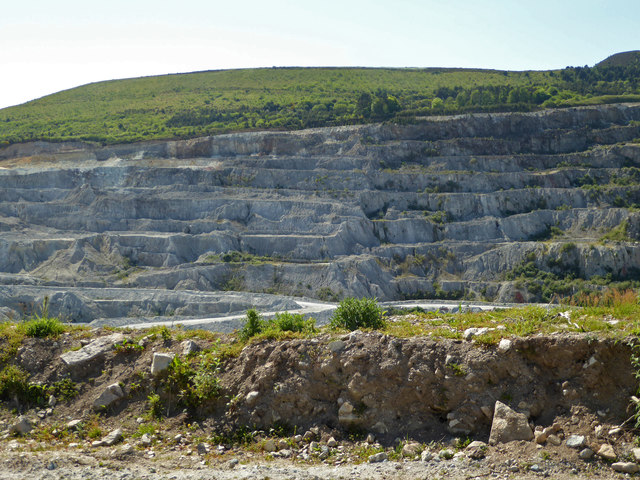
Because kaolinised granite is soft and disaggregated rather than the exceptionally hard, weathering-resistant rock granite normally is, china clay was never mined by tunnelling and blasting the way a hard-rock vein was — it was worked from the surface as a huge open pit, breaking the rock down further with high-pressure water jets and pumping the resulting clay-water slurry away to be settled and refined, leaving the resistant, unaltered quartz sand and larger corestones behind as waste. The scale of a china clay pit — vastly larger in surface area than any vein mine, but shallow rather than deep — is a direct consequence of quarrying a widespread altered zone rather than following a narrow target underground.
Associated commodities
China Clay (China clay is the direct product of this alteration process, not a separately-deposited mineral.)
Related geology
Greisen and Pegmatite Deposits, Hydrothermal Deposits
Diagrams
Images
MineArchive examples
Included only where MineArchive's own research gives a reasonable evidential basis — not every mine where this geology might plausibly apply.
- Balleswidden Mine — Cornwall (well documented example)
Much of the ground is soft kaolinised granite; the mine's tips were worked for china clay from 1875. - Lee Moor China Clay Works — Devon (well documented example)
One of only two British areas where kaolinization of a granite went deep enough to be worth working — the Dartmoor granite here, the Hensbarrow granite in Cornwall. - Tregonning Hill China Clay Pits — Cornwall (well documented example)
Granite of a detached outcrop of the Cornubian batholith altered by kaolinisation to china clay. - Wheal Martyn China Clay Works — Cornwall (well documented example)
The mine's own recorded geology explicitly describes extracting china clay (kaolin) as decomposed granite.
See all 4 linked mines.
Sources
- (primary) Mineralisation, Greisenisation and kaolinisation at Goonbarrow china clay pit, Cornwall, U.K — Oxford University Research Archive
- (secondary) The China Clay Deposits of South West England — Bath Geological Society
Record created: 22 August 2026 · Last researched: 22 August 2026