 MineArchive
Balleswidden Mine
| Also known as | Leswidden Mine, Leswidden and Balleswidden Mine |
|---|---|
| Location | Leswidden, near St Just, Cornwall — 50.1206, -5.6541 (approximate) |
| Commodities | Tin, Copper |
| Type | Metal |
| Worked | 1507 (earliest record)–1873 or 1875 |
| Maximum depth | Unknown. |
Overview
Once the biggest mine in St Just, employing more than 600 people, Balleswidden worked tin in soft kaolinised granite, suffered a great collapse of ground in 1847, and after closure its waste tips fed the Leswidden china clay works.
History
Balleswidden takes its name from the Cornish bal, a mine, at Leswidden, a place-name spelt Lesewyn, Leswen and Lesswyn between the 13th and 17th centuries and read as 'white manor' or perhaps 'white mud'. The first written evidence of mining there is a tin bounds at Busvargus registered at the Lelant Stannary Court in 1507. In 1841 the Royal Commission on children's employment named it as a copper and tin mine. Between 1833 and 1841 it was said to have raised £51,960 worth of black tin, and a few years later it was described as working an 'inexhaustible lode' with 144 heads of steam stamps and 36 of water stamps. On the night of 29 January 1847 a great collapse of ground took place, which Cyril Noall called 'perhaps, the largest ever known in the neighbourhood', its effects at surface resembling a minor earthquake; it had been foreseen and no one was hurt. Balleswidden was then the biggest mine in St Just, with more than 600 people employed above and below ground. By the late 1850s it was veering between break-even and loss while still employing more than 650; in 1856–57 it tried gas lighting in place of candles, a technical and financial success cut short by lack of money, and the gas plant, which had come from Tresavean, was sold to Holman's foundry at Nancherrow. In 1860 it acquired, nearly new from Great Wheal Vor, an 80-inch pumping engine, the biggest steam engine ever worked in St Just, which in 1870 was pumping 470 gallons a minute in the wet season. Francis Oats, later a mine captain at Botallack and a managing director of De Beers in South Africa, started work at Balleswidden at the age of 12. The mine closed in 1873 by one account and 1875 by another, and its sett was turned over to china clay almost at once.
Geology
Much of the Balleswidden ground is soft kaolinised granite, which made it prone to collapse and later made its waste tips a source of china clay. The mine worked tin, and in 1841 copper as well, from lodes including the New Lode and the Auboys Lode. The mine is known for pseudomorphs of kaolinite, fine-grained quartz and cassiterite after orthoclase feldspar, described by Rowe and Le Neve Foster in 1879, and its recorded minerals include cassiterite, wolframite, arsenopyrite, bismuthinite, native bismuth, native copper, fluorite and schorl.
Geological setting: Kaolinization and China Clay Deposits (well documented example), Veins and Lodes (well documented example)
Workings
The mine ran 144 heads of steam stamps and 36 of water stamps in the 1840s and from 1860 an 80-inch pumping engine bought from Great Wheal Vor. Mine plans survive of the New Lode (1863) and the Auboys Lode (1873). The 1847 collapse left a depression about 270 feet long and 60 feet wide on the north side of the site.
Closure
Accounts differ on the closing year: the Penwith Local History Group, following Noall, gives 1873 and Cornwall Calling 1875, while tin output is recorded for Balleswidden in 1852–75. Later ventures on the ground, New Balleswidden (1889–95) and North Balleswidden (1905–06), also recorded tin.
What remains
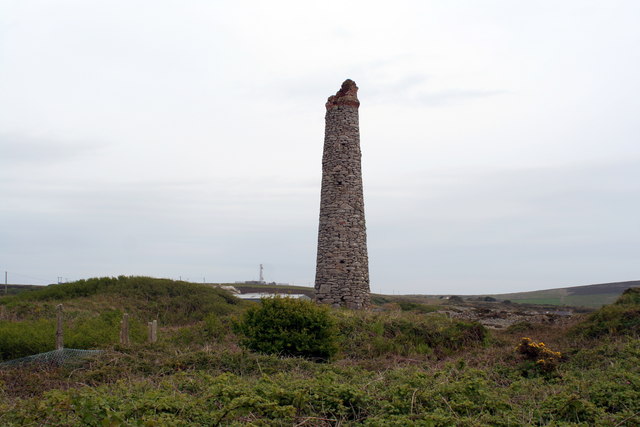
The south side of the site is dominated by a china clay pit and the north side by the depression left by the 1847 collapse; few mining remains can be seen, partly because of the clay working. A lone stone chimney near Leswidden, photographed in 2009, is presumably a remnant of the mine. In the 20th century the dumps were largely removed for reprocessing.
A stone chimney near Leswidden and the depression of the 1847 collapse.
Redevelopment
The sett became a china clay operation almost at once: clay was worked from 1875, first from Balleswidden's own waste tips, with works between about 1880 and 1910 and again in the 1920s and 1930s. The Balleswidden and Leswidden pits, worked together by H. D. Pochin and Co. and then English China Clays, closed in 1932; Bostraze clay works at the north-west end of the sett continued until about 1980, and a 1960s operation at South Bostraze is now abandoned.
Related mines
- Tresavean Mine — Balleswidden's 1856–57 gas-lighting plant had come from Tresavean.
Nearby mines
- Wheal Hermon — 2.5 km W
- Boscean Mine — 2.7 km NW
- Wheal Drea — 2.7 km NW
- Wheal Owles — 2.8 km NW
- Boswedden Mine — 3.0 km W
Straight-line distance, within 15 km. Show on the map.
People
- Francis Oats (1848–1918) · worker — Began work here at 12; later a Botallack mine captain and managing director of De Beers.
What's uncertain
Points where sources disagree or the record could not be settled; both accounts are kept. All open questions in the archive.
- The Penwith Local History Group gives 1873 for the mine's closure; Cornwall Calling says it worked until 1875; Buddlepit lists working periods to 1878. (disputed) 2,1,3
Recorded claims
Individual factual claims, each attached to the source(s) that support it below. Where sources disagree, both are kept.
- Balleswidden means the mine (bal) at Leswidden, a name spelt Lesewyn, Leswen and Lesswyn in the 13th to 17th centuries. 1
- The first written evidence of mining at Balleswidden is a tin bounds at Busvargus registered at the Lelant Stannary Court in 1507. 2
- Balleswidden was named as a copper and tin mine in the 1841 Royal Commission report on children working in mines. 1
- On the night of 29 January 1847 a great fall of ground took place in soft kaolinised granite, foreseen so that no one was injured; Noall called it perhaps the largest ever known in the neighbourhood. 2
- Balleswidden was then the biggest mine in St Just, with more than 600 employed, and still employed more than 650 in the late 1850s. 2
- In 1860 the mine acquired an 80-inch pumping engine, nearly new, from Great Wheal Vor, the biggest steam engine ever worked in St Just. 2
- In 1856–57 the mine experimented with gas lighting in place of candles, using a gas plant from Tresavean later sold to Holman's foundry at Nancherrow. 2
- The Penwith Local History Group gives 1873 for the mine's closure; Cornwall Calling says it worked until 1875; Buddlepit lists working periods to 1878. (disputed) 2,1,3
- Francis Oats started his working life at the age of 12 in Balleswidden mine and rose to be managing director of De Beers. 1
- Clay was worked on the site from 1875, first from Balleswidden's waste tips; the Balleswidden and Leswidden pits closed in 1932. 1
- BGS holds plans of Balleswidden Mine's New Lode (1863) and Auboys Lode (1873). 4
- Balleswidden, one of the richest tin mines in the district, produced pseudomorphs of kaolinite, fine-grained quartz and cassiterite after orthoclase (Rowe and Le Neve Foster, 1879); its dumps were largely removed for reprocessing in the 20th century. 5
Photographs & further reading
The Penwith Local History Group's account of the great collapse of 29 January 1847 and of the mine's heyday, engines and closure.
View sourceSources
- (secondary) Leswidden and Balleswidden Mine, Cornwall — Cornwall Calling
- (secondary) The Balleswidden Earthquake - mine collapse in St Just — Penwith Local History Group
- (secondary) Balleswidden (Buddlepit mine database) — Buddlepit
- (primary) Balleswidden Mine (1863) New Lode (mine plan) — British Geological Survey
- (secondary) Balleswidden Mine, St Just — Mindat
- (observational) Chimney at Leswidden (photograph, 2009) — Geograph (Rod Allday)
Record created: 18 September 2026 · Last researched: 18 September 2026