 MineArchive
Greisen and Pegmatite Deposits
| Category | Deposit Types |
|---|
A zone of intensely altered granite, converted by high-temperature fluids escaping from the granite's own crystallising magma into a coarse, quartz-and-mica rock hosting tin and tungsten ore — the deposit type behind some of Cornwall's and Devon's most important tungsten mines, and the last stage of a single continuous process that starts deep inside a cooling granite intrusion.
How it forms
As a body of granite magma crystallises, most elements lock into ordinary rock-forming minerals, but a distinctive suite of rarer elements — tin, tungsten, fluorine, lithium, boron and others — tend to stay concentrated in the last remaining pockets of fluid-rich melt, especially where the parent granite is itself unusually rich in these elements to begin with. As the granite finishes crystallising, this fluid becomes trapped and pressurised near the top of the intrusion, in structural highs called cupolas, and is eventually released as a very hot, aggressive fluid that attacks the surrounding solid granite: feldspar and mica are broken down and largely replaced by new mica, leaving a pale, sugary, quartz-rich rock — greisen — often laced with veins of the same origin carrying cassiterite (tin ore) and wolframite (tungsten ore).
Why minerals concentrate here
The same fractionation process that concentrates tin and tungsten into the last dregs of the crystallising magma also concentrates them into the fluid that later attacks the granite roof, so greisen zones and their associated veins end up carrying ore grades far above anything found in the ordinary granite around them — a direct result of the magma's own chemistry being progressively refined as it solidified, rather than of any later, unrelated fluid arriving from elsewhere.
Typical shape of the deposit
An irregular zone or cap of altered rock at or near the top of a granite cupola, commonly shot through with a stockwork of narrow, closely spaced quartz veins carrying the ore minerals — distinct from a single clean vein, and better pictured as a broad halo of alteration and mineralisation around the granite's apex than as one discrete body.
What this means for mining
Because ore in a greisen system is spread through a zone of altered rock and a network of small veins rather than concentrated along one clean fracture, greisen deposits often support bulk, lower-grade extraction methods — like Hemerdon's large open pit — that would make little sense applied to a single narrow vein, even though the underlying geology is closely related to the vein deposits described elsewhere on this site. Where greisen instead formed as a narrower, higher-grade zone, as at Cligga Head, more selective working closer to conventional vein mining was viable instead.
Associated commodities
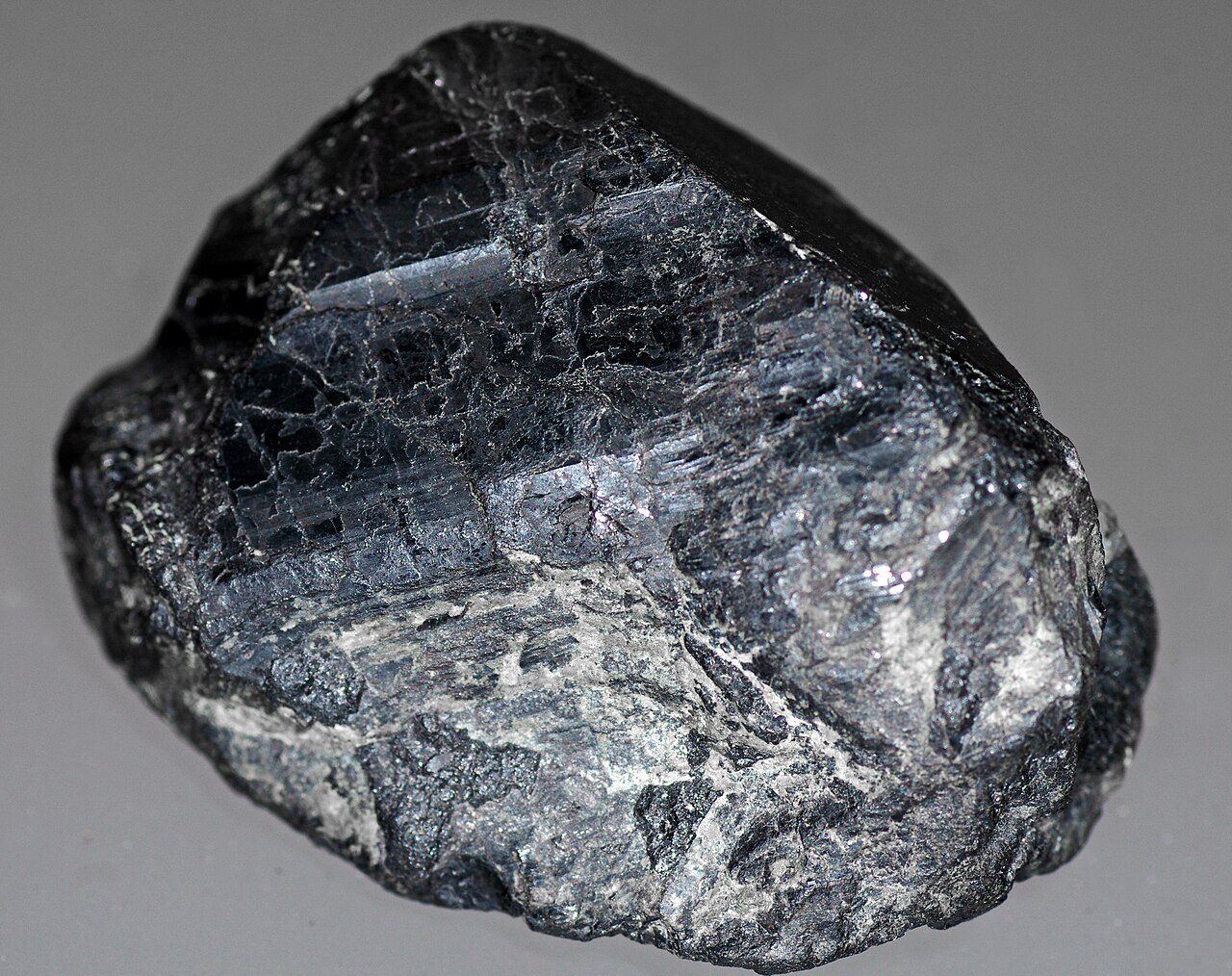
Tin (Cassiterite is a characteristic greisen and associated-vein ore mineral.), Tungsten (Wolframite is the characteristic ore mineral of greisen deposits.)
Related geology
Hydrothermal Deposits, Kaolinization and China Clay Deposits
Related Mining Terms & Methods
Vein (Greisen zones are commonly shot through with a stockwork of narrow quartz veins carrying the ore.)
Diagrams
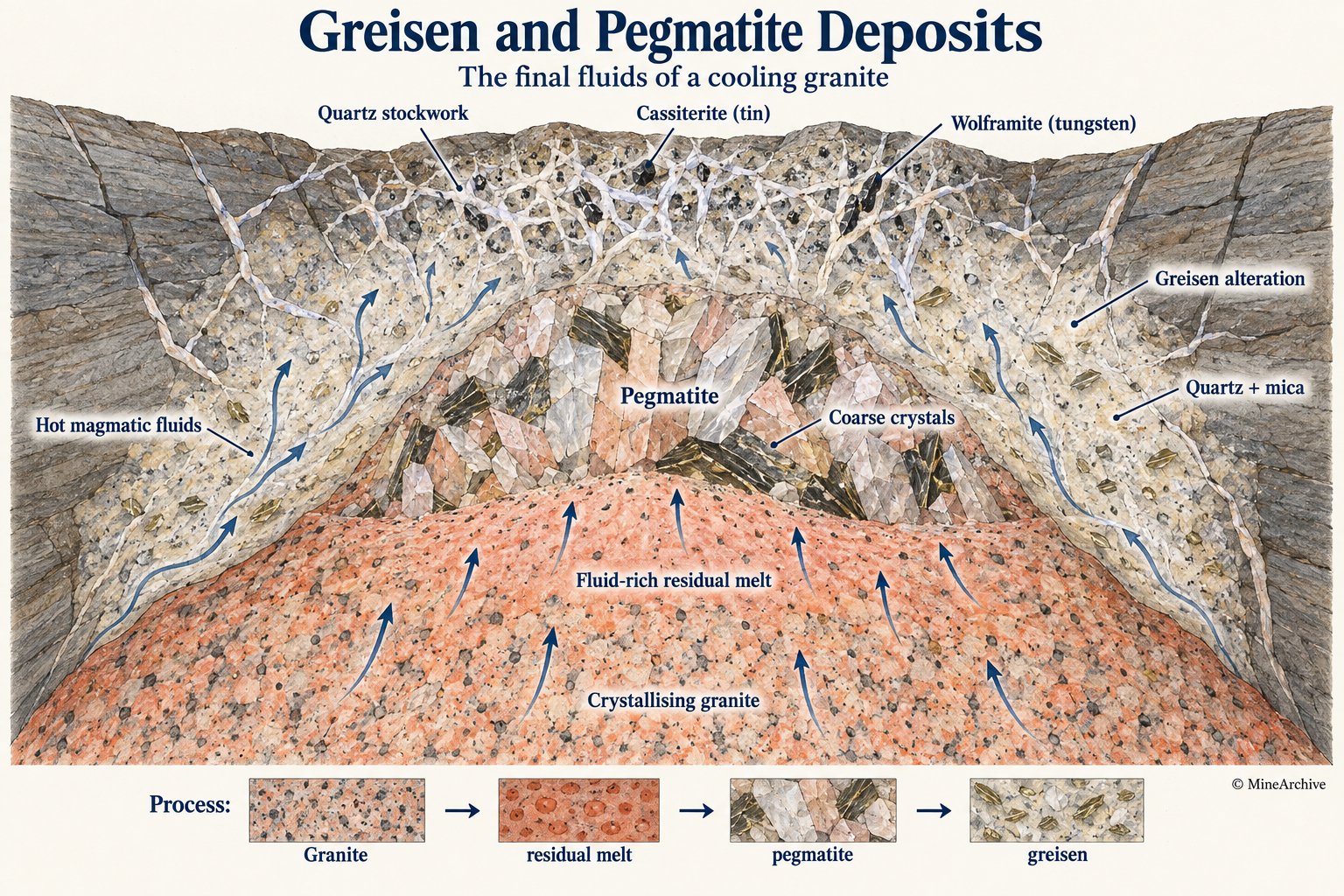
Images
MineArchive examples
Included only where MineArchive's own research gives a reasonable evidential basis — not every mine where this geology might plausibly apply.
- Wheal Fortune — Cornwall (well documented example)
The mine's geology field describes an ENE-trending sheeted stockwork bordered by greisen alteration (tourmaline-topaz-mica-cassiterite), the earlier of the site's two documented mineralisation phases, per the GCR account. - Cligga Head — Cornwall (well documented example)
The mine's own recorded geology explicitly identifies greisen — mineralised, altered granite — hosting tin and tungsten ore. - Hemerdon Mine — Devon (well documented example)
The mine's own recorded geology explicitly describes a tungsten-tin skarn/greisen body associated with the Dartmoor granite. - Bramcrag Quarry — Cumbria (historical documentary reference)
The quarry works the Threlkeld microgranite intrusion itself as a hard stone for ballast and roadstone; the intrusion is the product rather than the host of any mineralisation. - Buddon Wood Quarry — Leicestershire (historical documentary reference)
The quarry works the Mountsorrel Complex granodiorite itself as aggregate; the intrusion is the product rather than the host of mineralisation. - Craignair Quarry — Dumfries and Galloway (historical documentary reference)
The quarry works the Criffel-Dalbeattie granite itself as a building stone rather than any mineralisation within it — the intrusion is the product, not the host. - Lundy Granite Quarries — Devon (historical documentary reference)
Lundy is a granite island, and the stone itself — not any mineral in it — was the product; the workings cut straight into the intrusion. - Nunckley Quarry — Leicestershire (historical documentary reference)
The quarry worked Charnwood Forest volcanic rock as a hard stone for ballast; the rock body is the product rather than the host of mineralisation.
See all 8 linked mines.
Sources
- (primary) Vein and Greisen Sn and W Deposits — United States Geological Survey
- (secondary) Greisen — Wikipedia
Record created: 22 August 2026 · Last researched: 22 August 2026