 MineArchive
Craignair Quarry
| Location | Craignair Hill, west of Dalbeattie, Dumfries and Galloway — 54.9330, -3.8390 (approximate) |
|---|---|
| Commodity | Granite |
| Type | Quarry |
| Worked | 1826–Still active |
| Maximum depth | Unknown. |
| Operators | Liverpool Dock Trustees (1826–?), D. H. and J. Newall |
Overview
The granite quarry on Craignair Hill above the Urr Water, west of Dalbeattie, opened in 1826 by the Liverpool Dock Trustees to get block stone for their docks. It made Dalbeattie: the town's prosperity rose and fell with the granite trade, and the stone went from here into Liverpool's Stanley Dock, the Eddystone lighthouse, the Great and Little Basses lighthouses off Ceylon, and setts and kerbstones shipped as far as Argentina and Russia.
History
Granite working around Dalbeattie grew out of gathering boulders off the land rather than out of quarrying. The earliest recorded piece of business is from 1821, a certificate order for a pair of granite gateposts, and on 17 March 1828 Andrew Newall paid the proprietor for 26 and a half tons of granite at a shilling a ton — stone presumed to have been picked up more or less anywhere on the estate. A century before that the district had no quarries at all: the stones for Buittle bridge, whose centenary fell in 1897, were brought from a distance even though Craignair stood close at hand.
Large-scale quarrying began in 1826, when the Liverpool Dock Trustees leased part of Craignair Hill to get blocks for dock work and shipped their first consignment within weeks. By 1830 they were working Kirkmabreck at Creetown as well, and thousands of tons of Galloway granite were going to Liverpool by schooner. The opening of the Dumfries and Castle Douglas Railway in 1859 revived the trade, and the Dalbeattie quarries turned to dressed and polished granite; the firm of D. H. and J. Newall developed some of the first granite polishing machines. Dalbeattie also claims the first commercial crushing of granite for granolithic paving, which began with men riddling the sett-makers' chips before Shearer, Smith & Co. put up a crusher.
Geology
The Criffel-Dalbeattie granite, a Caledonian intrusion forming the hill above the Urr Water. Its value lay in being hard and highly resistant to weathering, which is what recommended it for dock and lighthouse work exposed to salt water, and in taking a polish well enough to make it a monumental stone in the Victorian trade.
Geological setting: Greisen and Pegmatite Deposits (historical documentary reference)
Workings
An open hillside quarry worked for block stone, with its own internal railway system relaid as the faces moved. Output was graded by size and use: large blocks for architectural and monumental work, smaller stone broken into setts, and the sett-makers' chips crushed for granolithic paving rather than wasted. Transport decided the economics — schooners down the Urr to Liverpool in the early decades, then the railway from 1859.
Closure
Still worked. Craignair outlasted the Victorian polished-granite trade that made Dalbeattie's name, the modern output being aggregate rather than dressed stone.
What remains
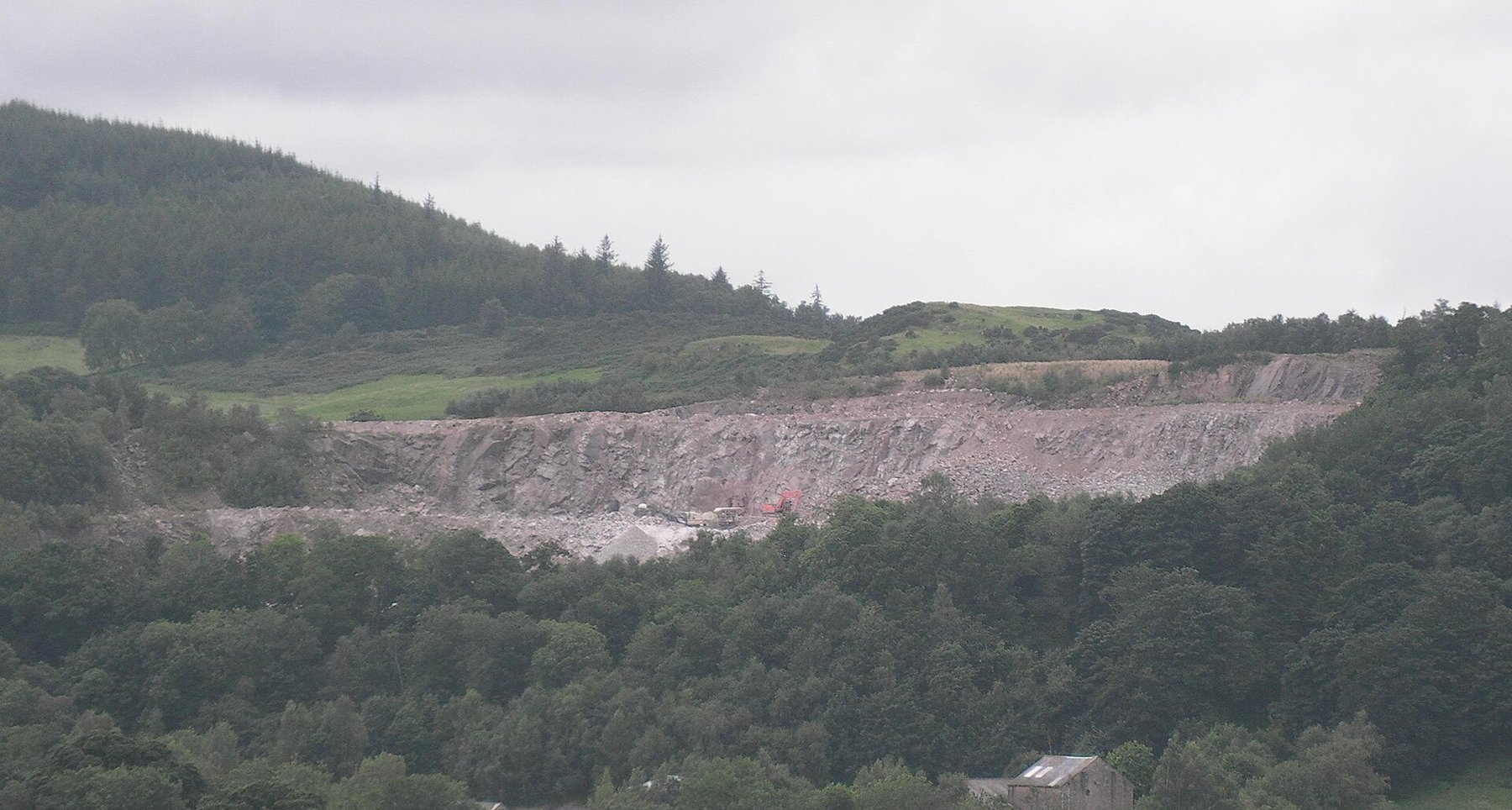
A working quarry and, as one source puts it, one of the town's most notable landmarks: the cut face on Craignair Hill is visible across Dalbeattie. The granite it produced is easier to find elsewhere than on site — in Liverpool's docks, in the Victorian tombs of the Glasgow Necropolis, and in lighthouses on two oceans.
A working quarry; the cut face on Craignair Hill is visible across Dalbeattie.
Related mines
- Shap Granite Quarries — Both were Victorian granite quarries whose trade depended on the railway reaching them, and both supplied dressed and polished monumental stone as well as setts; Craignair is named on the Shap record for the comparison.
Nearby mines
- Auchencairn Mine — 8.1 miles (13.0 km) S
Straight-line distance, within 9 miles (15 km). Show on the map.
Recorded claims
Individual factual claims, each attached to the source(s) that support it below. Where sources disagree, both are kept.
- Large-scale quarrying began in 1826 when the Liverpool Dock Trustees leased part of Craignair Hill to obtain blocks for dock work, shipping their first consignment to Liverpool within weeks. 1,2
- The earliest recorded business is a certificate order for a pair of granite gateposts in 1821, and a payment by Andrew Newall on 17 March 1828 for 26.5 tons of granite at a shilling a ton, gathered rather than quarried. 1
- Dalbeattie granite went into the old Stanley Dock at Liverpool, the Eddystone lighthouse, the Great and Little Basses lighthouses off Ceylon, harbour works at Trinidad, and setts and kerbstones exported as far as Argentina and Russia. 1,2
- The firm of D. H. and J. Newall developed some of the first granite polishing machines, and Dalbeattie claims the first commercial crushing of granite for granolithic paving, begun by Shearer, Smith & Co. 1
Photographs & further reading
A contemporary account of the Newall works and the whole Dalbeattie trade, with the early records of stone sold and the buildings the granite went into.
View sourceSources
- (secondary) The Dalbeattie granite industry, from the Gallovidian, Autumn 1902 — Kirkcudbright.co
- (primary) Craignair Granite Quarries, Dalbeattie — Future Museum, Dumfries and Galloway
- (observational) Craignair Quarry, Dalbeattie — Wikimedia Commons
- (secondary) Craignair Quarries — Railscot

Record created: 9 September 2026 · Last researched: 9 September 2026