 MineArchive
Nunckley Quarry
| Also known as | Nunckley Hill Quarry |
|---|---|
| Location | Nunckley Hill, near Swithland and Rothley, Leicestershire — 52.7003, -1.1560 (approximate) |
| Commodity | Granite |
| Type | Quarry |
| Worked | 1896–1922 |
| Maximum depth | Unknown. |
| Operators | Mountsorrel Granite Company (1896–1922) |
Overview
A small granite quarry on Nunckley Hill north of Swithland, opened because a railway happened to be routed past it. When the Mountsorrel company built a branch line to the Great Central Railway at Swithland in 1894, Nunckley Hill lay on the route and was leased from Lord Lanesborough for £86. The quarry worked from 1896, sent over 100,000 tons of ballast for the building of the Great Central, and closed in 1922. The hole is now the Mountsorrel and Rothley Community Heritage Centre.
History
Nunckley Hill was quarried as a by-product of the Mountsorrel granite company's transport arrangements rather than on its own merits. In 1894 the company built a branch line linking its quarries to the Great Central Railway at Swithland; Nunckley Hill Quarry lay on the proposed route, and was subsequently leased from Lord Lanesborough for £86, with £29 in legal fees. A branch line to the quarry itself followed in 1897.
It was a small working with a short life, running from 1896 until the First World War and closing in 1922. What it chiefly did was supply the railway that had created it: over 100,000 tons of ballast went from Nunckley for the construction of the Great Central. The rock is more than 400 million years old and was formed by volcanic activity in Charnwood Forest.
The quarry belongs to the Mountsorrel story rather than to Swithland's. The Swithland slate pits, in Swithland Wood a mile to the south, are a separate and much older industry working a different stone.
Geology
Charnwood Forest volcanic rock, more than 400 million years old, formed by volcanic activity in the area — part of the Precambrian and early Palaeozoic complex that also gives Mountsorrel its granodiorite and Swithland its slate. The faces around the perimeter of the old quarry are interesting enough for the site to be designated a Regionally Important Geological and Geomorphological Site.
Geological setting: Greisen and Pegmatite Deposits (historical documentary reference)
Workings
A small open quarry, worked for less than thirty years and never on the scale of Mountsorrel itself. Its whole economics rested on the branch line: the 1894 line to the Great Central at Swithland put the hill on a route, the lease followed, and a branch to the quarry was built in 1897 to move the ballast out. An area in the base of the quarry has been laid out to show how granite quarrying was done around Mountsorrel 120 years ago.
Closure
The quarry worked between 1896 and the First World War and closed in 1922. It had been opened for a particular job — ballasting the Great Central — and did not long outlast it.
What remains
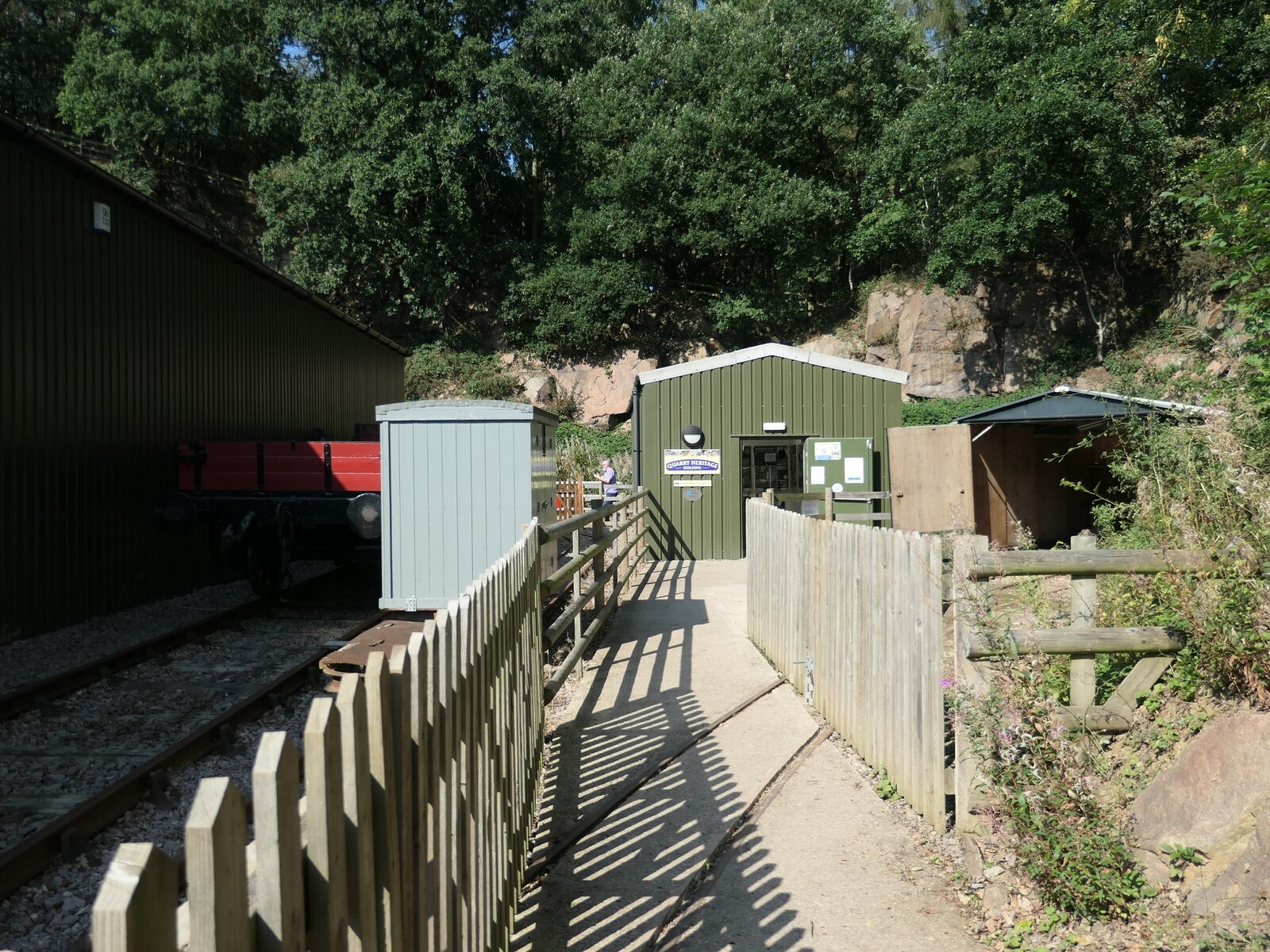
The site of the former quarry is occupied by the Mountsorrel and Rothley Community Heritage Centre, with heritage displays, a railway museum, a narrow gauge railway and Nunckley Hill station, open daily. A half-mile circular nature and history trail runs through the woodland south of Nunckley Hill, made by the centre's ecology group, and the quarry faces around the perimeter are protected as a Regionally Important Geological and Geomorphological Site.
The quarry faces survive around the perimeter of the heritage centre site and are protected as a geological site.
Redevelopment
The quarry is now the Mountsorrel and Rothley Community Heritage Centre: a museum, a narrow gauge railway with its own station on the site, a demonstration area showing how the granite was worked, and the Nunckley Trail through the woodland to the south.
Related mines
- Buddon Wood Quarry — Both were Mountsorrel company workings served by its branch lines; Nunckley was leased in the 1890s for Great Central ballast and closed in 1922, while Buddon Wood went on to become the main quarry.
- Mountsorrel Quarry — Nunckley was taken by the Mountsorrel granite company when its 1894 branch line to the Great Central at Swithland was routed past the hill, and worked as an outlying part of that concern; Nunckley is named on the Mountsorrel record.
Nearby mines
- Swithland Slate Quarry — 1.4 miles (2.3 km) SW
- Buddon Wood Quarry — 1.6 miles (2.5 km) NE
- Mountsorrel Quarry — 1.9 miles (3.0 km) N
- Groby Granite Quarry — 4.3 miles (7.0 km) SW
- Longcliffe Quarry — 5.7 miles (9.1 km) NW
Straight-line distance, within 9 miles (15 km). Show on the map.
Recorded claims
Individual factual claims, each attached to the source(s) that support it below. Where sources disagree, both are kept.
- The Mountsorrel company built a branch line to the Great Central Railway at Swithland in 1894; Nunckley Hill Quarry lay on the proposed route and was subsequently leased from Lord Lanesborough for £86 plus £29 legal fees. 1
- The quarry worked from 1896 until the First World War and closed in 1922; a branch line built in 1897 carried over 100,000 tons of ballast from it for the construction of the Great Central Railway. 2
- The old quarry is designated a Regionally Important Geological and Geomorphological Site for the rock faces around its perimeter, the rock being over 400 million years old and formed by volcanic activity. 2
Photographs & further reading
A survey of the Charnwood quarries in the Mercian Geologist, with the Mountsorrel company's branch lines, leases and workforce figures.
View sourceSources
- (secondary) The Rock Quarries of Charnwood Forest — East Midlands Geological Society
- (primary) Nunckley Trail — Mountsorrel and Rothley Community Heritage Centre — Mountsorrel and Rothley Community Heritage Centre
- (observational) Quarry Heritage Building — Geograph Britain and Ireland
Record created: 9 September 2026 · Last researched: 9 September 2026