 MineArchive
Groby Granite Quarry
| Location | Groby, north-west of Leicester, Leicestershire — 52.6582, -1.2327 (exact) |
|---|---|
| Commodity | Granite |
| Type | Quarry |
| Worked | by 1832 |
| Maximum depth | Not applicable: an open quarry, now flooded to an unrecorded depth. |
| Operators | Groby Granite Company (1865–?) |
Overview
The Charnwood Forest granite quarry north-west of Leicester whose stone paved Victorian London. It was linked to the Leicester and Swannington Railway in 1832 by a line the Stephensons advised on, finished before the main railway opened, and within months was sending a thousand tons a month of setts to Leicester West Bridge and on by canal to Macadam's depots in London. The Groby Granite Company employed 546 people in 1902. The quarry is disused and flooded.
History
Granite had been taken at Groby before the railway, but it was transport that made the trade. In 1825 the sixth Earl of Stamford and his Leicestershire estate agent Robert Martin went to the opening of the Liverpool and Manchester Railway and came back convinced that a line from the village quarry into Leicester would pay, because John Macadam needed granite in quantity for the roads of the City of London. George Stephenson and his son Robert came to Groby and advised on how a line might be engineered alongside the Ratby road and across the fields to Glenfield. The Groby granite railway was finished before the Leicester and Swannington Railway itself opened on 17 July 1832, and Thomas Chaplin had already been given the order to supply granite setts to Leicester West Bridge wharf at four shillings a ton, the work to be done by 18 May that year. On the evening of the Swannington line's opening day its locomotive Comet came back to Groby to collect twenty-four wagons of granite.
The early quarry used no locomotives of its own. A stationary steam engine beside the Ratby road wound loaded wagons up from the village quarry to a level area, and when enough had gathered they ran down to the Groby Granite sidings by the Leicester and Swannington under their own momentum with a brakesman aboard and two horses carried down to draw the empties back. By January 1833 nearly a thousand tons a month were going from Groby to West Bridge, and from there in pairs of canal boats to London; West Bridge was soon reported to be glutted with coals and granite, and frozen canals stopped the traffic in winter, so that in 1837 John Martin, who ran the transport, had twelve pairs of boats and more than a hundred men waiting for a thaw. The Groby Granite Company Limited was formed in 1865. By 1902 the Leicestershire quarry employed 546 people and worked both standard gauge and two-foot gauge railways; it was the first home of the locomotive later known as Lady Madcap. The village also had slate quarries, the last of which closed in 1908 when the lessee, Charles Wesley, could not compete with the lighter and cheaper Welsh slate the Midland Railway was bringing into Leicestershire. The quarry branch closed in 1966.
Geology
The stone is the hard igneous rock of Charnwood Forest, quarried for roadstone and setts and known locally simply as granite, though the variety around Groby and Markfield has also gone by the name markfieldite. Its hardness is the point: it was wanted for street paving and for Macadam's road building precisely because it took the wear.
Workings
An open quarry beside the village, served from 1832 by a standard gauge railway to the Leicester and Swannington near Glenfield. Loaded wagons were wound up from the quarry by a stationary steam engine beside the Ratby road, then ran down to the sidings by gravity under a brakesman, with two horses carried down to bring the empties back. The quarry later worked both standard gauge and two-foot gauge lines and was the original home of the locomotive later called Lady Madcap. The branch closed in 1966.
Closure
No source gives the year the quarry stopped working. The branch line that served it closed in 1966, and the quarry is now disused and flooded, with security on site and police warning the public away from swimming in it as recently as June 2025. A refresh should establish the working end date, most likely from the Charnwood Forest quarry studies referred to by the village's own site.
What remains
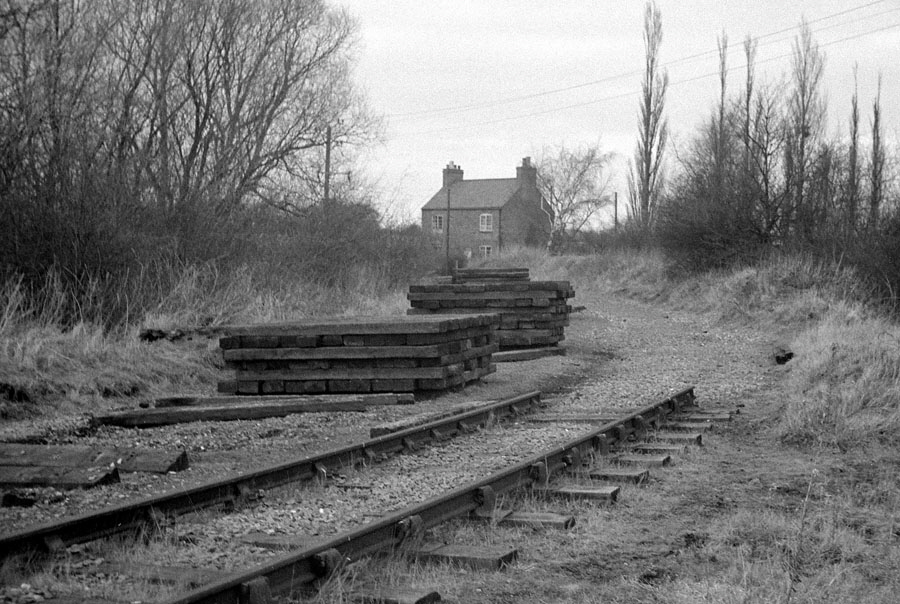
Disused and flooded. The quarry lake is fenced and watched by security, and Leicestershire police have warned repeatedly about people swimming and cliff-jumping there, describing it as highly dangerous for its deep and thermally layered water, steep and slippery sides, rockfall, high pH, blue-green algae and submerged machinery and vehicles; officers were called out to swimmers again in June 2025. The truncated stub of the quarry branch from the old Leicester and Swannington line near Glenfield was photographed in 1967.
The flooded quarry and the truncated formation of its railway branch.
Redevelopment
None; the quarry stands disused and water-filled.
Nearby mines
- Swithland Slate Quarry — 3.0 miles (4.8 km) NE
- Cliffe Hill Quarry — 3.6 miles (5.8 km) NW
- Merrylees Drift Mine — 3.7 miles (5.9 km) W
- Norwich Chalk Mines — 3.8 miles (6.1 km) SW, Norfolk
- Desford Colliery — 4.3 miles (6.9 km) W
Straight-line distance, within 9 miles (15 km). Show on the map.
Recorded claims
Individual factual claims, each attached to the source(s) that support it below. Where sources disagree, both are kept.
- The Groby granite railway, engineered on the advice of George and Robert Stephenson, was completed before the Leicester and Swannington Railway officially opened on 17 July 1832; on the evening of that opening the locomotive Comet returned to Groby to collect twenty-four wagons of granite. 1
- Thomas Chaplin was given the order to supply granite setts to Leicester West Bridge wharf at four shillings a ton, to be completed by 18 May 1832; by January 1833 nearly a thousand tons of granite a month were going from Groby to West Bridge and on by canal boat to Macadam's depots around London. 1
- The early quarry used no locomotives: a stationary steam engine beside the Ratby road wound loaded wagons up from the quarry, and they then ran down to the sidings under their own momentum with a brakesman, two horses being carried down to draw the empties back. 1
- The Groby Granite Company Limited was formed in 1865, though the quarry was already working when it was linked by railway in 1832; the Leicestershire quarry had 546 employees in 1902 and worked both standard gauge and two-foot gauge lines. 2
- The same company opened a second and entirely separate Groby Granite Quarry just south of Blaenau Ffestiniog in Gwynedd, working from 1901 to about 1932 and served by its own branch off the Ffestiniog Railway. 2
- Groby also had slate quarries; the last closed in 1908 when the lessee, Charles Wesley, could not compete with the lighter and cheaper Welsh slate being brought into Leicestershire by the Midland Railway. 2
- Employment in the village was largely in the local granite quarries and in farming, the stone being known as granite and formerly also as markfieldite. 3
- The quarry is disused and flooded; Leicestershire police were called to it in June 2025 after teenagers were seen swimming, and warned of deep and thermally layered water, steep and slippery sides, rockfall, industrial pollution raising the pH, blue-green algae and submerged machinery and vehicles. 4
Photographs & further reading
The Ffestiniog Railway heritage wiki's entry, which covers both the Leicestershire quarry and the company's quite separate Welsh quarry of the same name.
View sourceDavid Ramsey's account for the village of how the Stephensons came to Groby, how the 1832 line was worked by gravity and horses, and where the granite went.
View sourceSources
- (secondary) The Groby Granite Railway (Groby village history) — Groby Village / David Ramsey
- (secondary) Groby Granite Quarry (Festipedia, Ffestiniog Railway Heritage Group) — Festipedia
- (secondary) Groby (Wikipedia) — Wikipedia
- (observational) Groby quarry (GrobyOnline) — GrobyOnline
Record created: 9 September 2026 · Last researched: 9 September 2026