 MineArchive
Swithland Slate Quarry
| Also known as | Swithland Wood Quarries, The Great Pit |
|---|---|
| Location | Swithland Wood, Charnwood Forest, near Newtown Linford, Leicestershire — 52.6910, -1.1870 (approximate) |
| Commodity | Slate |
| Type | Slate |
| Worked | Roman–1887 (Great Pit |
| Maximum depth | Slate was being taken from more than 180 feet in the Great Pit by the mid-19th century |
| Operators | John Ellis of Leicester |
Overview
Slate quarries in Swithland Wood in Charnwood Forest, worked since Roman times and on an industrial scale in the nineteenth century. Two big pits developed within the wood — the Great Pit in the centre, worked to more than 180 feet under John Ellis of Leicester, and another near the road at the northern end — among some twenty-four smaller pits. The slate roofed Charnwood and beyond and, from the seventeenth century, made the incised headstones that fill Leicestershire and Nottinghamshire churchyards. Cheap Welsh slate arriving by canal and rail ended it: the northern pit stopped in 1838 and the Great Pit in 1887.
History
Swithland slate has been quarried since Roman times, and the name covers a line of outcrops along the east side of Charnwood — Hallgates, Little John, Swithland Wood, The Brand and up to Woodhouse Eaves — with a matching outcrop at Groby on the other side of the Charnwood anticline. Swithland Wood had been quarried for many centuries on a small scale; many of the twenty-four small pits in the wood may date from that early working. Unlike the woodland itself, which the Grey family’s Bradgate estate managed directly, the quarries were leased to local quarrymen. Two industrial-scale quarries eventually developed in the wood, one in the Great Pit at the centre and one near the road at the northern end, with four more water-filled pits across Swithland Road in The Brand. By the mid-nineteenth century, under the management of John Ellis of Leicester — among other things chairman of the Midland Railway — slate in the Great Pit was being extracted from more than 180 feet. Swithland slate began to be used on vernacular roofs from about 1750 and is still common on older buildings throughout Charnwood. Its roofs are laid graded, small slates along the ridge and the largest at the eaves, unlike the fixed sizes used with thinner Welsh slate. It went onto the Midland Railway’s London terminus at St Pancras and onto Ernest Gimson’s Leicester houses. Headstones have been made from it since the seventeenth century and are found across Leicestershire and neighbouring counties, especially Nottinghamshire; the stone takes detailed lettering and patterns that prove far more durable than on most other stone. Kerbstones, windowsills and sinks were made from it too. The end came from outside. Once the canals and railways could carry Welsh slate in quantity at low prices, demand for the local product fell away. Quarrying in the northern pit ended in 1838, and the Great Pit ceased production in 1887.
Geology
The Swithland Formation of the Brand Group, the youngest of the Charnian rocks, on the south-eastern edge of the Charnwood anticline. The rock is a fine-grained, evenly bedded metamorphosed mudstone: fine sediment laid down on a sea bed after the Precambrian volcanic activity had subsided, lithified by later burial and by the uplift of the anticline, with the cleavage planes along which it splits created by the tensions of that uplift. Roofing slates are split along those cleavage joints rather than the bedding planes. For most of the twentieth century the Brand Group was classified as Precambrian along with the more central Charnwood outcrops, which would have dated it before 539 million years ago. Trace fossils — the burrows of animals in the soft mud that became the slate — have since reclassed the whole group as Cambrian, formed around 530 million years ago. Some of those trace fossils can be seen on Swithland slate headstones, such as those in Ratby churchyard.
Workings
Open pits, about twenty-four of them small and probably early, with two worked at industrial scale: the Great Pit in the centre of Swithland Wood and another at the northern end near the road. Four more water-filled pits survive across Swithland Road in The Brand. The quarries were leased to local quarrymen rather than worked by the estate. Depth in the Great Pit exceeded 180 feet by the middle of the nineteenth century. Slates were split along the cleavage and graded by size for laying.
Closure
Welsh slate killed it. Once canals and then railways could deliver thin, light, uniform slate from north Wales in quantity and cheaply, the demand for a heavy graded local slate disappeared. The northern pit stopped in 1838; the Great Pit held on until 1887.
What remains
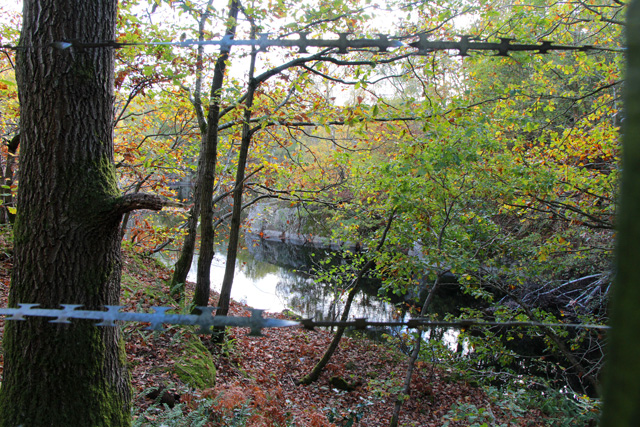
Both pits are now deep water and are fenced for safety, though paths around them give good views of the pools and rock faces; the Great Pit is used occasionally for scuba diving. Swithland Wood has been public woodland since 1925, when the Rotary Club of Leicester bought it to preserve the ancient woodland and provide public access; an inscription on the rock face of the Great Pit records the gift. It has been managed since 1931 by the Bradgate Park and Swithland Wood Trust and is a Site of Special Scientific Interest.
The flooded Great Pit and northern pit with their exposed rock faces, the four water-filled pits in The Brand, and the many small early pits scattered through the wood. The Rotary Club inscription is cut on the face of the Great Pit. The slate itself survives on Charnwood roofs and in Midland churchyards.
Nearby mines
- Nunckley Quarry — 1.4 miles (2.3 km) NE
- Buddon Wood Quarry — 2.9 miles (4.7 km) NE
- Groby Granite Quarry — 3.0 miles (4.8 km) SW
- Mountsorrel Quarry — 3.0 miles (4.8 km) NE
- Cliffe Hill Quarry — 4.7 miles (7.6 km) W
Straight-line distance, within 9 miles (15 km). Show on the map.
Recorded claims
Individual factual claims, each attached to the source(s) that support it below. Where sources disagree, both are kept.
- Swithland slate has been a traditional local roofing material since Roman times. Swithland gives its name to a line of slate outcrops along the east side of Charnwood, from Hallgates and Little John through Swithland Wood and The Brand up to Woodhouse Eaves, with a corresponding outcrop at Groby on the other side of the Charnwood anticline. 1
- Many of the 24 small pits in Swithland Wood may relate to early slate quarrying. Two industrial-scale quarries developed within the woods, one in the Great Pit in the centre and the other near the road at the northern end; four more water-filled pits remain in The Brand across Swithland Road. Unlike the woodland, the quarries were leased to local quarrymen. 1
- By the mid-19th century, under the management of John Ellis of Leicester — among other things chairman of the Midland Railway — slate in the Great Pit was being extracted from a depth of more than 180 feet. 1
- Swithland slate began to be used on vernacular roofs from around 1750 and is still very common on older buildings throughout Charnwood. Unlike the thinner, lighter Welsh slates, which are used in fixed sizes, Swithland slate roofs are graded from small slates along the ridge to the largest sizes at the base. 1
- Notable buildings on which the slates were used included the Midland Railway’s London terminus at St Pancras and the Leicester houses designed by Ernest Gimson. 1
- Headstones for graves have been made from Swithland slate since the 17th century and are found in graveyards throughout Leicestershire and neighbouring counties, especially Nottinghamshire. They could be engraved with detailed lettering and patterns which prove much more durable than on many other types of stone. Other uses included kerbstones, windowsills and sinks. 1
- Trace fossils — evidence of animals burrowing in the soft mud that became the Swithland slate — have reclassed the Brand Group rocks as Cambrian, formed around 530 million years ago, rather than Precambrian as they were classified for most of the 20th century. Some of these trace fossils can be seen on Swithland slate headstones, such as those in Ratby churchyard. 1
- Once the canals and railways could transport Welsh slate in large quantities at low prices, demand for the local slates diminished. Quarrying in the northern pit ended in 1838, and in 1887 the Great Pit ceased production. 1
- Both pits now have deep water and are fenced off for safety reasons, but paths around the quarries afford good views of the pools and rock faces; the Great Pit is used occasionally for scuba diving. 1
Photographs & further reading
The fullest account read: the outcrop and its pits, the leasing arrangement, John Ellis and the depth of the Great Pit, the graded roofs and the headstones, the Cambrian trace fossils visible on them, and the two closure dates.
View sourceA local heritage project’s research on the slate and the quarries that produced it, from the parish at the northern end of the outcrop.
View sourceSources
- (secondary) Swithland Wood and The Brand — Wikipedia
- (secondary) Swithland slate and St Paul’s — St Paul’s Church Heritage Project, Woodhouse Eaves
Record created: 8 September 2026 · Last researched: 8 September 2026