 MineArchive
Mountsorrel Quarry
| Location | Mountsorrel, near Loughborough, Leicestershire — 52.7270, -1.1470 (approximate) |
|---|---|
| Commodity | Granite |
| Type | Quarry |
| Worked | from Roman |
| Operators | Mountsorrel Granite Company (1872–1960), Tarmac (2015–?) |
Overview
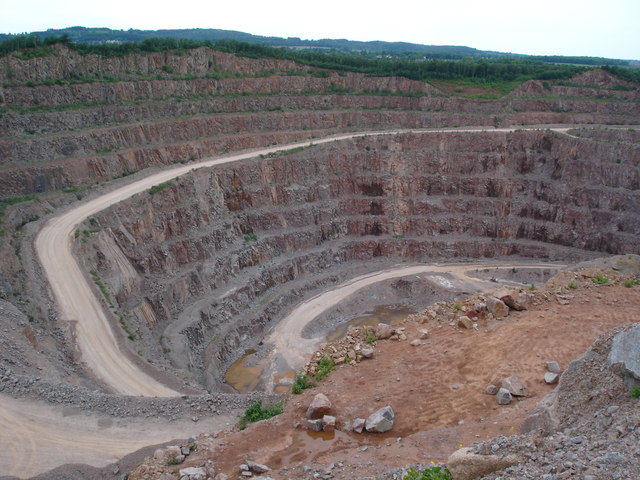
A hard-rock granite quarry worked at Mountsorrel since at least Roman times, grown by the 1970s-80s into one of the largest producing quarries in Europe and still operating today — while a small, fenced-off corner of the original historic pit is protected as a Site of Special Scientific Interest for a rare mineral once studied in international research into the origin of life on Earth.
History
Quarrying at Mountsorrel is traditionally said to date back to the Roman period: a villa reputedly stood on Broad Hill, the site of today's quarry, and 19th-century quarrying there turned up artefacts including a preserved wooden bucket. Organised commercial extraction began in earnest in the second half of the 18th century, driven by the turnpike road boom — Mountsorrel won a contract in 1758 to surface roads for the Harborough to Loughborough Turnpike, and demand for granite setts, kerbs and chippings grew rapidly as the road network expanded. The Mountsorrel Granite Company acquired the rights to the Broad Hill workings in 1872 and built the Mountsorrel Railway, authorised in 1859 and opened around 1860, to link the quarries to the Midland Railway near Barrow-upon-Soar; by 1870 the quarries employed around 500 workers, and a hospital was established locally to treat quarry dust-related illness among the workforce. The rail network expanded to eight and a half miles by the turn of the century, and an 1896-98 extension connected it to the Great Central Railway at Swithland Sidings, giving the company three distribution routes — road, rail and the Grand Union (Leicester Navigation) Canal, opened in 1794 — to widen its market. Mountsorrel Quarries were absorbed into Redland in 1960, and production grew through the 1970s and 80s to make the site the largest granite-producing quarry in Europe at the time. Redland was acquired by the French group Lafarge in the late 1990s; Lafarge combined its UK operations with Anglo American's Tarmac Group in 2013 as the joint venture Lafarge Tarmac, before CRH plc bought the business outright in 2015 and relaunched it as Tarmac, the quarry's current operator.
Geology
Mountsorrel's granite is technically a hornblende granite, or granodiorite, intruded around 450 million years ago during the volcanic and igneous activity that built Charnwood Forest's much older rocks — among the oldest exposed rock in England. It is prized for its distinctive pink-to-red colour and exceptional hardness, and has been used well beyond the county, including in Leicester's historic Humberstone stone and in a war memorial in Nottinghamshire. A small, separately designated part of the historic workings, Main Quarry (also called Castle Hill Quarry), is geologically exceptional in its own right: olivine-dolerite dykes there carry a rare mineral assemblage of asphaltite (a solid bitumen), dolomite-calcite and pyrite, described by Natural England as probably the most dramatic and well-developed occurrence of asphaltite in Britain — internationally significant enough to have been used in research into the origin of life on Earth, and protected as a Site of Special Scientific Interest since 1984.
Workings
Today's quarry is worked as a vast open pit — the Buddon Quarry, which has consumed most of the former Buddon Wood — using conventional bench-and-terrace hard-rock quarrying with scheduled blasting. Historically, cut stone left the site first by horse and cart, then by canal barge after 1794, then by the company's own railway from 1860, and finally, once the branch line fell out of use in the 1950s and its track was lifted in the 1960s, by a conveyor belt built in the 1970s that still carries rock along much of the old railway's route to a rail-served processing site near Barrow-upon-Soar.
Closure
Main Quarry (Castle Hill), the historic core of the site and the location of its Roman and early quarrying, closed and was set aside for its exceptional geology, receiving SSSI protection in 1984; it remains private land with no public access. The Mountsorrel Railway itself closed in stages — traffic ended in the 1950s and the track was removed in the 1960s — superseded first by road haulage and then by conveyor.
What remains
The wider Mountsorrel operation remains very much active: as of the late 1990s the quarry covered around 78.5 hectares with reserves of some 160 million tonnes, producing roughly 3 million tonnes of granite a year and ranking among the largest hard-rock quarries in Europe, now run by Tarmac. Quarrying remains a working industrial hazard — a contractor died at the site in June 2017, prompting a joint investigation by Leicestershire Police and the Health and Safety Executive.
Redevelopment
Beginning around 2007, volunteers led by Steve Cramp spent eight years and more than 80,000 hours rebuilding a section of the old Mountsorrel Railway; it reopened as a heritage line in October 2015, now run in partnership with the Great Central Railway and linked to a Heritage Centre at the former Nunckley Quarry site.
Related mines
- Buddon Wood Quarry — The same ground: Buddon Wood was the Lanesborough quarry of 1821, and the new workings opened there in the early 1970s became the present Mountsorrel Quarry. The two records cover the earlier and the modern phases of one site.
- Nunckley Quarry — Nunckley was taken by the Mountsorrel granite company when its 1894 branch line to the Great Central at Swithland was routed past the hill, and worked as an outlying part of that concern; Nunckley is named on the Mountsorrel record.
Nearby mines
- Buddon Wood Quarry — 0.9 miles (1.4 km) SE
- Nunckley Quarry — 1.9 miles (3.0 km) S
- Swithland Slate Quarry — 3.0 miles (4.8 km) SW
- Longcliffe Quarry — 4.5 miles (7.2 km) NW
- Groby Granite Quarry — 6.0 miles (9.6 km) SW
Straight-line distance, within 9 miles (15 km). Show on the map.
What's uncertain
Points where sources disagree or the record could not be settled; both accounts are kept. All open questions in the archive.
- Roman-era activity is traditionally associated with the site: a villa reputedly stood on Broad Hill, and 19th-century quarrying there uncovered artefacts including a preserved wooden bucket. (uncertain) 1
Recorded claims
Individual factual claims, each attached to the source(s) that support it below. Where sources disagree, both are kept.
- Roman-era activity is traditionally associated with the site: a villa reputedly stood on Broad Hill, and 19th-century quarrying there uncovered artefacts including a preserved wooden bucket. (uncertain) 1
- By 1870 the Mountsorrel quarries employed around 500 workers, and a hospital was established locally to treat quarry dust-related illness among the workforce. 1
- Castle Hill (Main) Quarry's olivine-dolerite dykes contain a rare mineral assemblage of asphaltite, dolomite-calcite and pyrite — described by Natural England as probably the most dramatic and well-developed occurrence of asphaltite in Britain, and studied internationally in research into the origin of life on Earth. 2,3
- By the late 1990s the quarry covered around 78.5 hectares with reserves of some 160 million tonnes, producing approximately 3 million tonnes of granite a year and ranking among the largest hard-rock quarries in Europe. 1
- A contractor died at Mountsorrel Quarry in June 2017, prompting a joint investigation by Leicestershire Police and the Health and Safety Executive. 4
Photographs & further reading
A local heritage group's archive of photographs and research covering the quarry's history.
View sourceSources
- (secondary) Mountsorrel — Wikipedia
- (secondary) Main Quarry, Mountsorrel — Wikipedia
- (primary) Castle Hill Quarry (Mountsorrel Granite Quarry), Leicestershire — Geological Conservation Review / GeoGuide
- (secondary) Investigation underway into fatality at Mountsorrel Quarry, UK — Aggregates Business
- (secondary) Mountsorrel Quarry, Quorn, Charnwood, Leicestershire, England, UK — Mindat
- (secondary) Mountsorrel Railway — Wikipedia
Record created: 22 August 2026 · Last researched: 22 August 2026