 MineArchive
Bramcrag Quarry
| Also known as | Bram Crag Quarry |
|---|---|
| Location | St John's in the Vale, near Threlkeld, Cumbria — 54.5980, -3.0290 (approximate) |
| Commodity | Granite |
| Type | Quarry |
| Worked | from Later 19th century |
| Maximum depth | Unknown. |
Overview
One of seven quarries that worked the microgranite around the western side of Threlkeld Knotts in St John's in the Vale, and the furthest along the valley. It was reached by an extension of the quarry railway that ran from Threlkeld station up past Spion Kop, and belongs to the same nineteenth-century expansion that opened Threlkeld Quarry in 1870 for railway ballast and grew in the 1890s on Thirlmere reservoir and roadstone work.
History
Threlkeld Quarry was opened in 1870 to supply ballast for the Cockermouth, Keswick and Penrith line and the wider railway network, and production rose in the 1890s with the building of Thirlmere reservoir and the growing demand for roadstone. That expansion did not stay in one hole. Seven quarries in all worked the microgranite around the western side of Threlkeld Knotts, the large Threlkeld Quarry with smaller workings at Birkett Bank, Hilltop and Bramcrag among them.
Bramcrag was the furthest up St John's in the Vale, and the quarry railway was extended to reach it: first to Spion Kop quarry and then on to Bram Crag, with a line running down to the main railway at Threlkeld station. The rock is the same Threlkeld microgranite worked at the main quarry, hard enough for ballast and roadstone, and the quarry has a second reputation among mineral collectors, pyrrhotite among the species recorded from it.
Geology
Threlkeld microgranite, an intrusion on the northern edge of the Lake District's Skiddaw Group forming the ground around Threlkeld Knotts. The rock is hard and tough, which is what made it valuable as railway ballast and later as roadstone rather than as a building or monumental stone. Mineral species recorded from the quarry include pyrrhotite.
Geological setting: Greisen and Pegmatite Deposits (historical documentary reference)
Workings
An open quarry on the valley side, one of seven working the same microgranite around Threlkeld Knotts. Its economics depended on the railway: the quarry line was pushed up the vale to Spion Kop and then to Bram Crag, connecting down to the main line at Threlkeld station, so that stone could reach the ballast and roadstone markets that justified working it at all.
Closure
The closure date is not known for Bramcrag specifically. The main Threlkeld Quarry closed in 1982 and reopened as the Lake District's mining museum.
What remains
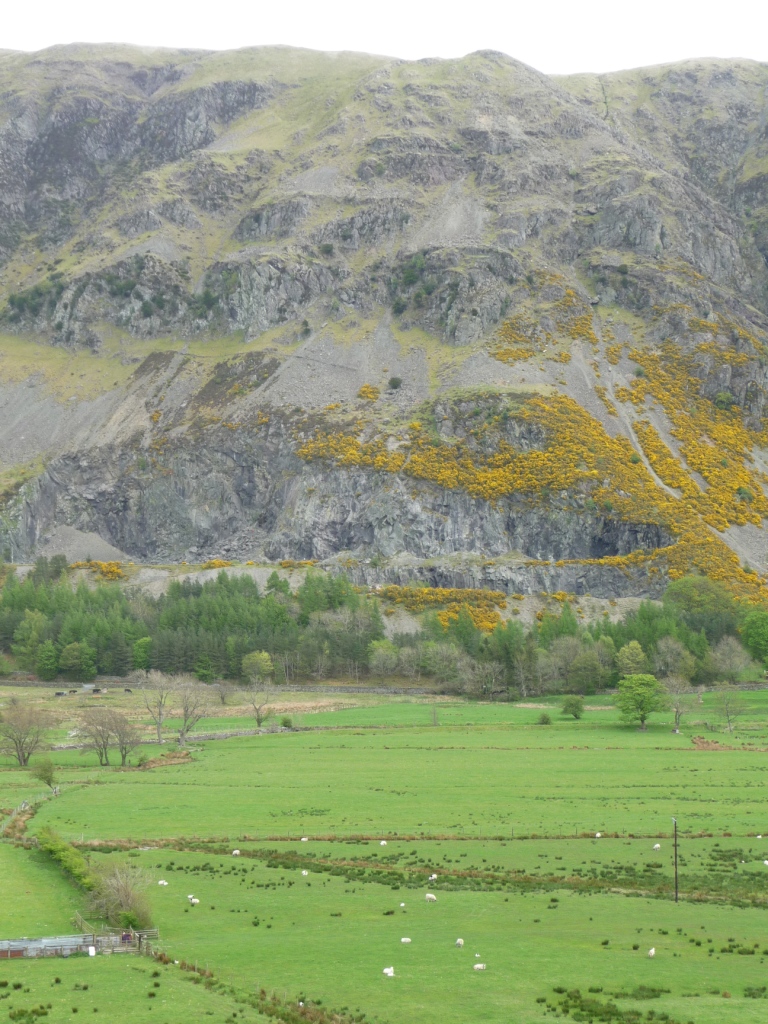
The quarry face survives in St John's in the Vale, reached by a gated track. It is used for rock climbing, and mountaineering clubs run meets there.
The quarry face survives in St John's in the Vale, used for climbing.
Related mines
- Threlkeld Quarry and Mine — Bramcrag is one of the seven quarries working the same Threlkeld microgranite around Threlkeld Knotts, and was reached by an extension of the Threlkeld quarry railway.
Nearby mines
- Threlkeld Quarry and Mine — 1.3 miles (2.0 km) NW
- Greenside Mine — 3.9 miles (6.3 km) SE
- Wythburn Mine — 5.1 miles (8.2 km) S
- Thornthwaite Mine — 5.6 miles (9.0 km) W
- Eagle Crag Mine — 5.6 miles (9.1 km) S
Straight-line distance, within 9 miles (15 km). Show on the map.
Recorded claims
Individual factual claims, each attached to the source(s) that support it below. Where sources disagree, both are kept.
- Seven quarries around the western side of Threlkeld Knotts worked the microgranite, including smaller workings at Birkett Bank, Hilltop and Bramcrag alongside the large Threlkeld Quarry. 1
- The quarry railway was extended first to Spion Kop quarry and then to Bram Crag further along St John's in the Vale, with a line down to the main line at Threlkeld station. 1
- Threlkeld Quarry opened in 1870 to supply railway ballast, with production increasing in the 1890s for Thirlmere reservoir and for roadstone. 1
Photographs & further reading
The museum's account of the seven microgranite quarries around Threlkeld Knotts and of the railway extensions that served them.
View sourceSources
- (secondary) History — Threlkeld Quarry and Mining Museum
- (observational) Bram Crag Quarry, St John's in the Vale — Keswick Mountaineering Club
- (observational) Bramcrag Quarry, St John's in the Vale — Geograph Britain and Ireland
Record created: 9 September 2026 · Last researched: 9 September 2026