 MineArchive
Lundy Granite Quarries
| Location | East Sidelands, Lundy, Devon — 51.1761, -4.6645 (exact) |
|---|---|
| Commodity | Granite |
| Type | Mineral |
| Worked | 1863–1868 |
| Operators | Lundy Granite Company (1863–1868) |
Overview
A five-year attempt to quarry an island. The Lundy Granite Company cut a terrace along the east side of Lundy, ran tramways and three inclined planes down to a jetty, put three hundred people on a rock in the Bristol Channel — and wound up in 1868, leaving the whole apparatus where it stood.
History
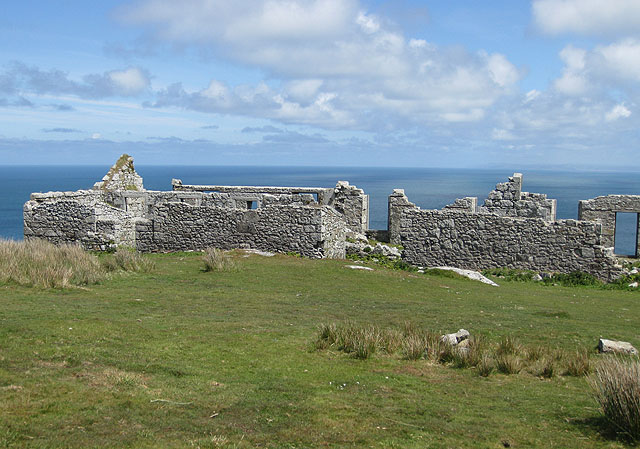
The company was registered in July 1863 with £25,000 of capital, having agreed with the island's owner, William Hudson Heaven, to lease Lundy for £500 a year plus royalties on the stone. It employed around three hundred people, housed first in wooden huts and then in stone buildings north of Quarter Wall, and exported granite through 1865 and 1866. It was wound up in 1868, five years after it began. The stone cottages at Quarter Wall housed the surgeon, the engineer and the foreman. One of the quarries was later the boyhood haunt of John Pennington Harman, awarded a posthumous Victoria Cross for 8 April 1944 in the Burma campaign, and was the scene of a commemoration on 23 June 1994; the terrace now carries one of the Lundy Field Society's bird traps.
Geology
Lundy is a granite island — a Tertiary intrusion standing out of the Bristol Channel — and the stone was quarried straight off the cliff faces on the sheltered east side, where it could be got down to a jetty.
Geological setting: Greisen and Pegmatite Deposits (historical documentary reference)
Workings
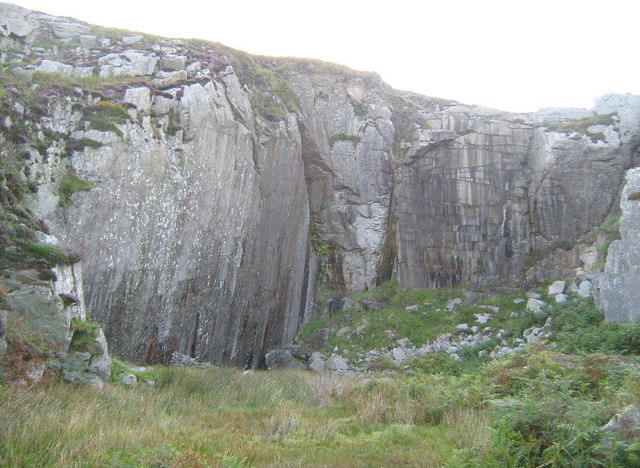
Five cliffside workings on the East Sidelands, with spoilheaps, a dressing floor, buildings for storage and stabling and a timekeeper's hut. A terrace was cut along the side of the island to carry a tramway between the quarries, with an upper and a lower line and three inclined planes taking stone down to sea level, where workshops and a jetty stood. Fieldwork tracing the sleeper grooves in the railbed in 1962 put the sleepers about three feet apart and roughly 4 ft 3 in long, suggesting a gauge of about two feet, with the bed made up between sleepers so horses could walk it.
Closure
The company was wound up in 1868 and the works simply stopped. Beyond machinery removed and stone robbed from the buildings for use elsewhere on the island, little has changed since.
What remains
The quarry complex survives as one of the most complete abandoned quarry landscapes anywhere in Britain: workings, spoil, inclines, the terrace and the ruins of the workers' cottages, the hospital and the officers' block. The terrace now carries a bird-ringing station run by the Lundy Field Society, and one working is known as VC Quarry after John Pennington Harman, who won the Victoria Cross at Kohima and spent his childhood on the island.
Five cliff quarries, spoilheaps, dressing floor, tramway terrace, three inclined planes with winding gear, workshops, timekeeper's hut, and the ruined hospital and officers' block.
Recorded claims
Individual factual claims, each attached to the source(s) that support it below. Where sources disagree, both are kept.
- The Lundy Granite Company was registered in July 1863 with £25,000 of capital, leasing the island from William Hudson Heaven for £500 a year plus royalties, and was wound up in 1868. 1,2
- A terrace cut along the east side carried tramways between five cliffside quarries, with three inclined planes taking stone down to a jetty at sea level. 1,2
- Fieldwork in 1962 traced sleeper grooves about three feet apart, with sleepers around 4 ft 3 in long, indicating a tramway gauge of about two feet, the bed made up between sleepers for horses. 2
- The workers were housed first in wooden huts and later in stone buildings north of Quarter Wall; the hospital and officers’ block still stand, though ruinous. 2
- The stone cottages at Quarter Wall were built to house the surgeon, engineer and foreman of the Lundy Granite Company in the 1860s and stand as ruins. 3
- John Pennington Harman, awarded a posthumous Victoria Cross for 8 April 1944 in the Burma campaign, had haunted one of the quarries as a boy, and a commemoration was held there on 23 June 1994; the terrace now carries one of the Lundy Field Society's bird traps. 1
Photographs & further reading
The island society’s account of the quarries and what survives.
View sourceSources
- (secondary) The Quarries — Lundy Field Society island tour — Lundy Field Society
- (primary) Lundy quarry railways — LFS Annual Report vol. 16 — Lundy Field Society, 1965 (fieldwork 1962)
- (observational) Ruins of Quarry Cottages, Quarterwall (Geograph, Pauline Eccles, 2009) — Geograph Britain and Ireland
Record created: 25 August 2026 · Last researched: 24 September 2026