 MineArchive
Wheal Sidney
| Location | Fernhill Wood, north of Plympton, Plympton St Mary and Shaugh Prior, Devon — 50.4182, -4.0427 (exact) |
|---|---|
| Commodities | Tin, Arsenic |
| Type | Metal |
| Worked | 1850 (modern working)–1865 |
| Maximum depth | 60 fathoms (110 m) at New Engine Shaft by 1861 |
Overview
An arsenical tin mine in Fernhill Wood north of Plympton, worked in earnest from 1850 to 1865 and named after its landowner Sidney Strode, whose 1862 engine chimney still stands.
History
Wheal Sidney lies in Fernhill Wood and the fields to the west, just south of the Dartmoor boundary, north of Plympton and three-quarters of a mile west of Crownhill Down and Hemerdon Ball. It takes its name from the mineral owner, Sidney Strode of Newnham Park. Its three east-west lodes belong to the Plympton mining district and, unlike those of the main Dartmoor granite, carried much arsenopyrite, so the ore had to be calcined. Workings called Fernehyll and similar names appear in documents from 1527 to 1660, when the old men worked openworks on the backs of the lodes and reached about 12 fathoms through a shallow adit from the Elfordleigh valley. The name Wheal Sidney first appears in 1795; a lease of 1836 to Captain Hitchens of the Bottle Hill company led to little work.
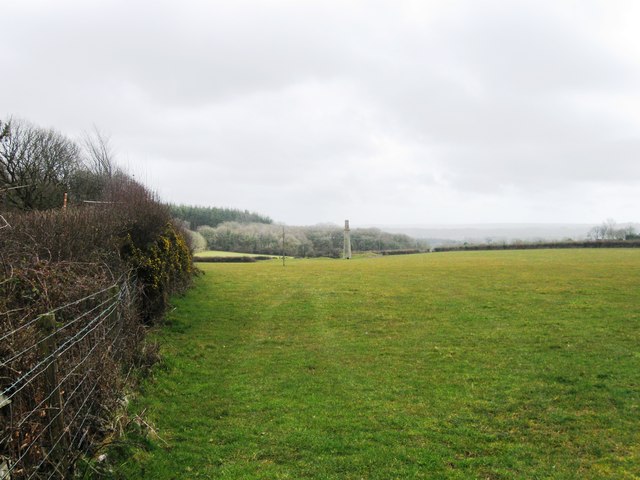
The modern mine began in 1850, when Eddy and Croker formed a cost-book company with shareholders in Plymouth, Salisbury and London. A 44-foot waterwheel and stamps were at work by December 1851 and a Brunton revolving calciner by June 1852; in 1856 the 21-year lease from 1850 was held from George Strode of Newnham at one-eighteenth, the one shaft was 45 fathoms deep, and a second 45-foot wheel did the pumping. A New Engine Shaft was begun in 1858, 100 fathoms to the north, pumped by flat-rods 270 fathoms long, and reached 60 fathoms by 1861. When the company gave up its lease in 1862 the mine had employed 40 to 80 people and produced about 360 tons of tin worth £25,000. Its successors built a house for a 56-inch pumping engine, started by Captain Sidney Strode in October 1862 and named the Strode engine, but work ceased in 1865. Wheal Mary Hutchings took the sett in 1870 to use the calciner, and the last licence was granted in 1920. The adjoining Wheal Julian, worked from 1855 to 1864, was eventually absorbed into Wheal Sidney. A chimney beside New Engine Shaft, the arsenic flue chimney in Fernhill Wood and the 44-foot wheelpit at the dressing floors remain.
Geology
Three east-west lodes in slate (killas) with tin and abundant arsenopyrite (mispickel), part of the Plympton mining district.
Workings
Old and New Engine Shafts, Williams' Shaft, Shallow and Deep Adits, 44-ft and 45-ft waterwheels with flat-rods, a 56-inch pumping engine, a Brunton calciner and a tramway to the dressing floors.
Closure
The first company gave up its lease in 1862 and mining ceased in 1865; later leases and licences came to little.
What remains
Ruins in woodland and fields.
The c.1862 chimney by New Engine Shaft, an arsenic flue chimney in Fernhill Wood, the 44-ft wheelpit, part of the calciner, and tramway traces.
Redevelopment
Woodland and farmland.
Related mines
- Hemerdon Mine — Neighbouring tin mine on Hemerdon Ball, three-quarters of a mile east.
Nearby mines
- Hemerdon Mine — 1.5 miles (2.5 km) E
- Cann Quarry — 1.6 miles (2.6 km) W
- Lee Moor China Clay Works — 1.8 miles (2.9 km) NE
- Headon Quarry — 2.7 miles (4.3 km) SE
- Yeoland Consols — 4.6 miles (7.3 km) NW
Straight-line distance, within 9 miles (15 km). Show on the map.
Recorded claims
Individual factual claims, each attached to the source(s) that support it below. Where sources disagree, both are kept.
- The mine is named after its owner, Sidney Strode of Newnham Park. 1
- The modern mine started in 1850 after the sett was leased to Eddy and Croker, who formed a cost-book company. 1
- In 1856 it was held under a 21-year lease from 1850 at 1/18th from George Strode of Newnham; one shaft had been sunk 45 fathoms and a 44-foot waterwheel drained and worked it; it was said to have been worked over 300 years before. 2,3
- A Brunton revolving calciner was erected in June 1852 because of the mundic in the ore. 1
- During 1850-62 the mine employed 40 to 80 people and produced about 360 tons of tin worth £25,000. 1
- A 56-inch pumping engine house was completed in October 1862 and the engine, started by Captain Sidney Strode, was named the Strode engine. 1
- By 1865 mining had ceased and the lease was revoked. 1
- Sections of Wheal Sidney in tin and copper ores are held in the national mine plan catalogue. 4
Sources
- (secondary) Wheal Sidney — Dartmoor Explorations
- (secondary) 1856 Mines in Devon and Cornwall — Grace's Guide
- (secondary) Sidney Mine — Grace's Guide to British Industrial History
- (primary) BGS mine plan: Wheal Sidney, tin and copper ores (sections only) — British Geological Survey / Mining Remediation Authority
Record created: 18 October 2026 · Last researched: 18 October 2026