 MineArchive
Carnon Mine
| Location | Restronguet Creek, near Devoran, Feock, Cornwall — 50.2084, -5.0806 (exact) |
|---|---|
| Commodities | Tin, Gold |
| Type | Metal |
| Worked | 1824–1830 |
Overview
A short-lived but highly profitable tin mine on Restronguet Creek near Devoran, Cornwall, notable for the unusual engineering used to work tin-bearing gravels beneath the tidal creek bed itself: cast-iron cylinder shafts sunk from an artificial island built in the estuary. Opened in 1824 and closed after only six years in 1830 not through exhaustion or accident but a navigation dispute, despite reportedly turning a profit of over £28,000. Its ruined engine house, one of the oldest surviving in Cornwall, is a Grade II listed building.
History
Tin-bearing gravels in the Carnon Valley had already been worked by streaming and by embanked open workings before 1800: an earlier operation, the Great Carnon Stream Works, dammed back the tidal water at Restronguet Creek to expose the streambed beneath, employing some 150 workers, until a severe gale combined with an exceptionally high tide breached the dam in 1812 and flooded the works, ending that phase of operation. Leases for a new attempt at mining beneath the water itself were being sought from around 1818, and the present Carnon Mine opened in 1824 using a fundamentally different, underground method: an artificial island was built out in the estuary, and shafts in the form of cast-iron cylinders, cast at the nearby Perran Foundry, were sunk into the soft ground from barges at high tide. A 24-inch pumping engine, together with a smaller 14-inch engine and horse whim on the artificial island, kept the workings beneath the creek bed dry via a flatrods system linking the engine to the shaft. The venture proved highly profitable, reportedly clearing over £28,000, but lasted only six years: the Redruth and Chasewater Railway Company, whose boats used the creek, complained that the mine's works obstructed navigation, and the mine closed and its engine was sold in 1830. As with much of the wider Carnon Valley's tin gravels, small amounts of alluvial gold were recovered alongside tin as a by-product.
Geology
Tin-bearing gravels beneath the tidal bed of Restronguet Creek, reached by cast-iron cylinder shafts sunk from an artificial island built in the estuary.
Workings
Worked from cast-iron cylinder shafts sunk into the bed of Restronguet Creek from an artificial island built in the estuary, reaching tin-bearing gravels beneath the tidal water; pumped via flatrods from a beam engine on the creek bank.
Closure
Closed in 1830, six years after opening, following complaints from the Redruth and Chasewater Railway Company that the mine's estuary workings obstructed boat traffic on the creek — a commercial/navigational closure rather than exhaustion of the deposit or an accident.
What remains
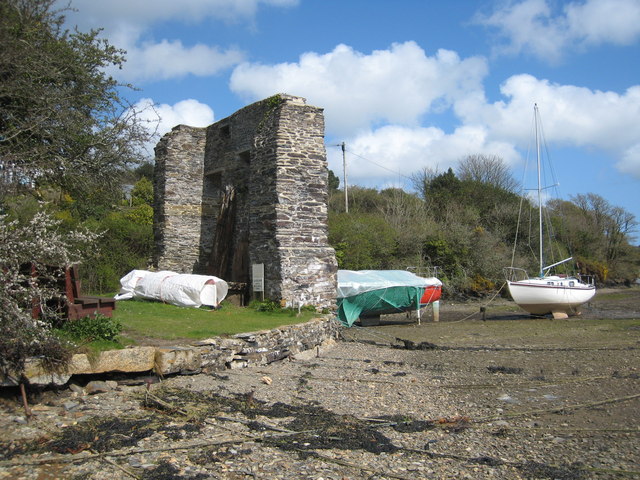
A ruined engine house survives on the north bank of Restronguet Creek — the south-east wall and parts of the north-east and south-west walls stand to two of the original three storeys. Listed Grade II on 12 March 1986, it is considered one of the oldest surviving engine houses in Cornwall, and lies within the Cornish Mining World Heritage Site. The site is now owned by Feock Parish Council and is easily accessible from the road.
Related mines
- Great Carnon Stream Works — Carnon Mine (1824) worked the same tin ground as the earlier Great Carnon Stream Works, by the very different method of mining beneath the water rather than excluding it.
Nearby mines
- Great Carnon Stream Works — 0.8 miles (1.3 km) NW
- Nangiles Mine — 3.1 miles (5.0 km) NW
- Wheal Jane — 3.1 miles (5.0 km) NW
- Great County Adit — 3.2 miles (5.1 km) NW
- Mount Wellington Mine — 3.4 miles (5.5 km) NW
Straight-line distance, within 9 miles (15 km). Show on the map.
Recorded claims
Individual factual claims, each attached to the source(s) that support it below. Where sources disagree, both are kept.
- Opened in 1824, working tin-bearing gravels beneath Restronguet Creek via cast-iron cylinder shafts (cast at Perran Foundry) sunk from an artificial island in the estuary, pumped by a 24-inch engine via flatrods, with a smaller 14-inch engine and horse whim on the island itself. 1,2
- The mine was profitable — one account gives over £28,000 in profit — but closed in 1830, after the Redruth and Chasewater Railway Company complained that its estuary works obstructed boat traffic on the creek; the engine was sold that year. 1,2
- The surviving engine house, on the north bank of the creek, was listed Grade II on 12 March 1986; the south-east wall and parts of the north-east and south-west walls survive to two of the original three storeys. 1
- Tin-bearing gravels at the same site were worked before 1800 by an embanked, dammed operation (the Great Carnon Stream Works) employing around 150 workers, until a severe gale and exceptionally high tide breached the dam in 1812 and flooded the works, ending that operation; the 1824 mine used a different, underground method to work the same deposit. 3
Sources
- (secondary) Carnon Mine — Wikipedia
- (observational) Carnon Mine — Explore Cornwall
- (secondary) The Great Carnon Stream Works — Feock Parish Council
Record created: 26 August 2026 · Last researched: 26 August 2026