 MineArchive
Mount Wellington Mine
| Location | St Day / Twelveheads, Gwennap, Cornwall — 50.2350, -5.1450 (approximate) |
|---|---|
| Commodity | Tin |
| Type | Metal |
| Worked | 1976–1978 (initial closure) |
| Maximum depth | 310 metres (No. 1 Wellington Shaft) |
| Operators | Cornwall Tin & Mining Corporation (1976–1978), Carnon Consolidated Tin Mines Ltd (1979–1991) |
Overview
Mount Wellington, sunk in 1976, was the first new mine opened in Cornwall in decades — a bold bet on the tin industry that flooded so badly it closed within two years, was rescued as a satellite of neighbouring Wheal Jane, and finally shut for good in 1991 as one of the last working tin mines in Cornwall.
History
Mount Wellington opened in 1976 as the first new mine development in the Cornish tin industry for many years, sunk by the Cornwall Tin & Mining Corporation at a cost estimated between £4 million and £25 million and initially forecast to have a 25-year working life. The No. 1 Wellington Shaft was sunk to 210 metres and later deepened to 310 metres, working mineralised lodes including Wheal Andrew and neighbouring claims. The mine proved extremely wet, pumping over 5,000 gallons of water a minute, and closed prematurely on 20 April 1978, with no more ore raised from the shaft after that date. The site was sold to a scrap dealer before being bought in 1979 by Carnon Consolidated, a subsidiary of Rio Tinto-Zinc, which reopened it in association with the neighbouring Wheal Jane mine, partly to help dewater Wheal Jane's own workings; Billiton Minerals separately purchased the Mount Wellington mill in 1979 and reprocessed tailings and dumps in the Carnon Valley until 1981. By 1984 Mount Wellington operated as part of an integrated mining unit with Wheal Jane and South Crofty under RTZ management, and the combined operation, including Mount Wellington and the Wheal Maid tailings lagoons, finally closed for the last time in March 1991.
Geology
The mine worked tin-bearing lodes, including Wheal Andrew, within the Gwennap mining district's granite-related hydrothermal mineralisation, the same system that produced the district's historic copper and tin wealth.
Geological setting: Hydrothermal Deposits (well documented example), Veins and Lodes (well documented example)
Workings
The No. 1 Wellington Shaft was sunk to 210 metres and later deepened to 310 metres; the mine's greatest operational challenge was water, pumping over 5,000 gallons a minute at its wettest, and its later life was run as an integrated unit alongside the neighbouring Wheal Jane and South Crofty mines.
Closure
The mine closed prematurely in April 1978 due to severe water ingress, reopened in 1979 as a satellite operation of Wheal Jane, and finally closed for the last time in March 1991 alongside Wheal Jane and the Wheal Maid tailings lagoons.
What remains
The former mine site was redeveloped in 2007 as a private, gated business park, now home to a number of tenants operating in the renewable energy sector.
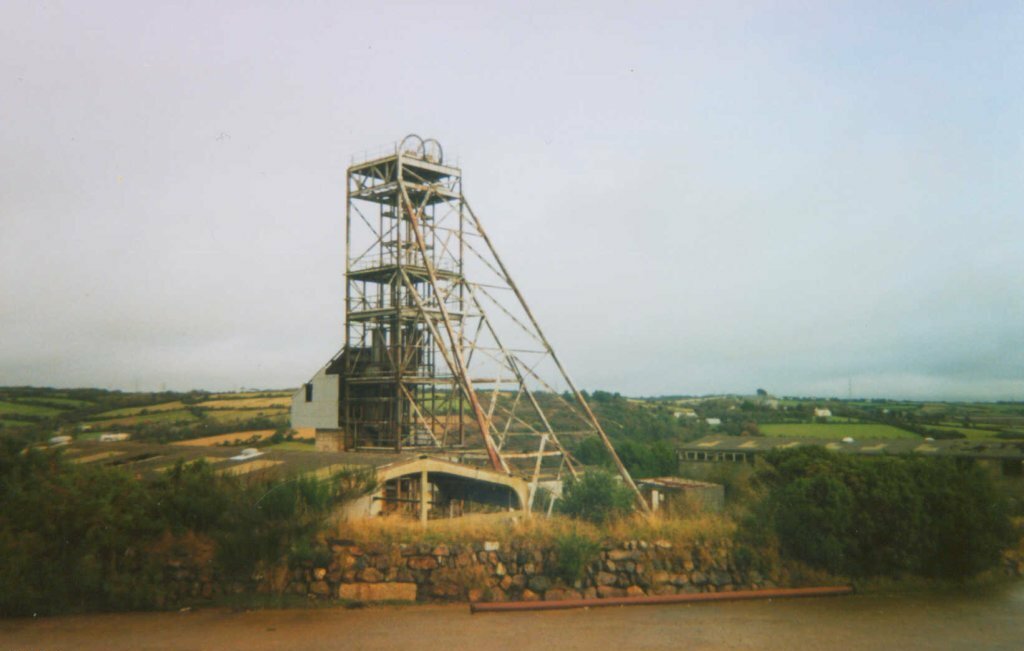
A truncated headgear and a large, largely stripped processing building survive on the redeveloped site; the mine's underground workings remain accessible via older, adjoining workings.
Related mines
- Pendarves Mine — Both were Carnon Consolidated mines in the 1980s.
- South Crofty — Operated as part of a single integrated mining unit with Wheal Jane under RTZ management from 1984.
- Wheal Andrew — Mount Wellington Ltd acquired the rights over Wheal Andrew in 1935, and the brothers who gave that mine its name had worked the Wheal Andrew lodes in the 1920s.
- Wheal Clifford — Mount Wellington Ltd acquired the rights over Wheal Clifford in 1935.
- Wheal Jane — Reopened in 1979 as a satellite operation of Wheal Jane, and later run as a single integrated unit with it under RTZ management.
Nearby mines
- Cusvey Mine — 0.1 miles (0.2 km) W
- Great County Adit — 0.2 miles (0.4 km) E
- Nangiles Mine — 0.4 miles (0.6 km) E
- Wheal Clifford — 0.8 miles (1.2 km) W
- Consolidated Mines — 0.8 miles (1.3 km) W
Straight-line distance, within 9 miles (15 km). Show on the map.
Recorded claims
Individual factual claims, each attached to the source(s) that support it below. Where sources disagree, both are kept.
- The No. 1 Wellington Shaft was sunk to 210 metres and later deepened to 310 metres; the mine pumped over 5,000 gallons of water a minute at its wettest. 1
- The combined operation including Mount Wellington, Wheal Jane and the Wheal Maid tailings lagoons finally closed for the last time in March 1991. 1
- The British Geological Survey holds a schematic composite plan of the No. 1 and No. 2 lodes and the western extension (MP25542), viewable online, and the Mining Remediation Authority's abandonment plans for the tin-ore workings at 1:200 (OM15312, 60 sheets in all). 2,3
- In August 1979 Carnon Consolidated, a Rio Tinto-Zinc subsidiary, acquired Wheal Jane and bought the freehold of Wellington's No. 1 shaft area; production at Wheal Jane restarted in June 1980 with some ore from Mount Wellington, and by 1984 Carnon owned all of South Crofty and ran the three mines as one unit. 1
Photographs & further reading
A January 2007 visit to a 20th-century mine rather than a Victorian one, and useful for exactly that: the truncated headgear, settlement tank, sloping conveyor and the four-storey processing building, stripped but standing, with its mill machinery and missing floors. A reminder of how recently, and how completely, a modern Cornish mine was abandoned.
View sourceThe scanned composite plan, viewable online.
View sourceSources
- (secondary) Mount Wellington Tin Mine — Wikipedia
- (primary) Mount Wellington Mine mine plan — British Geological Survey (BGS Exeter)
- (primary) Mount Wellington abandonment plans OM15312 (BGS mine plans catalogue) — British Geological Survey / Mining Remediation Authority
- (secondary) Mount Wellington Mine (Wheal Magpie), Cusgarne, Gwennap, Cornwall, England, UK — Mindat
Record created: 23 August 2026 · Last researched: 24 September 2026