 MineArchive
Tailings
| Category | Ore Processing |
|---|
The finely ground waste material left over once ore has been crushed and its valuable mineral extracted — a slurry of rock fragments and residual chemicals that historically had to be dumped, discharged into a stream, or, in later, more regulated practice, stored in an engineered lagoon or dam.
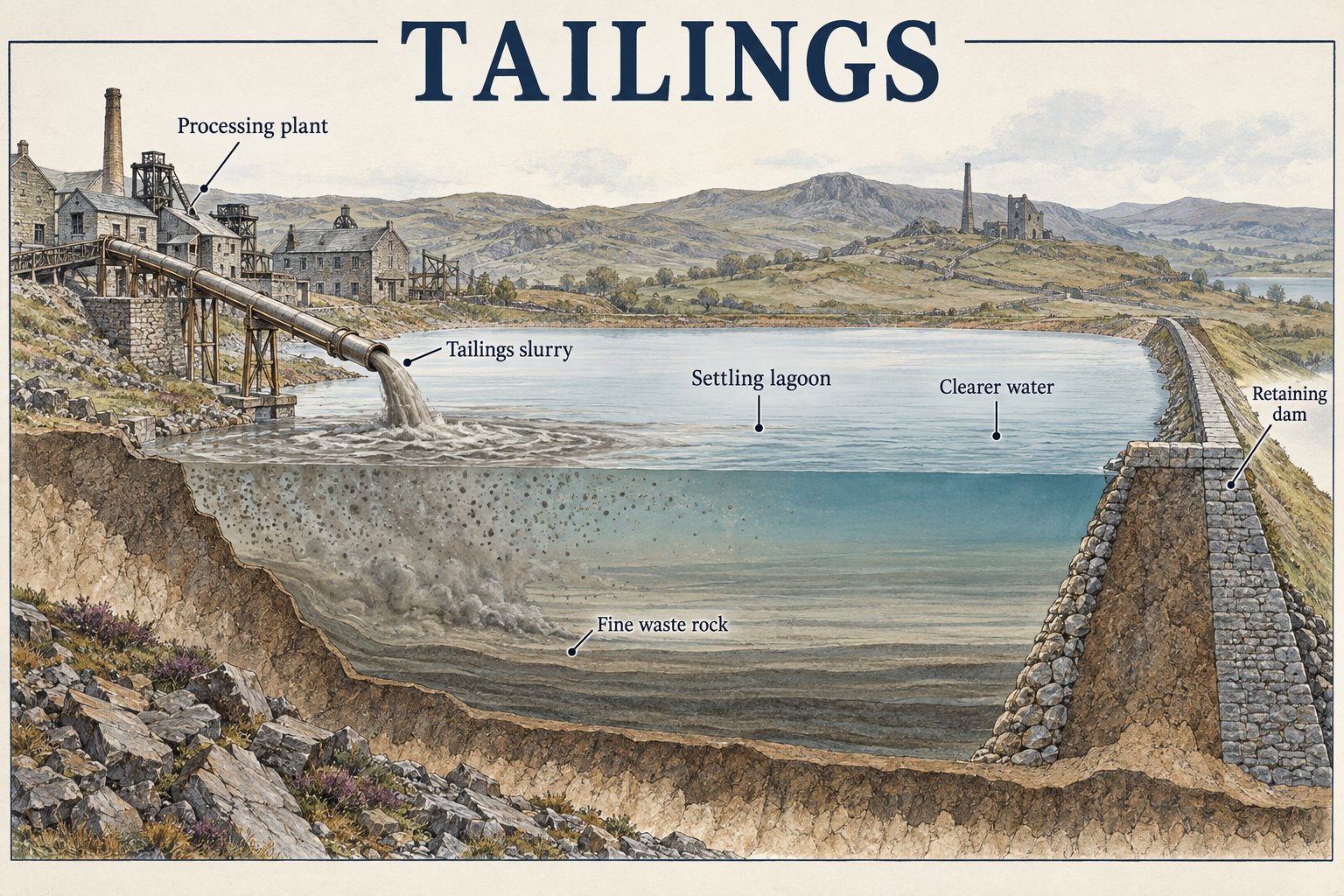
Historical usage
Tailings disposal has been a byproduct of ore processing for as long as ore has been crushed and dressed, but the method changed markedly over time. Historically, tailings were often discharged directly into the nearest stream or river, or simply tipped into heaps and valleys close to the mill — a practice that left lasting metal contamination in watercourses across British mining districts. From the mid-20th century onward, tightening environmental regulation increasingly required tailings to be contained in purpose-built lagoons or dams rather than released or dumped freely; Wheal Maid's valley in Cornwall, converted into a series of engineered tailings lagoons through the 1970s and 1980s to store waste from the nearby Mount Wellington and Wheal Jane mines, is a well-documented example of this later, more contained approach.
How it worked
After ore was crushed and the valuable mineral separated out — traditionally by gravity methods such as jigging and buddling, later by froth flotation — the remaining fine-grained waste, a slurry of ground rock, water and residual processing chemicals, was carried away from the mill, historically by gravity flow into a nearby stream or spoil ground, and in later practice by pipeline into a contained lagoon or dam designed to hold it.
Why it was used
Separating usable ore from waste rock is inherent to almost all mineral processing, so tailings disposal was never optional — only the method changed. As processing technology improved and made it economic to work lower-grade ore, the volume of tailings produced for each tonne of metal recovered tended to increase, making disposal and, later, containment an ever larger part of a mine's overall footprint.
Risks & limitations
Tailings retain a residual proportion of the target metal along with other heavy metals, and where the ore was sulphide-bearing, contain pyrite that continues to oxidise for decades after deposition, generating acidic, metal-laden drainage — the process documented in detail at Wheal Maid, now one of the most scientifically studied contaminated legacy sites in Britain. Historic streamside dumping left many British mining districts with long-term watercourse pollution, and even engineered tailings dams require ongoing management to prevent leakage or failure.
Related terminology
Mines associated with this term
5 examples chosen from 20 linked records — the term page is not an index.
- Carrock Fell Mine — Cumbria (well documented example)
The mine's own recorded current condition explicitly describes a tailings lagoon bulldozed and graded after the site's 1988 closure. - Carshield Mine — Northumberland (well documented example)
Named in this record’s current condition: “…running at up to 180 times the level safe for river wildlife. The tailings dam has been reprofiled and stabilised and a mine-water treatment…” - West Chiverton Mine — Cornwall (well documented example)
Named in this record’s current condition: “…instead. An adit still discharges water at the site, and extensive tailings and scattered building remains survive across the wider mine site.…” - Beezy Mine — North Yorkshire (well documented example)
Named in this record’s geology: “…horizon is known, Beezy Level, is at the top of that limestone. Tailings analysed by the Survey were notably zinc-rich: about 14 per cent…” - Conlig and Whitespots Lead Mines — County Down (well documented example)
The mine's own recorded workings and surface remains explicitly describe surviving tailings impoundments.
Sources
- (secondary) Evolution of Sulfidic Legacy Mine Tailings: A Review of the Wheal Maid Site, UK — Minerals (MDPI), peer-reviewed journal
- (secondary) Wheal Maid — Wikipedia
Record created: 24 August 2026 · Last researched: 24 August 2026