 MineArchive
Mines Royal
| Also known as | Mine Royal (Singular form referring to an individual royal mine, as distinct from the chartered company) |
|---|---|
| Category | Law & Custom |
The Crown's legal claim, confirmed by the 1568 Case of Mines, to any mine anywhere in England and Wales whose ore contained gold or silver in commercially worthwhile quantities — regardless of whose land the mine stood on — and, by extension, the Elizabethan chartered company established the same year to exploit that claim.
Historical usage
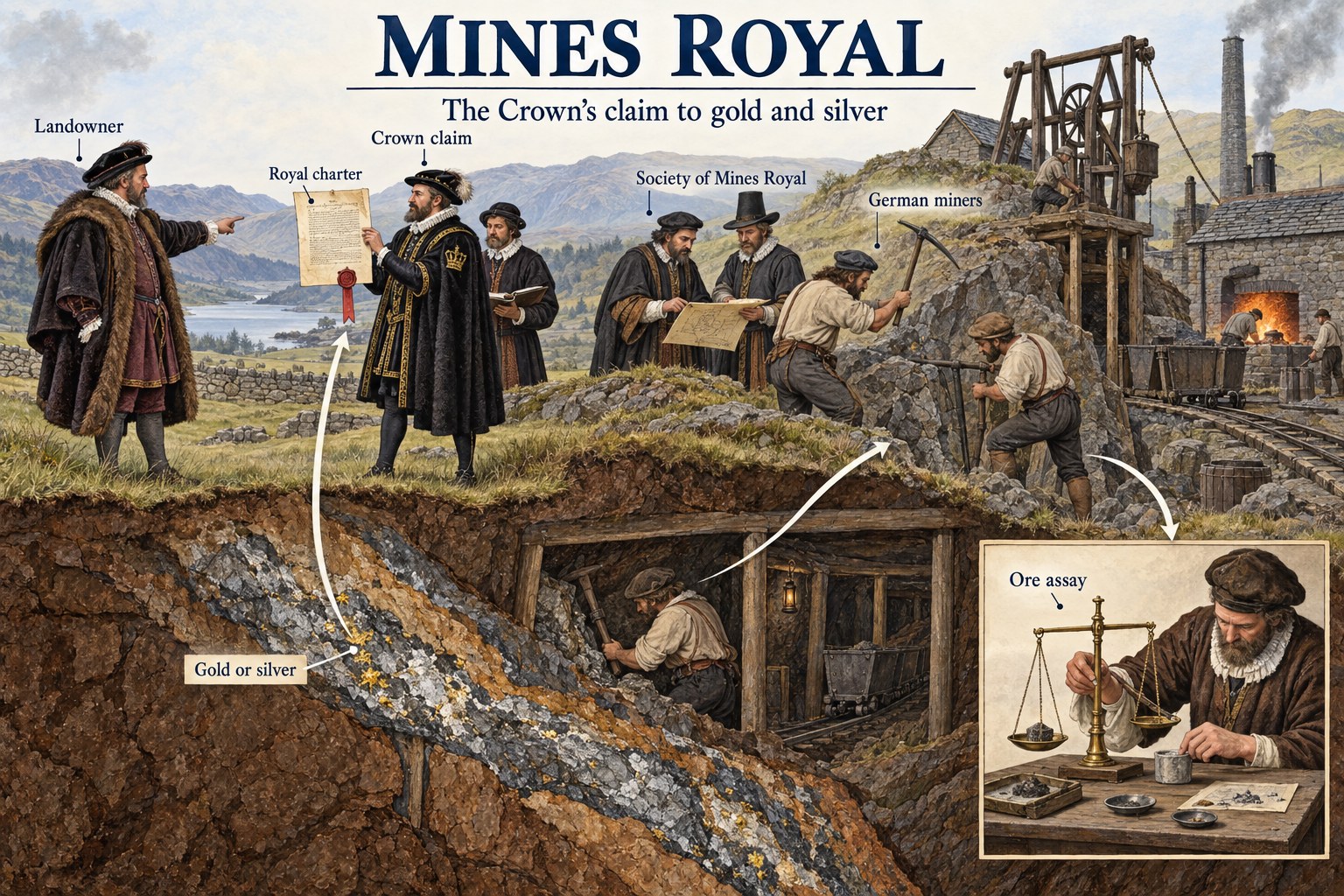
The principle was tested and confirmed in the 1568 Case of Mines (R v Earl of Northumberland), when copper ore mined on the Earl's land in Cumberland was found to contain a worthwhile admixture of gold; a panel of twelve senior judges ruled that all mines of gold and silver belonged to the Crown 'by prerogative', regardless of who owned the land above them, reasoning that gold and silver, being 'the most excellent things which the soil contains', naturally belonged to 'the person who is most excellent' — the monarch. On 28 May 1568, the same year, Elizabeth I chartered the Society of Mines Royal by letters patent, a joint-stock company of 24 shareholders given a monopoly to work and smelt ore at named sites in England and Wales, including the rich copper deposits around Keswick in Cumberland. The doctrine remained a live source of dispute for well over a century, most dramatically at Esgair Mwyn in Cardiganshire in 1753, where rival claimants invoking the Crown's mines-royal rights seized the mine by force and had its lessee, Lewis Morris, arrested at gunpoint. The Crown's claim never actually lapsed: The Crown Estate still owns virtually all naturally occurring gold and silver deposits in England, Wales and Northern Ireland today, and runs a formal modern licensing process for them — company enquiries go through a dedicated mineral agent, successful applicants can secure an option to lease the mines royal rights once a viable deposit is found and planning permission secured, and separately, if the Crown Estate does not itself own the surface land in question, a would-be prospector still has to secure access from whoever does.
The doctrine was finally cut down by statute after the Revolution of 1688. The Royal Mines Act 1688 enacted that no mine of tin, copper, iron or lead should thereafter be adjudged, reputed or taken to be a royal mine although gold or silver might be extracted out of it — which removed at a stroke the trigger the whole prerogative had depended on, and with it the monopolies of the Society of Mines Royal and the Company of Mineral and Battery Works. The same Act repealed the part of the Gold and Silver Act 1403 that had made it a felony to make gold and silver by alchemy. It did not settle matters, and the Royal Mines Act 1693 says so in its own preamble: notwithstanding the good provision of the earlier statute, 'many doubts and questions have arisen upon the said Statute whereby great suits and troubles have arisen to many owners and Proprietors of such Mines'. The 1693 Act therefore declared plainly that owners of mines containing copper, tin, iron or lead should hold, enjoy and work them notwithstanding any claim that they were royal mines, any law, usage or custom to the contrary. It expressly saved the charters of the tinners of Devon and Cornwall and the laws and customs of the Stannaries, which went on under their own regime. The Crown's claim to gold and silver as such was never abolished and has not been to this day; what the two Acts removed was its reach into the base-metal mines where, in practice, almost all the litigation had been.
How it worked
Any mine anywhere in the realm could, in principle, be claimed by the Crown the moment its ore was found to contain gold or silver worth extracting — even a mine primarily worked for copper, tin, lead or iron. In practice the Crown usually exercised this right not by working mines directly, but by granting a chartered monopoly, such as the Society of Mines Royal, the exclusive right to prospect, work and smelt ore across large tracts of named counties, displacing or absorbing existing landowners' and prospectors' own claims.
Why it was used
For the Crown, the doctrine was a straightforward source of revenue and strategic advantage: Elizabeth I's government was acutely conscious that Spain had ready access to vast quantities of American silver and gold, while England had almost none of its own, and claiming any domestic source, however small, mattered accordingly. For the chartered company itself, mines-royal status brought a state-backed monopoly and access to the German mining expertise the Crown deliberately imported to work it.
Risks & limitations
The doctrine's very breadth made it a constant source of legal conflict, since almost any base-metal lode might contain enough gold or silver to trigger a Crown claim, unsettling landowners and independent miners alike; disputes over it produced repeated, expensive lawsuits for well over a century. It was finally curtailed after the 1688 revolution, when Parliament passed the Mines Royal Act, ruling that no mine of copper, tin, iron or lead should thereafter be treated as a mine royal merely because it happened to yield some gold or silver alongside its main ore.
Regional variation
The Society of Mines Royal's own chartered monopoly was concentrated on the copper and lead deposits of Cumberland (notably around Keswick and Newlands) and parts of Wales, worked with the help of German miners recruited for their superior technical expertise; the underlying legal principle, however, applied across the whole of England and Wales until its 1688 restriction.
Related terminology
Mines associated with this term
5 examples chosen from 11 linked records — the term page is not an index.
- Esgair Hir and Esgair Fraith Mines — Powys (well documented example)
The mine's own recorded history explicitly describes its owner directly challenging the Society of Mines Royal's royal monopoly in court, and winning. - Carrock End Copper Mine — Cumbria (well documented example)
Named in this record’s history: “…here is reputed to go back to the 16th century — the Company of Mines Royal opened copper mines in the Caldbeck Fells from 1570 — but the…” - Coniston Copper Mines — Cumbria (well documented example)
The mine's own recorded history explicitly describes the Crown-backed Company of the Mines Royal bringing German miners to work the Bonsor and Paddy End veins from the 1590s. - Cwmsymlog Mine — Ceredigion (well documented example)
The mine's own recorded history explicitly describes the Crown-chartered Mines Royal company starting excavation there in 1585. - Esgair Mwyn Mine — Ceredigion (well documented example)
The mine's own recorded history explicitly describes the Crown's prerogative to claim the site as a 'mine royal', the dispute at the heart of the 1753 confrontation.
Sources
- (primary) Commercial exploration of mines royal — The Crown Estate
- (primary) Royal Mines Act 1688 (1 Will. & Mar. c. 30) — legislation.gov.uk
- (primary) Royal Mines Act 1693 (5 & 6 Will. & Mar. c. 6) — legislation.gov.uk
- (secondary) Case of Mines — Wikipedia
- (secondary) Society of Mines Royal — Wikipedia
- (secondary) The Most Excellent Things are the King's? The Case of Mines (1568) — Legal History Miscellany
Record created: 23 August 2026 · Last researched: 11 September 2026