 MineArchive
Esgair Mwyn Mine
| Location | Ysbyty Ystwyth, upper Ystwyth basin, Ceredigion — 52.3068, -3.8285 (exact) |
|---|---|
| Commodities | Lead, Copper, Silver, Zinc |
| Type | Metal |
| Worked | 1746–1994 |
| Operators | Lewis Morris (1746–1756), Robert Clive (1756–1780), Esgair Mwyn Mining Company (1850–1895), Thomas Ward (1890–1927), Elineth Mining Company (1947–1994) |
Overview
Esgair Mwyn, in the upper Ystwyth basin of northern Ceredigion, was already an old, abandoned working when the poet and antiquarian Lewis Morris rediscovered it in 1746 — and went on to draw in a Crown ownership dispute violent enough to see Morris arrested at pistol-point, and later, remarkably, the direct personal investment of Robert Clive of India.
History
The exact age of Esgair Mwyn is unknown — local place-names suggest medieval or older origins — but the site had lain abandoned for a long period before Lewis Morris, deputy steward for the Crown Manors of Cardiganshire, rediscovered and began formally reworking it in 1746. Output was substantial from the start: 1,000 tons of ore were raised in 1751 alone. The mine's profitability soon attracted a rival claim. On 23 February 1753, Herbert Lloyd of Peterwell and John Ball, acting for the neighbouring Grogwynion mine's backers and supported by the county sheriff, marched on Esgair Mwyn to seize it by force; Lloyd reportedly held a cocked pistol to Morris's head, and Morris was arrested and held in Cardigan gaol until early April. The dispute turned on the Crown's prerogative to claim as a 'mine royal' any workings whose ore yielded enough silver to be worth extracting — a legal principle that produced repeated, expensive lawsuits between rival claimants across Wales. Royal intervention eventually secured Morris's release and confirmed Crown ownership of the mine; by 1755 Morris, amused by the international mix of miners he had assembled, was calling the site 'Babel'. Robert Clive — Clive of India — became personally involved with Esgair Mwyn in the 1750s to 1770s, with accounts differing on the exact date and whether his involvement began as a leaseholder or as an outright purchase around 1770-71; John Probert managed declining output through the 1780s. The Esgair Mwyn Mining Company took over from 1850, extending the workings, installing a new dressing mill in 1852 and sinking the Penmor shaft around 1878, before falling lead prices forced closure in 1895. Thomas Ward of Sheffield resumed working at Penmor from the 1890s until the price collapse of the 1920s finally ended the mine in 1927. Even that was not quite the end: the Elineth Mining Company reprocessed the site's own spoil tips for residual zinc and lead from 1947, working intermittently until 1994, when equipment failure and pollution concerns finally closed the site for good.
Geology
The mine worked a lead, silver, zinc and copper-bearing vein within the Central Wales orefield, the same broad hydrothermal, non-magmatic mineralised belt worked at nearby Cwmystwyth and Grogwynion.
Geological setting: Hydrothermal Deposits (well documented example), Veins and Lodes (well documented example)
Workings
An adit completed in 1766 drained floodwater that had accumulated in the workings, improving productivity; the Penmor shaft, sunk around 1878, extended the mine considerably deeper, and a dressing mill installed in 1852 processed ore on site.
Closure
Falling lead prices closed the mine in 1895 and again, after a Sheffield-led revival, in 1927; a final phase reprocessing the mine's own spoil tips for residual metal continued intermittently until 1994.
What remains
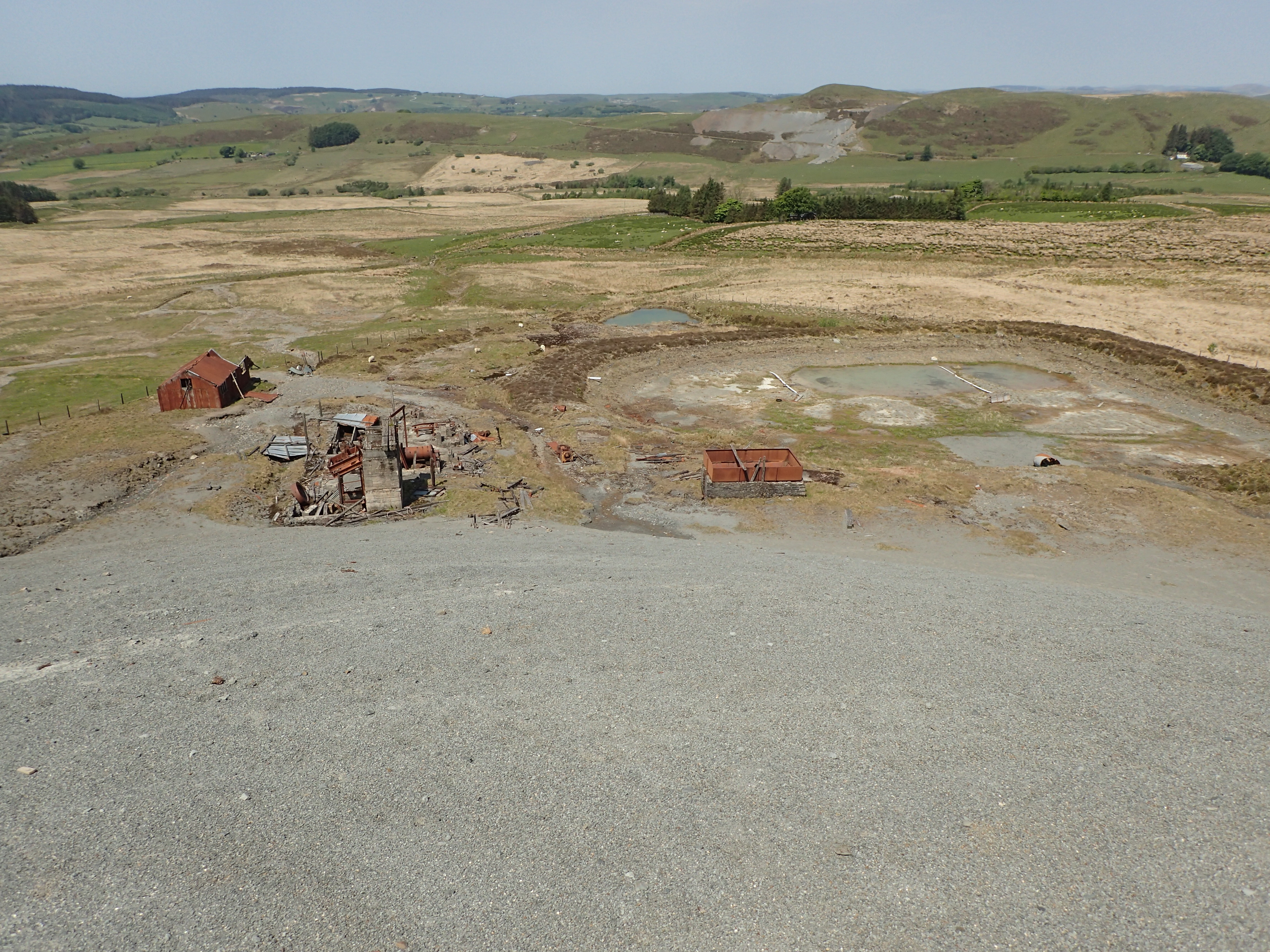
The site's spoil tips, including a fine tailings tip estimated at around 60,000 tonnes, have been the subject of environmental case-study assessment for metal contamination.
Extensive ruins survive, including mill foundations with machinery such as flywheels, ball mills and shaking tables, office and workshop buildings, pump buildings, tramway infrastructure, tailings lagoons and coarse waste dumps.
Related mines
- Grogwynion Mine — Grogwynion's backers organised an armed raid on Esgair Mwyn in 1753 to seize it by force.
Nearby mines
- Logaulas Mine — 1.7 miles (2.8 km) NW
- Grogwynion Mine — 3.1 miles (4.9 km) NW
- Frongoch Mine — 4.2 miles (6.8 km) NW
- Cwmystwyth Mines — 4.9 miles (7.8 km) NE
- Penrhiw Mine — 6.0 miles (9.6 km) N
Straight-line distance, within 9 miles (15 km). Show on the map.
Recorded claims
Individual factual claims, each attached to the source(s) that support it below. Where sources disagree, both are kept.
- Lewis Morris raised 1,000 tons of ore in 1751 alone; roughly £150,000 of lead ore is estimated to have been extracted between 1751 and 1788. 1
- On 23 February 1753 Herbert Lloyd of Peterwell and John Ball, backed by the county sheriff, seized the mine by force; Lloyd reportedly held a cocked pistol to Lewis Morris's head, and Morris was arrested and held in Cardigan gaol until early April before royal intervention secured his release and confirmed Crown ownership. 1
- The site's spoil tips, including a fine tailings tip estimated at around 60,000 tonnes, have been the subject of environmental case-study assessment for metal contamination. 2
Sources
- (secondary) The Derelict Miscellany: Esgair-mwyn Mine — The Derelict Miscellany
- (primary) June 2016 Abandoned Mine Case Study: Esgair Mwyn Lead Mine — Natural Resources Wales
- (primary) Esgair Mwyn mine, Cwm Du lead mine in Beddgelert and Llanllyfni; discovery of copper ore in Caernarfonshire; papers of Robert, 1st Baron Clive — National Library of Wales Archives and Manuscripts
Record created: 22 August 2026 · Last researched: 22 August 2026