 MineArchive
Cwm Mawr Mine
| Also known as | Cwmmawr Mine, Fairchance Mine, Cwm Mawr No. 1 |
|---|---|
| Location | About half a mile north of Pontrhydfendigaid, Ceredigion — 52.2894, -3.8546 (exact) |
| Commodities | Lead, Zinc |
| Type | Metal |
| Worked | 1753–1917 |
| Maximum depth | 20 fathoms below the shallow adit (about 37 m) |
Cwm Mawr, also known as Fairchance, was a lead and zinc mine half a mile north of Pontrhydfendigaid. It is first recorded in 1753 and was worked on and off for a century and a half. Its last and best spell came late: reopened in 1911, it returned 836 tons of lead ore and 131 of blende between 1913 and 1917, then stopped and was dismantled. Water running through its shaft and adit still carries zinc into the Teifi.
Location
Recorded location. The large pin is this mine; the small round markers are the nearest mines on record. Click one for its page. View on full map
History
The mine is on record in 1753 and was worked intermittently from then on, with varying success. It was prospected again about 1838. None of this early work left figures behind it.
What figures there are belong to the twentieth century, when most of the district's mines were already dead. Cwm Mawr was reopened in 1911 and was in production from 1913 to 1917, working a shaft sunk 20 fathoms below a shallow adit. In those five years it returned 836 tons of lead ore and 131 tons of blende, and its best year, 1914, gave 358 tons. Work stopped in 1917, and the mine was afterwards dismantled.
It has been studied since for a different reason. A stream runs into the open shaft and comes out again lower down, through seepages and the old adit, loaded with zinc, lead and cadmium. Surveys in 2008 and 2010 looked at turning the stream away from the shaft, and modelling in 2012 suggested that Cwm Mawr by itself was enough to make the Teifi fail its zinc standard for about ten kilometres.
Geology
The lode runs east-north-east and dips north, high up in the Frongoch formation. It carries galena and blende.
Geological setting: Veins and Lodes (historical documentary reference)
Workings
The mine was worked by a shaft sunk 20 fathoms below a shallow adit, at about 650 feet above sea level, which was driven east on the lode. A deeper adit comes out about 350 metres south-west of the shaft.
Closure
The mine stopped working in 1917 and was later dismantled.
What remains
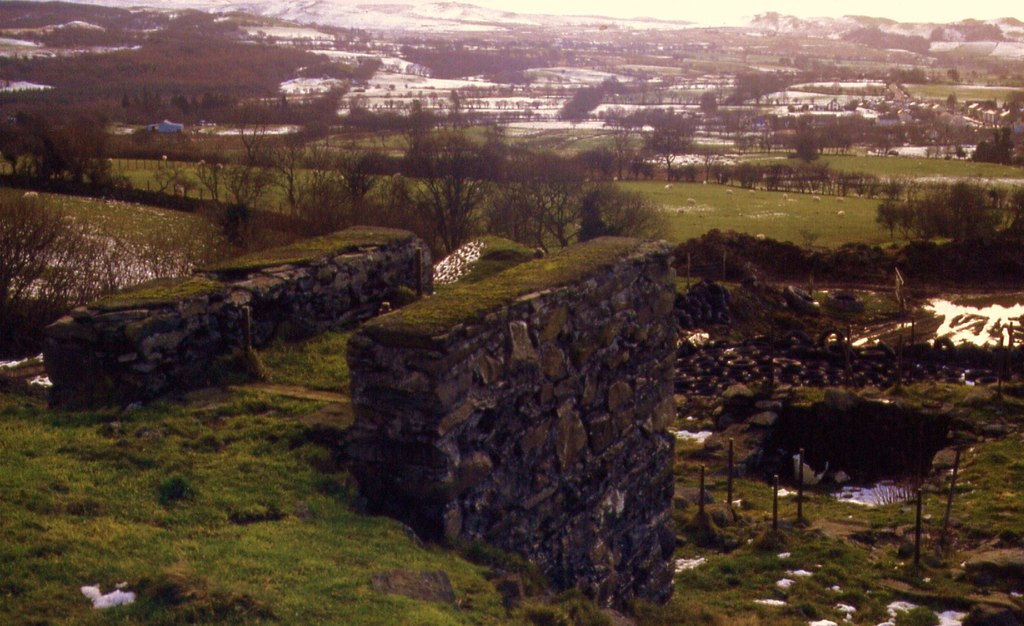
The shaft stands open, with a stream running into it, and the portal of the deep adit has collapsed. Two thick stone walls of a ruined mine building stood on the slope above the village in 2011.
Fragments of buildings, shafts, small waste tips, tanks, ponds and sluices, a reservoir tank with its leats, and the collapsed adit portal.
Redevelopment
Natural Resources Wales has studied diverting the stream away from the mine shaft to cut the metals reaching the Teifi.
Nearby mines
- Abbey Consols Mine — 0.8 miles (1.4 km) SE
- Esgair Mwyn Mine — 1.6 miles (2.6 km) NE
- Penlanfach Mine — 1.6 miles (2.6 km) N
- Hendrefelen Mine — 1.9 miles (3.1 km) NW
- Glogfawr Mine — 2.1 miles (3.4 km) N
Straight-line distance, within 9 miles (15 km). Show on the map.
Further reading
The Royal Commission's site record of the tips, tanks and leats, with photographs from 1967 to 2019.
View sourceThe regulator's two-page study of the mine's effect on the Nant y Cwm and the Teifi and the options for dealing with it.
View sourceSources
- (secondary) Abandoned Mine Case Study: Cwm Mawr Lead & Zinc Mine (June 2014) — Natural Resources Wales
- (primary) Cwm Mawr Mine, N. of Pontrhydfendigaid (NPRN 300609) — Coflein, Royal Commission on the Ancient and Historical Monuments of Wales
- (primary) Lead and Zinc: The Mining District of North Cardiganshire and West Montgomeryshire (Special Reports on the Mineral Resources of Great Britain, vol. XX), O. T. Jones, 1922 — Memoirs of the Geological Survey
- (observational) Cwm Mawr Mine (Geograph photograph 2700596, 2011) — Geograph
- (primary) Mine plan: Cwmmawr Mine, SN76NW 2 (KP17025) — British Geological Survey
Record created: 18 November 2026 · Last researched: 18 November 2026