 MineArchive
Donisthorpe Colliery
| Also known as | Donisthorpe Nos. 1 & 2, Donisthorpe Lower Pit, Donisthorpe Upper Pit |
|---|---|
| Location | Donisthorpe, near Ashby-de-la-Zouch, Leicestershire — 52.7231, -1.5321 (approximate) |
| Commodity | Coal |
| Type | Coal |
| Worked | 1871–12 April 1990 |
| Maximum depth | 263 m (863 ft) after the 1890 deepening; 205 m (672 ft) as first sunk |
| Operators | Checkland, Son and Williams (1871–1903), Donisthorpe Colliery Company Limited (1903–1947), National Coal Board (1947–1987), British Coal Corporation (1987–1990) |
Overview
Donisthorpe was sunk in 1871 by Checkland and Williams on the Leicestershire–Derbyshire border, originally as two separate pits — the Lower and Upper — worked by different companies and later becoming the No.1 and No.2 shafts of one colliery. The shafts reached 205 metres at first and were deepened to 263 metres in 1890. From 1903 the pit was run by the Donisthorpe Colliery Company, later part of the Moira Colliery Company combine, which electrified it and tripled its output. It won a national competition as Britain’s Best Pit in 1951 and topped a million tons a year by the mid-1960s. When it closed at noon on 12 April 1990 it was one of only two mines left in Britain still winding with a steam engine.
History
Sinking began in 1871 under the colliery owners Checkland and Williams, to a depth of 205 metres, and in 1890 the shafts were deepened to 263 metres. The colliery was originally two pits — Donisthorpe Lower Pit, which became the No.1 shaft, and Donisthorpe Upper Pit, which became the No.2 — and, unusually, the two were worked by different mining companies. Kelly’s Directory of the period records simply that at Donisthorpe "there is a colliery, worked by Messrs. Checkland, Son and Williams"; the same firm appears in the official 1880 list of collieries at work as the owner of Donisthorpe Nos. 1 and 2.
In 1903 both came under the control of the newly formed Donisthorpe Colliery Company Ltd, which later became part of the Moira Colliery Company combine. Over the next sixteen years the new company put electricity underground in place of steam and oil equipment, built a generating plant, steel headframes, new winding gear and improved workshops on the surface, acquired fifty houses for its men and kept ninety horses and ponies below ground. Output tripled to 300,000 tons a year.
New reserves were opened up in the 1940s in what became the Oakthorpe, South, Newfields and Woodfield sections, with a new pit bottom built to work them. After nationalisation the years 1948 to 1952 brought modern mechanical coal-winning equipment and a complete reorganisation of underground haulage and winding, along with pithead baths, a canteen and a medical centre. In 1951 Donisthorpe won a national competition for Britain’s Best Pit and broke a series of area and national production records, output rising to about 750,000 tons a year and reaching 1,039,018 tons by the mid-1960s. New workshops, a lamproom, a rescue room and deputies’ offices followed in 1966. In 1980 a drift 2,200 metres long was driven to bring the coal out at Rawdon, the neighbouring Moira pit, and the pit bottom was rebuilt around an 800-tonne vertical bunker.
Geology
Donisthorpe worked the southern end of the Leicestershire and South Derbyshire coalfield, the same field as the Moira pits three miles north. The shafts passed the Little Coal on their way to the Main Coal, and the 1890 deepening was made to reach the Stockings seam; the Woodfield seam gave its name to one of the 1940s districts. The coal did not run out: at closure the complex had twenty-two newly prepared faces, only one of which had started production, and the faces that were working were described as good and level with plenty of room.
Geological setting: Sedimentary Beds and Seams (well documented example)
Workings
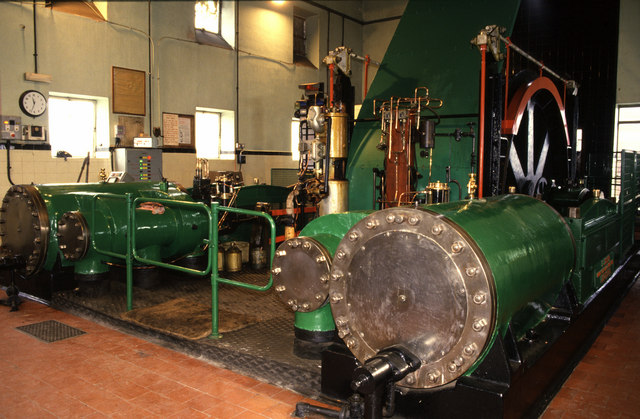
Two shafts, No.1 (the former Lower Pit) and No.2 (the former Upper Pit). The No.2 shaft was still wound by steam at closure — a horizontal twin-cylinder engine of about 1880–90 with 28 inch cylinders and a 48 inch stroke, working at 75 to 80 psi and capable of winding at 65, with piston valve gear and anti-stall valves on the back of the cylinders in case of an overwind. It had been overhauled by J. Jessop of the London Steam Crane Company, Leicester, in 1916. The winder was a Worsley Mesnes with steam brakes and a banking engine until 1978, when an electric banker and pneumatic brakes replaced them to meet safety requirements and the keps were disconnected after two close winding accidents. The old steam brakes had a habit of juddering and running on, because the winding drum was slightly elliptical, and the bottom deck of the descending cage would slide into the sump. One of the last drivers demonstrated to the recording team that the cages could nonetheless be stopped and reversed in the shaft on steam alone. From 1980 coal left through a 2,200-metre drift to the surface at Rawdon rather than up the Donisthorpe shafts.
Closure
The mine was deemed uneconomic and scheduled for closure despite considerable remaining reserves, and the men could not understand it: twenty-two new faces had recently been created in the complex and only one had started production, while the faces in work were good and level. Most of the workforce belonged to the Union of Democratic Mineworkers, formed during the 1984 strike. Closure came at twelve noon on Thursday 12 April 1990 — the same day a film crew arrived to record the last steam winder still working in the Midlands, having had no idea the pit was shutting. Some later accounts give the closure as 1991.
What remains
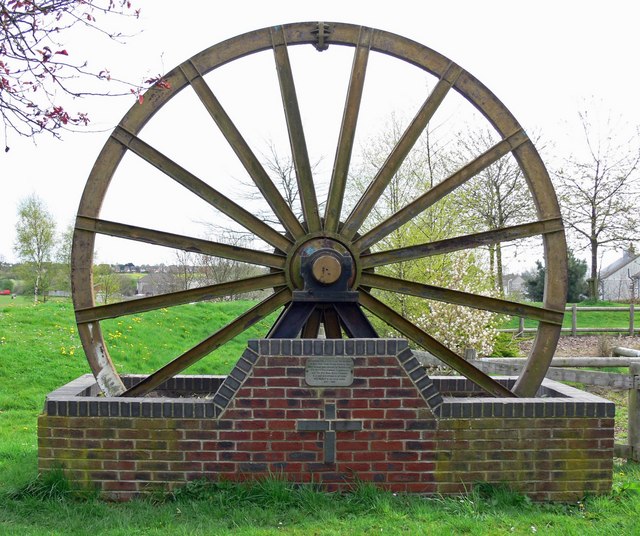
The colliery site has become Donisthorpe Woodland Park, part of the National Forest, with housing on part of the former mine ground. A winding wheel and a memorial stand on the site. The village that the pit supported has contracted with it: when it was working Donisthorpe had two post offices, five public houses and fourteen shops; by closure that was four shops and a post office, and by the 2010s one shop and two pubs. The Miners’ Welfare Centre closed in 2005.
A colliery winding wheel mounted as a monument, with a plaque, and a separate colliery memorial, both within Donisthorpe Woodland Park. The No.2 steam winding engine was taken into store for preservation after closure.
Redevelopment
Donisthorpe Woodland Park and housing, within the National Forest.
Related mines
- Moira Collieries — The Donisthorpe Colliery Company became part of the Moira Colliery Company combine, the two firms joined in erecting the Bath Lane war memorial to their employees, and in 1980 a drift 2,200 m long was driven from Donisthorpe to bring its coal out at the surface of Rawdon, the last of the Moira pits.
- Oakthorpe Colliery — Oakthorpe's shafts became a service shaft of Donisthorpe Colliery, joined underground by a flight of steps.
Nearby mines
- Moira Collieries — 0.6 miles (1.0 km) NW
- Oakthorpe Colliery — 0.9 miles (1.4 km) E
- Measham Colliery — 1.4 miles (2.2 km) SE
- Netherseal Colliery — 2.7 miles (4.4 km) W, Derbyshire
- Church Gresley Colliery — 2.9 miles (4.6 km) NW, Derbyshire
Straight-line distance, within 9 miles (15 km). Show on the map.
What's uncertain
Points where sources disagree or the record could not be settled; both accounts are kept. All open questions in the archive.
- I.A. Recordings, whose crew were on site that day, record the colliery as officially due to close at twelve noon on 12 April 1990; the Wikipedia article on the village gives the closure as 1991. (disputed) 1,2
Recorded claims
Individual factual claims, each attached to the source(s) that support it below. Where sources disagree, both are kept.
- The mine was first sunk in 1871 by Checkland and Williams to a depth of 205 m (672 ft), and the shafts were deepened to 263 m (863 ft) in 1890. 1
- Donisthorpe was originally two pits — the No.1 shaft was Donisthorpe Lower Pit and the No.2 shaft Donisthorpe Upper Pit — and the two were worked by different mining companies until they came under the Donisthorpe Colliery Company Ltd in 1903. 1
- Donisthorpe won a national competition for Britain’s Best Pit in 1951, breaking a number of area and national production records, with output rising to about 750,000 tons a year and reaching 1,039,018 tons a year by the mid-1960s. 1
- At closure Donisthorpe was one of only two mines in Britain still retaining and using a steam winding engine, on the No.2 pit. 1,2
- I.A. Recordings, whose crew were on site that day, record the colliery as officially due to close at twelve noon on 12 April 1990; the Wikipedia article on the village gives the closure as 1991. (disputed) 1,2
- Twenty-two new faces had recently been created in the mine complex, only one of which had started production, and the working faces were described as good and level with plenty of room — which is why the men could not understand the closure. 1
- Grace’s Guide’s transcription of the 1922 list of colliery undertakings records the Donisthorpe Colliery Co. at Donisthorpe, near Ashby-de-la-Zouch. 3
- The BGS mine-plans catalogue holds a Mining Remediation Authority abandonment plan titled 'Donisthorpe' (catalogue EM1385, Stockings, dated 1990). 4
Photographs & further reading
The record made by a film crew who arrived on 12 April 1990 to film the last working steam winder in the Midlands and found the pit closing at noon that day: the engine’s specification, the driver demonstrating that the cages could be handled on steam alone, and the men’s account of the reserves being left behind.
View sourceSources
- (observational) Donisthorpe Colliery, Leicestershire — Mining History Feature — I.A. Recordings
- (secondary) Donisthorpe — Wikipedia
- (primary) 1922 Colliery Undertakings — Grace’s Guide to British Industrial History
- (primary) BGS / Mining Remediation Authority mine plans: DONISTHORPE — British Geological Survey / Mining Remediation Authority
Record created: 6 September 2026 · Last researched: 6 September 2026