 MineArchive
Golborne Colliery
| Location | Golborne, near Wigan, Greater Manchester — 53.4758, -2.5943 (approximate) |
|---|---|
| Commodity | Coal |
| Type | Coal |
| Worked | 1880 (sinking)–1989 |
| Maximum depth | No. 3 shaft: 606 yards (555m) |
| Operators | Richard Evans and Co (1880–?) |
Overview
A Lancashire coal mine near Wigan, sunk from 1880 by Richard Evans and Co and worked until 1989. It is the site of one of Britain's worst coal-mining disasters of the post-nationalisation era: a firedamp explosion on 18 March 1979 that killed ten men, with a 20-year-old apprentice electrician the sole survivor among those caught in the blast.
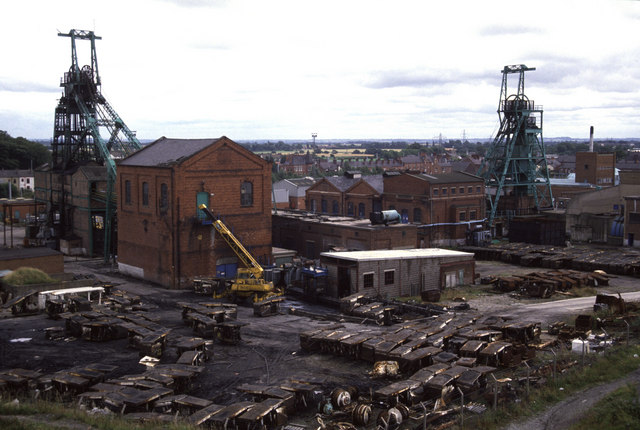
History
The colliery was sunk from 1880 on land previously held by Edward Johnson, acquired by Richard Evans and Co, who developed Nos. 1 and 2 pits and began operations in 1883. No. 3 shaft was sunk in 1902 to 606 yards and became the main coal-winding shaft; No. 2 was progressively deepened to the same depth and used for manriding, while No. 1, sunk only to 150 yards, was filled in 1943. Over its working life the colliery worked eight seams: Crombuke, Ince Six Feet, Higher Florida, Plodder, Lower Florida, Wigan, Arley, Peacock and Trencherbone, and operated almost continuously from 1883 aside from closures in 1932 and 1936 during the trade depression. By the late 1970s the workforce stood at 870 men, producing 9,000 tonnes of saleable coal a week from four seams.
In August 1975 an underground connection was made to the neighbouring Bickershaw Colliery, and from April 1977 coal winding at Golborne itself ceased, with coal thereafter wound at Bickershaw — Golborne continuing as a feeder pit into the wider Bickershaw complex. On 18 March 1979 the colliery was the scene of a major disaster — see Disasters, below. The colliery closed in 1989, with significant job losses across Golborne, Lowton, Abram and Ashton-in-Makerfield.
Geology
Coal of the Lancashire field: eight seams over the pit's life — Crombuke, Ince Six Feet, Higher Florida, Plodder, Lower Florida, Wigan, Arley, Peacock and Trencherbone.
Workings
No. 1 shaft, 14ft diameter, was sunk to 150ft in 1880 and filled in 1943. No. 2 shaft, also 14ft diameter and sunk in 1880, was progressively deepened to 600 yards by 1902 and used for manriding. No. 3 shaft, 18ft diameter, was sunk in 1902 to 606 yards and served as the colliery's main coal-winding shaft until winding transferred to Bickershaw in 1977.
Closure
Coal winding moved to the neighbouring Bickershaw Colliery from April 1977 after the two were connected underground; Golborne closed in 1989.
What remains
The colliery site is now 'the Bonk', the largest park in Golborne. A memorial stone, commissioned after two years of community fundraising and dedicated in 2006, stands on Kid Glove Road commemorating everyone who worked and died at the colliery between its 1880 opening and 1989 closure. Streets on the Rothwells Farm development, Edwards Trumble Meadow and McPherson Place, are named after victims of the 1979 disaster, and annual remembrance services continue to mark its anniversary.
Related mines
- Bickershaw Colliery — Connected underground in 1975; Golborne's coal was thereafter wound at Bickershaw once Golborne's own winding ceased in 1977.
Nearby mines
- Garswood Hall Colliery — 1.7 miles (2.7 km) NW
- Bickershaw Colliery — 2.0 miles (3.2 km) NE
- Parkside Colliery — 2.0 miles (3.2 km) S, Lancashire
- New Boston Colliery — 2.3 miles (3.8 km) W, Merseyside
- Maypole Colliery — 2.4 miles (3.9 km) N, Lancashire
Straight-line distance, within 9 miles (15 km). Show on the map.
Disasters & major incidents
-
Golborne Colliery explosion, 1979
18 March 1979 · Explosion · 10 fatalities
A firedamp explosion in the Plodder Seam at Golborne Colliery killed ten men on 18 March 1979; a 20-year-old apprentice electrician, seriously injured, was the sole survivor among those caught in the blast.
Recorded claims
Individual factual claims, each attached to the source(s) that support it below. Where sources disagree, both are kept.
- The colliery was sunk from 1880 by Richard Evans and Co; No. 3 shaft, sunk in 1902 to 606 yards, became the main coal-winding shaft. 1
- An underground connection was made to the neighbouring Bickershaw Colliery in August 1975, and from April 1977 coal winding at Golborne ceased, with the pit continuing as a feeder into the wider Bickershaw complex. 1,2
- The colliery closed in 1989, causing significant job losses across Golborne, Lowton, Abram and Ashton-in-Makerfield. 3
- A memorial stone commemorating everyone who worked and died at the colliery was dedicated on Kid Glove Road in 2006, following two years of community fundraising. 4
- The BGS/Coal Authority mine plans catalogue holds ten records for Golborne, including surface plans and plans for the Wigan Four Feet and Plodder (Ravine) seams, the latter being the seam of the 1979 explosion. 2
Sources
- (secondary) Golborne Colliery — Northern Mine Research Society
- (primary) Golborne mine plan records — British Geological Survey / Coal Authority mine plans catalogue
- (observational) Golborne Mining Disaster — Lowton and Golborne News
- (observational) Remembering the Golborne Colliery Disaster — Lowton and Golborne News
Record created: 26 August 2026 · Last researched: 26 August 2026