 MineArchive
Parkside Colliery
| Location | Newton-le-Willows / Croft, near Winwick, Lancashire — 53.4479, -2.6033 (exact) |
|---|---|
| Commodity | Coal |
| Type | Coal |
| Worked | From 24 November 1957–1993 |
| Maximum depth | c. 810-812m (both shafts) |
Overview
A purpose-built National Coal Board colliery sunk 1957-64 at Newton-le-Willows, the last new coal mine sunk in the Lancashire Coalfield. Worked six seams to depths of around 810 metres using modern Koepe winding towers and its own methane-recovery pipeline, it employed up to around 1,750 men at its 1970s peak and closed in 1993 as the last deep mine in the Lancashire Coalfield, ending some 700 years of coal mining in the area. The site, beside the M6 near Croft and Winwick, has since been the subject of long-running plans for a rail freight interchange.
History
The foundation stone was laid in May 1957 and sinking of No. 1 and No. 2 shafts began that November and December, reaching a final depth of around 810-812 metres by 1962 at a development cost to the National Coal Board of more than £13 million. At least one fatality occurred during the sinking phase, before any coal was wound, though no further detail on the incident survives. Coal production began on 31 March 1964, working the Crombouke, Lower Florida, Ince Six Feet, Wigan Four Feet, Wigan Five Feet and Trencherbone seams by longwall extraction.
The workforce peaked at around 1,753 men in 1971-72, and output peaked at 831,527 tons in 1979-80. From 1978 methane drawn off the coal faces was piped some 7½ miles to a chemical works in Warrington rather than simply vented, at up to 12-15 million therms a year at peak — a genuinely advanced piece of energy-recovery infrastructure for a British colliery of its era. Coal was despatched by merry-go-round train to Fiddlers Ferry power station in Cheshire.
Production ceased around October 1992, amid the wider wave of British Coal pit closures announced that year, with formal closure following by June 1993 — consistent with a set of BGS mine-plan abandonment dates for different workings running from June to October 1993. Parkside was by then the last deep coal mine working in the Lancashire Coalfield. In April 1993 four women led by Anne Scargill staged a four-day underground occupation of the colliery in protest at its closure, ending 12 April 1993 — an episode later dramatised in Maxine Peake's play Queens of the Coal Age. The winding towers were demolished shortly after closure, and the site has since been the subject of long-running redevelopment proposals, gaining planning approval in December 2019 for a Strategic Rail Freight Interchange.
Geology
Coal of the Lancashire field, six seams worked to depths of around 810 metres, with enough methane in the ground to justify its own recovery pipeline.
Workings
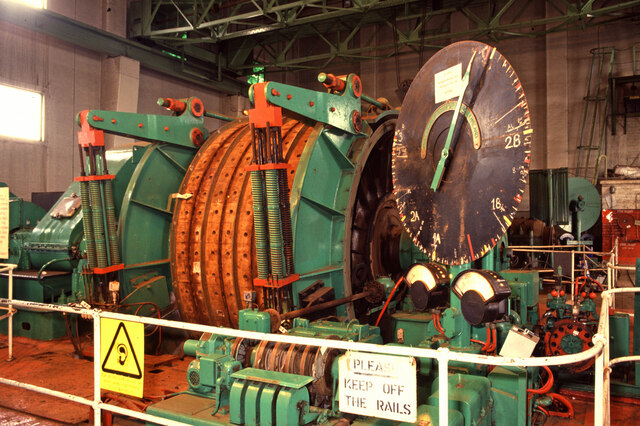
Two shafts, both around 810-812 metres deep, were sunk 1957-62 and equipped with Koepe friction winding towers rather than older drum-winding gear — No. 1 for personnel and materials, No. 2 hauling coal in 15-tonne skips. Six seams were worked by longwall extraction: Crombouke, Lower Florida, Ince Six Feet, Wigan Four Feet, Wigan Five Feet and Trencherbone.
Closure
The winding towers were demolished shortly after closure.
What remains
The winding towers were demolished shortly after closure. The site beside the M6 near Croft and Winwick has been the subject of long-running proposals to redevelop it as a Strategic Rail Freight Interchange, which gained planning approval in December 2019.
Nearby mines
- Haydock Colliery — 2.0 miles (3.1 km) W
- Golborne Colliery — 2.0 miles (3.2 km) N, Greater Manchester
- New Boston Colliery — 2.4 miles (3.9 km) NW, Merseyside
- Collins Green Colliery — 2.7 miles (4.4 km) W, Merseyside
- Sutton Manor Colliery — 2.8 miles (4.6 km) W, Merseyside
Straight-line distance, within 9 miles (15 km). Show on the map.
What's uncertain
Points where sources disagree or the record could not be settled; both accounts are kept. All open questions in the archive.
- At least one fatality occurred during the colliery's shaft-sinking phase, before any coal was wound, though no further named detail or date is recorded. (uncertain) 1
Recorded claims
Individual factual claims, each attached to the source(s) that support it below. Where sources disagree, both are kept.
- Sinking of the colliery's two shafts began in November/December 1957, reaching a final depth of around 810-812 metres by 1962 at a development cost to the National Coal Board of more than £13 million. 1,2
- Coal production began 31 March 1964; the workforce peaked at around 1,753 men in 1971-72 and output peaked at 831,527 tons in 1979-80. 2
- From 1978 methane drawn off the coal faces was piped around 7½ miles to a chemical works in Warrington, carrying up to 12-15 million therms a year at peak, rather than being simply vented. 1
- Production ceased around October 1992 with formal closure following by June 1993, making Parkside the last deep mine in the Lancashire Coalfield; in April 1993 four women led by Anne Scargill staged a four-day underground occupation of the colliery in protest, ending 12 April 1993. 1,2
- At least one fatality occurred during the colliery's shaft-sinking phase, before any coal was wound, though no further named detail or date is recorded. (uncertain) 1
- The BGS/Coal Authority mine plans catalogue holds records for Parkside Colliery with abandonment dates in 1992 and 1993 recorded for different workings as the pit wound down. 3
Sources
- (secondary) Parkside Colliery — Wikipedia
- (secondary) Parkside Colliery (1957-1993) — Northern Mine Research Society
- (primary) Parkside Colliery mine plan record — British Geological Survey / Coal Authority mine plans catalogue
Record created: 26 August 2026 · Last researched: 26 August 2026