 MineArchive
Koepe Winding
| Category | Structures & Machinery |
|---|
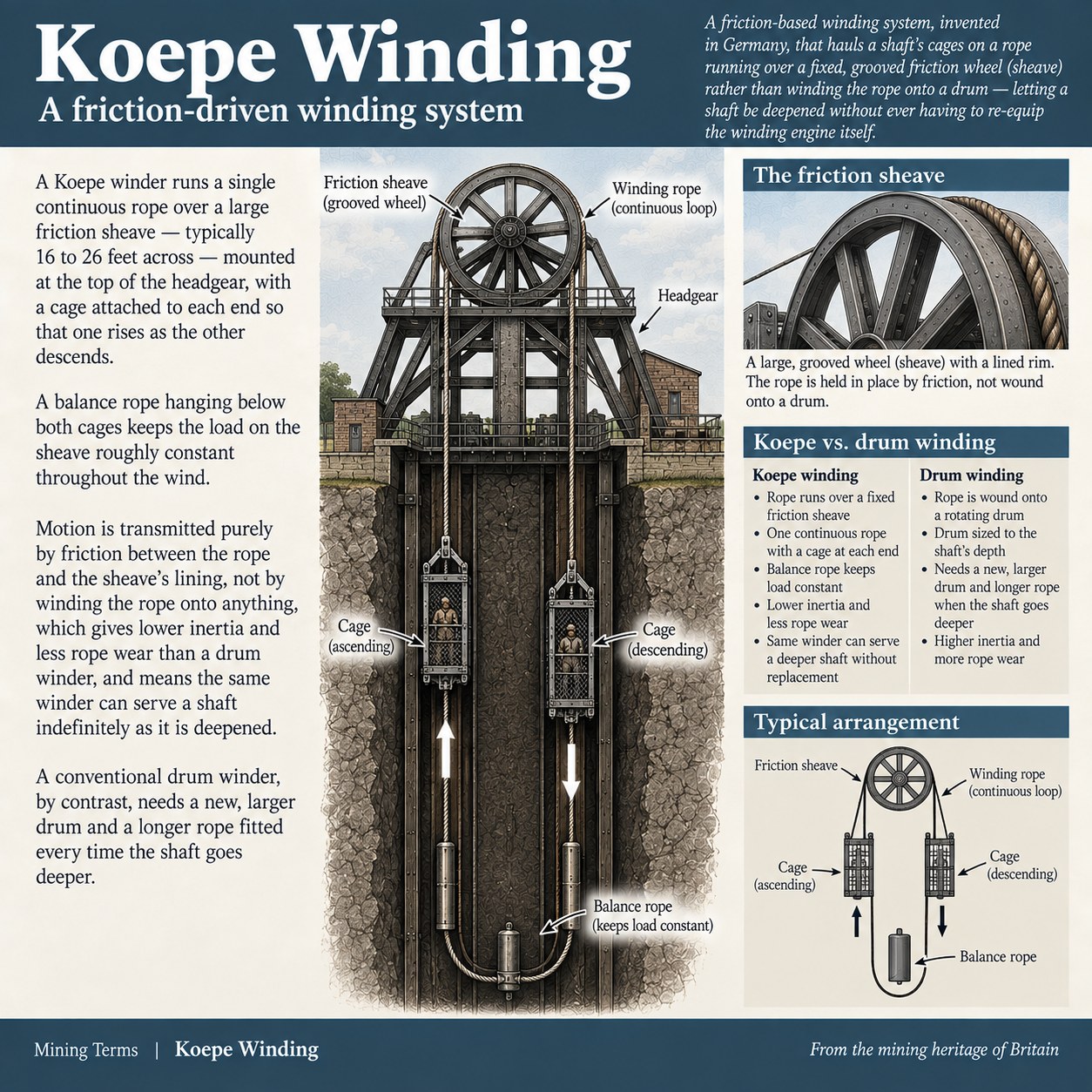
A friction-based winding system, invented in Germany, that hauls a shaft's cages on a rope running over a fixed, grooved friction wheel (sheave) rather than winding the rope onto a drum — letting a shaft be deepened without ever having to re-equip the winding engine itself.
Historical usage
Friedrich Koepe patented the system in Germany in 1873, and it was first installed at the Hannover colliery in Westphalia in 1877; it spread through the German and Dutch coalfields from the late 19th century onward, but saw only a handful of installations in Britain before the Second World War. It was the National Coal Board's major post-war reinvestment and restructuring programme, driving the industry to work ever-deeper seams, that finally made Koepe winding worth adopting more widely in England: Clipstone Colliery's 1953 headstocks, built to reach the deeper Low Main seam, are recognised as an early British example and, according to the Twentieth Century Society, appear to be the earliest such installation still standing in the country today. Later British coalfield developments, including the Selby Coalfield's Wistow mine, used descendants of the same friction-winding principle.
How it worked
Unlike a conventional drum winder, which spools the rope onto a rotating drum sized to the shaft's own depth, a Koepe winder runs a single continuous rope over a large friction sheave — typically 16 to 26 feet across — mounted at the top of the headgear, with a cage attached to each end so that one rises as the other descends; a balance rope hanging below both cages keeps the load on the sheave roughly constant throughout the wind. Motion is transmitted purely by friction between the rope and the sheave's lining, not by winding the rope onto anything, which gives the system markedly lower inertia and rope wear than a drum winder, and, critically, means the same winder can go on serving a shaft indefinitely as it is deepened — a drum winder, by contrast, needs a new, larger drum and a longer rope fitted every time the shaft goes deeper.
Why it was used
Koepe winding suited exactly the problem post-war British collieries increasingly faced: working seams at ever-greater depths without repeatedly rebuilding the winding plant itself each time a shaft was deepened, alongside genuine savings in wear, running cost and the sheer inertia the winding engine had to overcome on every cycle.
Risks & limitations
The system depends entirely on friction between the rope and the sheave lining rather than a mechanical wind-on connection, so that lining's condition, and the calculated balance between the loads on each side of the sheave, both mattered more directly to safe operation than in a conventional drum system; friction linings required regular renewal as they wore.
Regional variation
Widely used across German and Dutch coalfields from the late 19th century, Koepe winding remained rare in England until the post-nationalisation investment drive of the 1950s and 60s, and even then was installed at only a limited number of collieries.
Related terminology
Mines associated with this term
Included only where MineArchive's own research gives a reasonable evidential basis — not every mine where this might plausibly apply.
- Clipstone Colliery — Nottinghamshire (well documented example)
Clipstone's 1953 headstocks were built specifically to house Koepe friction winders, described in the record's own workings section, and are held by the Twentieth Century Society to be the earliest surviving example of the system in Britain. - Parkside Colliery — Lancashire (well documented example)
Named in this record’s summary: “…Worked six seams to depths of around 810 metres using modern Koepe winding towers and its own methane-recovery pipeline, it employed up to…”
Sources
- (primary) Headstocks and Powerhouse at the site of the former Clipstone Colliery — Historic England
- (secondary) Clipstone Colliery, Mansfield, Nottinghamshire — The Twentieth Century Society
- (secondary) Koepe winder — mindat.org glossary
Record created: 27 August 2026 · Last researched: 27 August 2026