 MineArchive
Clipstone Colliery
| Location | Clipstone, Nottinghamshire — 53.1630, -1.1100 (exact) |
|---|---|
| Commodity | Coal |
| Type | Coal |
| Worked | 1922–2003 |
| Operators | Bolsover Colliery Company (1922–?) |
Overview
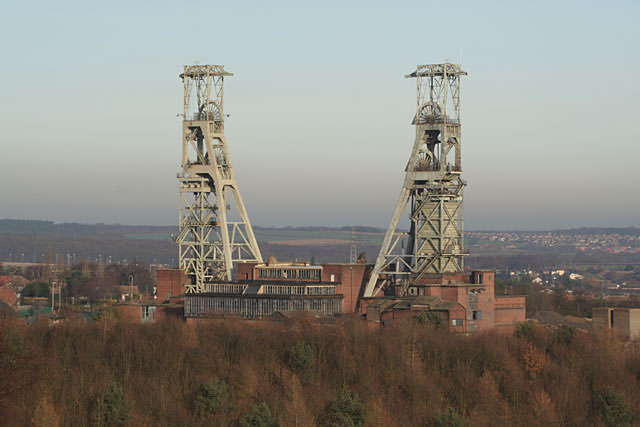
A Nottinghamshire colliery whose twin 1953 headstocks — the tallest in Europe when built — still stand as a listed landmark long after the pit itself closed.
History
Clipstone Colliery was sunk by the Bolsover Colliery Company to work the Top Hard coal seam east of Mansfield; sinking began in the early 1920s but was interrupted by the First World War, resuming in 1919, and the colliery was operational by 1922. It quickly became one of the most productive pits in Britain, raising 4,000 tons of coal a day by the 1940s — part of the Bolsover Mining Company's rise to become the third-largest coal enterprise of its kind in Britain before nationalisation.
In the post-war period the colliery was developed to reach the deeper Low Main seam, around 800 feet below the Top Hard, requiring new winding engines. Two headstocks, linked by a shared central powerhouse, were completed in 1953 to the designs of Manchester architects Young and Purves, built by Head Wrightson Colliery Engineering with winding engines from Markham and Company of Chesterfield; these were Koepe friction winders, a German-developed system well suited to deepening mines that only became widely used in England after post-nationalisation government investment made its advantages worthwhile. At completion, the headstocks were the tallest of their type in Europe, and Clipstone's shaft was one of the two deepest in the country. In the state-of-the-art colliery that resulted, employment peaked at over 1,300 men, and the pit produced almost a million tons of coal in 1986 alone.
British Coal closed and mothballed Clipstone in 1993; RJB Mining reopened it in April 1994, though restricted to the Yard seam at a depth of 957 yards (870m). The colliery finally closed in April 2003, after more than eighty years of production, and the wider site was subsequently cleared of all colliery structures and transport systems except the winders, headstocks and powerhouse, which survive as a Grade II listed landmark on the edge of Sherwood Forest.
Geology
Clipstone worked the Top Hard seam of the Nottinghamshire coalfield from its opening, and, from the 1950s, the deeper Low Main seam, around 800 feet further down; after a 1994 reopening, working was limited to the Yard seam at 957 yards (870m) depth.
Workings
Sinking began in the early 1920s but was interrupted by the First World War, resuming in 1919; the colliery was operational by 1922. Post-war development to reach the deeper Low Main seam required a pair of new winding engines, installed in twin headstocks linked by a shared central powerhouse and completed in 1953 to the designs of Manchester architects Young and Purves, built by Head Wrightson Colliery Engineering of Thornaby-on-Tees and Sheffield, with winding engines from Markham and Company of Chesterfield. These were Koepe winders, a friction-winding system developed in Germany in the 1870s and well suited to deep mines since, unlike the drum winders used at most British collieries, they did not require a shaft to be closed and re-equipped with a new drum and longer rope each time it was deepened; Koepe winding was little used in England before the post-war, post-nationalisation investment drive made its advantages worthwhile. The complex served two shafts, the No.1 Service Shaft to the north for staff and materials and the No.2 Winding Shaft to the south for raising coal. At completion the headstocks, with their 24-foot-diameter twin winding sheaves mounted in an 'under and over' arrangement, were the tallest of their type in Europe, and Clipstone's shaft was one of the two deepest in the country.
Closure
British Coal closed and mothballed Clipstone in 1993; RJB Mining reopened it in April 1994, but on a reduced basis, restricted to the Yard seam at 957 yards depth. The colliery finally closed in April 2003, after which the site was cleared of all colliery structures and transport systems except the winders, headstocks and powerhouse.
What remains
The headstocks and powerhouse were listed Grade II in April 2000, three years before the colliery's own closure, recognised by Historic England as the most visible surviving evidence of the post-war, post-nationalisation pit modernisation programme; the complex remains structurally complete, with much of its original winding plant and machinery still in place. The wider site was cleared of all other colliery structures and transport systems after 2003 closure.
The twin 1953 headstocks and their connecting powerhouse, now preserved as listed buildings.
Related mines
- Bolsover Colliery — Both were Bolsover Colliery Company pits: the company took the Clipstone lease in 1922, and it was at Clipstone in 1944 that it demonstrated the Meco-Moore cutter-loader whose successor, the Gloster Getter, made the Bolsover System possible.
Nearby mines
- Mansfield Colliery — 1.9 miles (3.1 km) SW
- Rufford Colliery — 2.1 miles (3.3 km) S
- Thoresby Colliery — 3.3 miles (5.3 km) NE
- Sherwood Colliery — 3.6 miles (5.9 km) W
- Bilsthorpe Colliery — 3.9 miles (6.3 km) E
Straight-line distance, within 9 miles (15 km). Show on the map.
Recorded claims
Individual factual claims, each attached to the source(s) that support it below. Where sources disagree, both are kept.
- Clipstone Colliery was sunk by the Bolsover Colliery Company to exploit the Top Hard coal seam, opening in 1922. 1
- The colliery's twin headstocks and connecting powerhouse were completed in 1953 to designs by Young and Purves of Manchester, built by Head Wrightson Colliery Engineering with Markham and Company winding engines, and were the tallest headstocks in Europe at the time of completion. 2,3
- Clipstone Colliery closed in 2003. 1
- Sinking of Clipstone's pit shaft began in the early 1920s but was interrupted by the First World War, resuming only in 1919; the colliery was operational by 1922. 3
- The 1953 headstocks were equipped with Koepe friction winders, a German-developed system particularly suited to deep mines since it did not require a shaft to be closed and re-equipped each time it was deepened, unlike the drum winders used at most British collieries; Koepe winding only became widely used in England after post-nationalisation government investment. 3
- Employment at Clipstone peaked at over 1,300 men, and the colliery produced almost a million tons of coal in 1986 alone. 3
- British Coal closed and mothballed Clipstone in 1993; RJB Mining reopened it in April 1994, restricted to the Yard seam at a depth of 957 yards (870m). 4
- After the colliery's final closure in April 2003, the site was cleared of all colliery structures and transport systems except the winders, headstocks and powerhouse. 3
- Located at about 53.163 N, 1.110 W. 4
Sources
- (secondary) Clipstone Colliery's Centenary Year — Nottinghamshire Mining Museum
- (secondary) Clipstone Colliery, Mansfield, Nottinghamshire — The Twentieth Century Society
- (primary) Headstocks and Powerhouse at the site of the former Clipstone Colliery — Historic England
- (secondary) Clipstone Colliery — Wikipedia
Record created: 21 August 2026 · Last researched: 27 August 2026