 MineArchive
Bolsover Colliery
| Location | Bolsover, north-east Derbyshire — 53.2283, -1.3100 (approximate) |
|---|---|
| Commodity | Coal |
| Type | Coal |
| Worked | 1891–1993 |
| Maximum depth | 365 yards to the Top Hard seam |
| Operators | Bolsover Colliery Company (1890–1947), National Coal Board (1947–1993) |
Overview
The first and founding colliery of the Bolsover Colliery Company, sunk from June 1890 and striking the Top Hard coal in September 1891 at 365 yards. Around it the company built New Bolsover, a model village with schools, an institute and a co-operative store, which set the pattern for colliery villages elsewhere. The company went on to sink Creswell, Mansfield, Rufford, Clipstone and Thoresby, and by 1933 employed over 9,000 men. Bolsover itself gave its name to a system of continuous longwall mining developed after nationalisation, and worked until May 1993.
History
In 1888 Emerson Muschamp Bainbridge, previously a colliery manager in the Sheffield area, acquired leases of the coal beneath the Duke of Portland’s estate at Creswell and Bolsover, and promoted the Bolsover Colliery Co. Ltd with John Plowright Houfton as general manager. The capital was fully subscribed by the beginning of 1890, sinking began in June that year, and the Top Hard coal was struck in September 1891 at 365 yards.
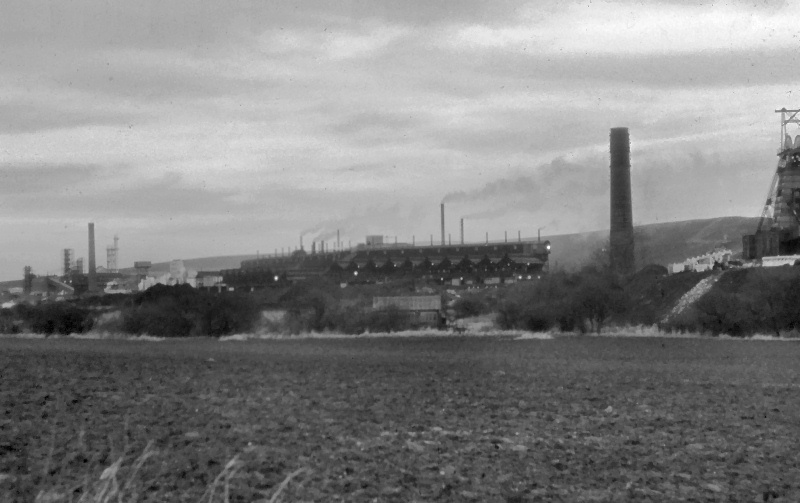
The colliery stood north of Chesterfield Road just east of the river Doe Lea, with spoil tips and a brickworks south of the road, and further south the model village of New Bolsover, built between 1891 and 1895 with schools, an institute and a co-operative store. By 1895 output had reached 1,800 tons a day with about 850 men; by 1905 it was 2,850 tons a day, and 300,000 tons were exported from the pit the following year.
The company prospered where much of the Derbyshire coalfield did not, sinking Creswell in 1894-6 and Crown Farm at Mansfield Woodhouse from 1905, and taking leases at Rufford in 1913, Clipstone in 1922 and Thoresby in 1928; by 1923 it was raising 11,000 tons a day, and by 1933 its mines employed over 9,000 men. At Bolsover the workings were extended to the Waterloo and Deep Hard seams in the late 1920s, hand getting and pony haulage gave way to mechanised cutting and electric rope haulage by the early 1930s, pithead baths opened in 1935, a Coalite works was built beside the colliery in 1936 and an aerial ropeway to the tips in 1943.
After nationalisation the Gloster Getter — developed by W. V. Sheppard, formerly of the Bolsover Company — nearly doubled output per man-shift and made continuous longwall mining possible here; the technique became known as the Bolsover System and cut the cost of producing coal considerably. By the mid-1950s the pit was producing 10,000 tons a week with 1,000 men, though the easier seams were long worked out.
Geology
The Derbyshire coalfield. The Top Hard seam was struck at 365 yards in 1891; the Waterloo and Deep Hard seams were brought into work in the late 1920s. The company as a whole worked the Top Hard, Waterloo and High Hazel seams.
Workings
Three shafts. The headgear and winding engine at the original No. 1 shaft were removed in 1974; the winding engine at No. 2 was replaced by an electric winder in 1968, and skip winding was introduced at No. 3 in 1976. On the surface were a brickworks, spoil tips south of Chesterfield Road served by an aerial ropeway from 1943, pithead baths from 1935 and, from 1936, a Coalite works.
Closure
Decline set in after the dispute of 1984-5. Output was 650,000 tonnes in 1987 with 750 employed; three years later only 600 men including 150 contractors were working. In August 1992 British Coal announced that more than 450 miners would lose their jobs when Bolsover closed the following spring. Coal was last turned on 7 May 1993 — and early that year the remaining 350 men were said to be producing coal very cheaply and breaking output records again.
What remains
Some of the surface buildings were adapted into an industrial estate for small businesses after closure. The former Bolsover Colliery Company headquarters east of the pit, which became the NCB area office in 1947, was likewise converted into units for small businesses. The New Bolsover model village survives.
Adapted colliery surface buildings, now small business units, and the company’s former headquarters.
Redevelopment
An industrial estate for small businesses on part of the colliery surface.
Related mines
- Clipstone Colliery — Both were Bolsover Colliery Company pits: the company took the Clipstone lease in 1922, and it was at Clipstone in 1944 that it demonstrated the Meco-Moore cutter-loader whose successor, the Gloster Getter, made the Bolsover System possible.
- Creswell Colliery — Sunk by the same company two to five years after Bolsover, on leases of the Duke of Portland’s coal that Bainbridge acquired together in 1888, and given a larger model village on the New Bolsover pattern.
- Rufford Colliery — Both were Bolsover Colliery Company pits, Rufford taken on lease by the company in 1913 as it expanded out of Derbyshire into north Nottinghamshire.
Nearby mines
- Ramcroft Colliery — 1.8 miles (2.8 km) S
- Oxcroft Colliery — 1.9 miles (3.1 km) NE
- Arkwright Colliery — 2.0 miles (3.3 km) W
- Seymour Colliery — 2.3 miles (3.7 km) N
- Glapwell Colliery — 2.3 miles (3.8 km) S
Straight-line distance, within 9 miles (15 km). Show on the map.
Disasters & major incidents
-
Bolsover Colliery rope accident, 1892
1 August 1892 · Winding / Shaft Accident · 3 fatalities
Three colliers were killed at the new Bolsover Colliery on 1 August 1892 when a hemp rope broke as they were raising a wire conductor in the shaft.
Culture
- Bolsover Colliery Band (Music)
The colliery of New Bolsover whose company's band this was, formed three years after the colliery first raised coal.
Recorded claims
Individual factual claims, each attached to the source(s) that support it below. Where sources disagree, both are kept.
- Sinking began in June 1890 and the Top Hard coal was struck in September 1891 at a depth of 365 yards. 1
- A model village complete with schools, an institute and a co-operative store was built south of the colliery between 1891 and 1895, and became known as New Bolsover. 1
- By 1895 output had reached 1,800 tons a day with about 850 men employed; by 1905 the pit was raising 2,850 tons a day, and 300,000 tons were exported from it in 1906. 1
- The Bolsover Colliery Company also secured coal at Creswell in 1894, Mansfield in 1905, Rufford in 1913, Clipstone in 1922 and Thoresby in 1928. By 1933 its mines employed over 9,000 men raising 4.5 million tons a year from the Top Hard, Waterloo and High Hazel seams. 2
- After nationalisation the Gloster Getter, developed by W. V. Sheppard, formerly of the Bolsover Company, almost doubled output per man-shift and made continuous longwall mining possible at Bolsover. The technique pioneered here became known as the Bolsover System. 1
- Employment fell from 750 in 1987 to 600 in 1990. British Coal announced in August 1992 that more than 450 miners would lose their jobs, and coal was last turned on 7 May 1993. 1
Photographs & further reading
A full short history of the colliery from Bainbridge’s leases to the last coal in 1993, covering New Bolsover, the company’s expansion, mechanisation and the Bolsover System.
View sourceSources
- (secondary) Bolsover Colliery — Derbyshire Victoria County History
- (secondary) Bolsover Colliery Company — Wikipedia
Record created: 8 September 2026 · Last researched: 8 September 2026