 MineArchive
Thoresby Colliery
| Location | Edwinstowe, Sherwood Forest, Nottinghamshire — 53.1980, -1.0560 (approximate) |
|---|---|
| Commodity | Coal |
| Type | Coal |
| Worked | 1925-28 (sinking)–10 July 2015 |
| Maximum depth | 690m (2,260ft) from 1928; deepened by a further 109m in the 1950s |
| Operators | Bolsover Colliery Company (1925–1947), National Coal Board (1947–1994), RJB Mining / UK Coal (1994–2015) |
Overview
A record-breaking Sherwood Forest 'Dukeries' colliery, the first pit in the country built with electric winding and without its own chimney, which went on to set repeated European output records before closing in 2015 as the last working colliery in Nottinghamshire.
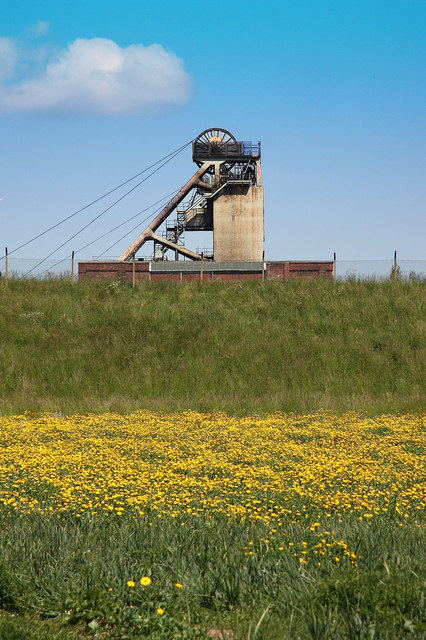
History
The Bolsover Colliery Company sank Thoresby Colliery in Sherwood Forest from 1925, a two-year process delayed by industrial disputes including the 1926 General Strike and complicated by an unusually large volume of water, managed with cementation; coal was finally reached on 25 April 1928. Thoresby was built as a showcase of contemporary mining technology: the first pit in the country with electric winding, and the first built without its own chimney, drawing power instead by overhead line from other Bolsover Company collieries nearby. A model village was built alongside it on land from Manor Farm and Villa Real Farm, around a mile from the pithead — the first hundred houses ready by the end of 1926 (92 occupied), a further 297 by 1928, though the General Strike forced the company to scale back its original plans, cutting a proposed swimming pool and church from the scheme.
The colliery worked several seams over its ninety-year life, including the Top Hard, Deep Soft and High Hazels (the last ceasing in 1983), later gaining access to the Parkgate seam after the neighbouring Ollerton Colliery closed in 1994. Thoresby repeatedly broke production records: in 1951 it became the first mine under National Coal Board ownership to exceed a million tons of coal in a year, and in the late 1980s it set a series of European records, raising 61,718 tons in a week in 1986/87 and 64,453 tons in a week in July 1988, with a single day in September 1989 producing 91,040 tons from a workforce of 1,100 men; its peak year, 1988/89, saw 2,307,419 tons raised for a profit of £35 million. Ownership passed from the Bolsover Colliery Company to the National Coal Board on nationalisation in 1947, then to British Coal Corporation from 1987, and finally to RJB Mining (later UK Coal) after the industry's 1990s privatisation.
UK Coal announced Thoresby's closure in April 2014 after running into financial difficulty; the colliery closed on 10 July 2015, its workforce having fallen from around 1,500 in the early 1980s to 360 by the end, as the last working colliery in Nottinghamshire and the closure of a pit that had stood in Sherwood Forest for ninety years.
Geology
Thoresby's shafts, sunk to 690m in 1928 and deepened by a further 109m in the 1950s, worked the Top Hard, Deep Soft and High Hazels seams (the last ceasing production in 1983), later gaining access to the Parkgate seam once the neighbouring Ollerton Colliery closed in 1994.
Workings
As the first British colliery built with electric rather than steam winding, and the first built without its own chimney — power was instead supplied by overhead line from other Bolsover Company collieries — Thoresby was a showcase installation from the moment it opened; sinking itself had to overcome an unusually heavy inflow of water using cementation techniques.
Closure
UK Coal announced Thoresby's closure in April 2014 after the company ran into financial difficulty; the colliery closed on 10 July 2015, the last working colliery in Nottinghamshire, its workforce having fallen from around 1,500 in the early 1980s to 360 by closure.
What remains
The site has been cleared and is being redeveloped by the Harworth Group under a ten-year scheme known as Thoresby Vale, converting the former colliery into a residential estate at Edwinstowe with an associated country park, primary school and proposed doctors' surgery.
The colliery site has been cleared as part of its ongoing housing redevelopment; no original structures are known to survive on site.
Related mines
- Ollerton Colliery — Thoresby gained access to the Parkgate seam specifically after the neighbouring Ollerton Colliery closed in 1994.
Nearby mines
- Ollerton Colliery — 1.9 miles (3.0 km) E
- Clipstone Colliery — 3.3 miles (5.3 km) SW
- Welbeck Colliery — 3.7 miles (5.9 km) NW
- Bilsthorpe Colliery — 3.9 miles (6.3 km) S
- Rufford Colliery — 5.1 miles (8.1 km) SW
Straight-line distance, within 9 miles (15 km). Show on the map.
Culture
- Thoresby Colliery Band (Music)
The band was formed in 1948 under the auspices of Thoresby Colliery, and was the last in Britain with working deep miners until the pit closed in 2015.
Recorded claims
Individual factual claims, each attached to the source(s) that support it below. Where sources disagree, both are kept.
- Thoresby was sunk from 1925, delayed by industrial disputes and heavy water inflow managed by cementation, reaching coal on 25 April 1928; it was the first British pit built with electric winding and the first built without its own chimney, drawing power by overhead line from other Bolsover Company collieries. 1
- A model village was built on land from Manor Farm and Villa Real Farm about a mile from the pithead, the first hundred houses ready by the end of 1926 and a further 297 by 1928, though the 1926 General Strike forced the company to cut a proposed swimming pool and church from its original plans. 1
- In 1951 Thoresby became the first National Coal Board mine to exceed a million tons of coal in a year; in the late 1980s it set European weekly output records of 61,718 tons (1986/87) and 64,453 tons (July 1988), with a single day in September 1989 raising 91,040 tons, and its peak year of 1988/89 saw 2,307,419 tons raised for a £35 million profit. 1
- The colliery worked the Top Hard, Deep Soft and High Hazels seams (the last ceasing in 1983), and gained access to the Parkgate seam after the neighbouring Ollerton Colliery closed in 1994. 2
- Ownership passed from the Bolsover Colliery Company (1925-47) to the National Coal Board (1947-87), British Coal Corporation (1987-93) and finally RJB Mining, later UK Coal, following the industry's 1990s privatisation. 2
- UK Coal announced Thoresby's closure in April 2014 after financial difficulty; the colliery closed on 10 July 2015 as the last working colliery in Nottinghamshire, its workforce having fallen from around 1,500 in the early 1980s to 360. 2,1
Sources
- (secondary) Coal Mining - Thoresby Colliery — Edwinstowe Historical Society
- (secondary) Thoresby Colliery — Wikipedia
Record created: 27 August 2026 · Last researched: 27 August 2026