 MineArchive
Garswood Hall Colliery
| Also known as | Edge Green Colliery, Garswood Hall No. 9 Colliery |
|---|---|
| Location | Edge Green Lane, Ashton-in-Makerfield, Greater Manchester |
| Commodity | Coal |
| Type | Coal |
| Worked | By 1902–1932 (No. 9 Pit) |
| Maximum depth | The No. 9 sinking reached the Ravin seam at 270 yards in 1902 and was being taken on to the Arley. |
| Operators | Garswood Hall Collieries Company (?–1932) |
Overview
The Garswood Hall Collieries Company's pits at Edge Green, Ashton-in-Makerfield, whose No. 9 pit exploded twice — in 1902 while still sinking through the gassy Ravin seam, killing 14, and in 1932, killing 27 — before it was abandoned and filled.
History
Garswood Hall Colliery was a group of pits at Ashton-in-Makerfield owned by the Garswood Hall Colliery Company, later the Garswood Hall Collieries Company Limited. Its No. 9 pit, off Edge Green Lane and also known as Edge Green Colliery, was being sunk to the Arley mine in 1902. On 2 April 1902, when the 14-foot 6-inch shaft had just reached the Ravin seam at 270 yards, gas from the seam rose up the shaft and was ignited — the evidence pointed to the shaft's electric light, which had been lowered and whose cable had been bared — killing fourteen and injuring fifteen (see Disasters, below). The shaft stayed full of gas for months; once cleared, gas from the Ravin was piped to the surface and sinking resumed. By 1932 the No. 9 colliery had three shafts and worked the Ravin and the Orrell Four Foot or Arley, reached through tunnels across an 80- to 90-yard fault, raising about 800 tons a day with some 420 people over three shifts. There were no overmen between the undermanager and the firemen. At about 3 a.m. on Saturday 12 November 1932 an explosion of firedamp in the Ravin seam killed 27 (see Disasters, below); the Chief Inspector's inquiry examined the safety lamps and the electric signalling bells. The colliery was then abandoned and its shaft filled, and it exploded again during the filling, throwing the cage into the headgear but injuring no one.
Geology
The Ravin seam, known to give off much firedamp, and the Orrell Four Foot or Arley, separated from it by an upthrow fault of some 80 to 90 yards.
Workings
In 1932 No. 9 Pit had three shafts — No. 9 downcast and coal-winding, No. 2 upcast with a Walker fan, and No. 3 disused — with four districts in the Ravin and Orrell Four Foot and electric signalling on the haulage roads.
Closure
No. 9 Pit was abandoned after the 1932 explosion and its shaft filled; closure dates for the group's other pits have not been found.
What remains
Unknown.
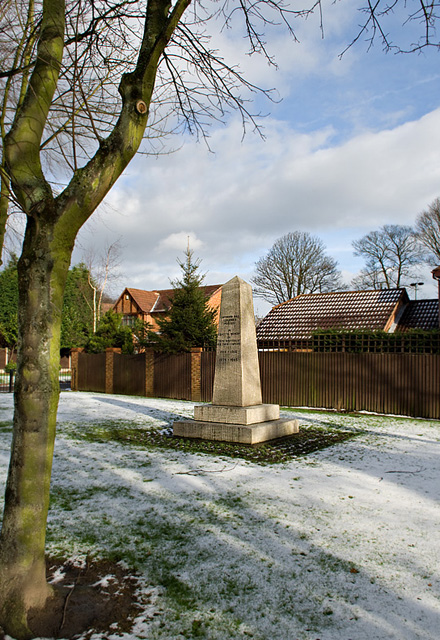
A war memorial to the colliery's employees stands in Ashton-in-Makerfield.
People
- Peter Bullough · manager, 1932 — Undermanager of No. 9 Colliery in 1932.
- James H. Edmondson · official, 1932 — Managing director of Garswood Hall Collieries Company Limited at the 1932 explosion.
- Joseph Naylor · victim, 1902 — Pit browman of Ashton, killed instantly at the shaft top in the 1902 sinking explosion.
What's uncertain
Points where sources disagree or the record could not be settled; both accounts are kept. All open questions in the archive.
- The inquiry report gives 27 deaths in the explosion of 12 November 1932; the Secretary for Mines told the Commons two days later that 25 had died. (disputed) 2,3,4
Recorded claims
Individual factual claims, each attached to the source(s) that support it below. Where sources disagree, both are kept.
- On 2 April 1902, as the No. 9 sinking reached the Ravin seam at 270 yards, gas in the shaft exploded, killing fourteen and injuring fifteen. 1
- Evidence at the 1902 inquest showed the shaft's electric light had been lowered from its safe place and its cable bared. 1
- In 1932 No. 9 Colliery, owned by Garswood Hall Collieries Company Limited, worked the Ravin and Orrell Four Foot seams and raised about 800 tons a day. 2,3
- The inquiry report gives 27 deaths in the explosion of 12 November 1932; the Secretary for Mines told the Commons two days later that 25 had died. (disputed) 2,3,4
- The colliery was abandoned after the 1932 explosion; while the shaft was being filled it exploded again, throwing the cage into the headgear. 2
- The national catalogue holds a Garswood Hall surface plan. 5
Photographs & further reading
The No. 9 Colliery, its districts and ventilation, and the 1932 explosion and inquiry.
View sourceThe explosion in the No. 9 sinking pit in 1902.
View sourceSources
- (secondary) Garswood Hall Colliery Explosion – Ashton-in-Makerfield 1902 — Northern Mine Research Society
- (secondary) Garswood Hall Colliery Explosion – Ashton-in-Makerfield 1932 — Northern Mine Research Society
- (primary) Garswood Hall No. 9 Colliery. Explosion, 12th November 1932 (inquiry report) — Durham Mining Museum
- (primary) Garswood Hall Colliery Disaster (HC Deb 14 November 1932 vol 270 c761) — Hansard
- (primary) BGS / Mining Remediation Authority mine plans catalogue: Garswood Hall (surface plan) — British Geological Survey
Record created: 17 September 2026 · Last researched: 17 September 2026