 MineArchive
Oakdale Colliery
| Location | Oakdale, Sirhowy Valley, Caerphilly — 51.6814, -3.1808 (exact) |
|---|---|
| Commodity | Coal |
| Type | Coal |
| Worked | From 1907 (sinking)–August 1989 |
| Maximum depth | South Pit 650-680 yards; North Pit 626 yards; Waterloo Pit 282-286 yards |
| Operators | Tredegar Iron and Coal Company (1907–?) |
Overview
A deep coal mine at Oakdale in the Sirhowy Valley, sunk 1907-11 by the Tredegar Iron and Coal Company as part of a planned model colliery village. It grew into one of the largest and longest-lived collieries in Gwent, employing well over 2,000 men through the interwar and postwar periods, before closing in August 1989 as the last deep mine working in the county. The site is now the Pen-y-Fan Industrial Estate.
History
In 1906 the Tredegar Iron and Coal Company leased 2,700 acres at Ty Mellyn, Oakdale, and set up Oakdale Colliery Company as a wholly-owned subsidiary, financed entirely from its own profits. Sinking began in 1907; early workings struck an unproductive 'rider' seam rather than the true workable coal, and a roof fall exposed the correct seam above, forcing a new pit bottom to be driven around 30 feet higher than originally planned in the North shaft. Sinking was completed and the separate Waterloo Pit sunk in 1911, when production began; winding engines for all the shafts were supplied by Markham and Company of Chesterfield.
The workforce grew rapidly, from 235 men during sinking in 1907 to 2,127 by 1915 and a reported 3,465 in 1928 — a figure that sits oddly against the more commonly cited peak of 2,235 men in 1938, when annual output reached around one million tons; the two figures are not reconciled. Pithead baths and a canteen, capacity 1,728 men, opened in 1936 and were extended to 2,590 men in 1941. By 1955 the colliery's NUM lodge, with 1,920 members, was the largest in the Merthyr and Rhymney District.
Waterloo Pit closed in 1970. Winding engines were converted from steam to electricity in 1962, and a new central washery was completed in 1972. From the late 1970s a £35 million modernisation scheme linked Oakdale's underground workings with the neighbouring Markham and Celynen North collieries, briefly making the combined complex the largest colliery in Gwent — but output fell as low as 226,000 tons a year by 1979-80 as the wider coalfield contracted. Oakdale closed in August 1989 with a workforce down to 873 men, described at the time as the last deep mine working in the County of Gwent. Demolition was complete by March 1990, and the 170-acre site was reclaimed in 1995 into industrial plateaux with woodland, ponds and grassland, now the Pen-y-Fan Industrial Estate.
Geology
Coal of the South Wales field: the early workings struck an unproductive 'rider' seam rather than the true coal, and a roof fall exposed the right seam above it.
Workings
Three shafts served the colliery: South Pit (downcast), 21ft diameter with 76ft lattice headgear, worked to the Upper Rhas Las seam at a depth reported as 650-680 yards; North Pit (upcast, ventilation), 83ft lattice headgear, 626 yards deep, at the time among the largest-diameter shafts in South Wales; and the separate Waterloo Pit, 55ft lattice headgear, 282-286 yards deep to the Brithdir seam. Seams worked also included the Meadow Vein, Old Coal and Yard seams, and at Waterloo Pit the Red Ash and Mynyddislwyn seams. Estimated capacity was around 2,500 tons a day when fully operational.
Closure
The Waterloo Pit closed in 1970, and the colliery itself followed after the 1970s modernisation that had linked it to Markham and Celynen North.
What remains
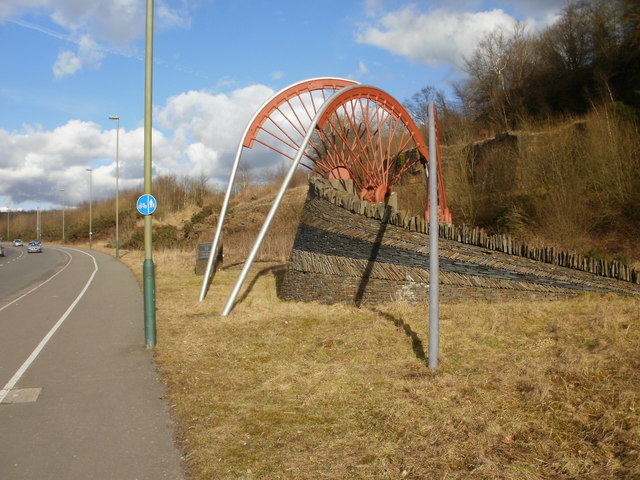
The colliery was fully demolished by March 1990 and the site reclaimed in 1995 into industrial plateaux, woodland, ponds and grassland, now the Pen-y-Fan Industrial Estate; no headgear or colliery buildings survive. A memorial in the village, depicting colliery winding wheels, is dedicated to the Oakdale miners.
Related mines
- Britannia Colliery, Pengam — Britannia's shafts were kept pumping water to protect Oakdale's workings until Oakdale closed in 1989.
- Celynen Colliery — Celynen North was linked underground with Oakdale in 1982, and its workforce transferred there on closure in 1985.
- Llanover Colliery — From about 1929 Llanover was kept as a pumping station to stop water from its workings flooding Oakdale.
- Markham Colliery, Sirhowy Valley — Both Tredegar Iron and Coal Company pits; joined underground in the Second World War, and from 1979 Markham's coal was raised at Oakdale.
- Pochin Colliery — Both were sunk and worked by the Tredegar Iron and Coal Company; Pochin was the largest of the company's South Wales collieries by 1935.
Nearby mines
- Islwyn Level — 0.3 miles (0.5 km) N
- Gwrhay Colliery — 0.5 miles (0.7 km) N
- Cwrt-y-bella Colliery — 0.7 miles (1.1 km) N
- Argoed Colliery — 0.9 miles (1.5 km) NW
- Rock Colliery, Blackwood — 1.0 miles (1.6 km) SW
Straight-line distance, within 9 miles (15 km). Show on the map.
What's uncertain
Points where sources disagree or the record could not be settled; both accounts are kept. All open questions in the archive.
- NMRS records a workforce of 3,465 in 1928, while the more widely cited peak figure is 2,235 men in 1938 with output around one million tons a year; the two figures disagree. (disputed) 2,1
Recorded claims
Individual factual claims, each attached to the source(s) that support it below. Where sources disagree, both are kept.
- Sinking began in 1907 under the Tredegar Iron and Coal Company; early workings struck an unproductive 'rider' seam, and a roof fall exposed the true workable seam above, forcing a new pit bottom roughly 30ft higher than planned in the North shaft. 1
- NMRS records a workforce of 3,465 in 1928, while the more widely cited peak figure is 2,235 men in 1938 with output around one million tons a year; the two figures disagree. (disputed) 2,1
- From the late 1970s a £35 million modernisation scheme linked Oakdale's underground workings with the neighbouring Markham and Celynen North collieries, briefly making the combined complex the largest colliery in Gwent. 2,1
- The colliery closed in August 1989 with a workforce of 873, described at the time as the last deep mine working in the County of Gwent; demolition was complete by March 1990. 1
- The BGS/Coal Authority mine plans catalogue holds a substantial set of records for Oakdale, including a 1940 Waterloo Oakdale abandonment plan and multiple 1980s spoil-heap plans for the Nant Gwrhay tip. 3
Sources
- (secondary) Oakdale Colliery — Northern Mine Research Society
- (secondary) Oakdale Colliery — Wikipedia
- (primary) Oakdale mine plan records — British Geological Survey / Coal Authority mine plans catalogue
Record created: 26 August 2026 · Last researched: 26 August 2026