 MineArchive
Abercwmboi Colliery
| Location | Abercwmboi (Cap Coch), between Aberaman and Mountain Ash, Rhondda Cynon Taf — 51.6867, -3.4046 (approximate) |
|---|---|
| Commodity | Coal |
| Type | Coal |
| Worked | 1851 (working by 1828 on one account)–1962 |
| Maximum depth | 1,027 ft 7 in (313 m) to the Four Feet; 342 yards (313 m) to the Gellideg |
| Operators | David Davis and Sons (1851–1881), Powell Duffryn Steam Coal Company (1881–1946), National Coal Board (1947–1962) |
Overview
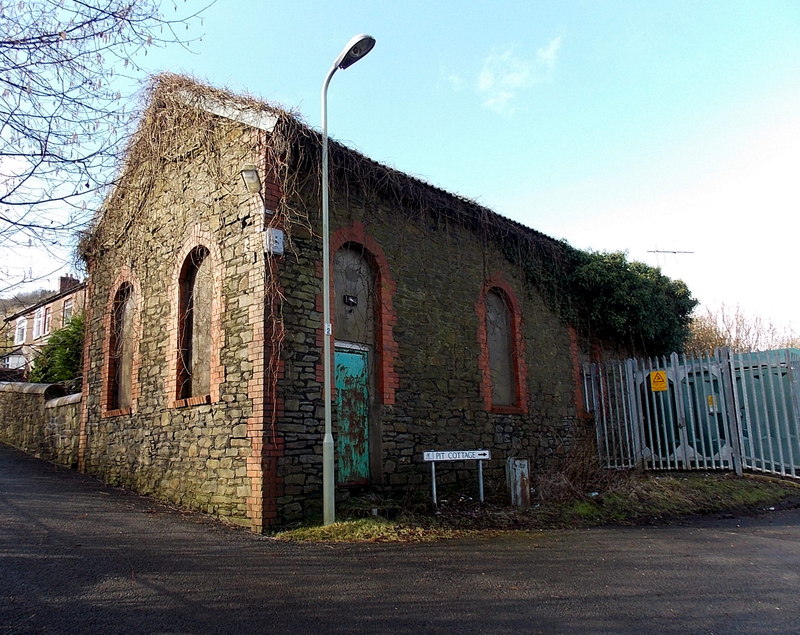
A Cynon valley steam-coal colliery at Abercwmboi, the village between Aberaman and Mountain Ash that was called Cap Coch until 1905, sunk by D. Davis and Sons in the 1850s to the Four Feet and Gellideg seams over a thousand feet down. It employed 466 men in 1870, the year an explosion at the ventilating furnace killed five of them (see Disasters, below), was sold to Powell Duffryn in 1881 as a pumping and ventilation pit, revived in the 1900s, merged with Aberaman Colliery in 1923 and closed by the National Coal Board in 1962. A single colliery building survives behind Bronallt Terrace.
History
An Abercwmboy colliery was working as early as 1828, when a Mr Davies ordered a steam engine from the Neath Abbey ironworks. The pit that built the village was sunk by Messrs D. Davies in 1851 to the Gellideg seam at 342 yards on Welsh Coal Mines' account, or in 1856 to the Four Feet at 1,027 feet 7 inches on Ray Lawrence's, the two depths being much the same; the Four Feet averaged 66 inches, and the Graig and the Clay seam, the latter yielding 28 inches of coal with 42 inches of fireclay, were also worked. The upcast, No. 1, was an elliptical shaft of 18 by 12 feet on the Four Feet and the downcast, No. 2, 16 by 12 feet on the Seven Feet, ventilated at first by furnace. It was here, in the days of the Aberdare Steam Collieries Association, that the first claim for indemnity against a strike was made, David Davis claiming £7,914 and being awarded £4,700. An explosion on 24 December 1866 killed three men, and another on 8 October 1870 killed five (see Disasters, below); that year the colliery employed 466 men and raised 65,135 tons. A 40-foot Waddle fan replaced the furnace in 1874, but the pit was not working in 1878 and in 1881 D. Davis and Sons sold it to the Powell Duffryn Steam Coal Company, which meant to use it only for pumping and ventilation. It was working again in 1888, raised 17,162 tons in 1889, stood idle through the mid-1890s, and had 53 men in 1907. Coal cutters were introduced in 1906, and under the manager D. R. Morgan the workforce grew from 122 in 1908 to 470 in 1910, working the Graig and Two Feet Nine; it fell to 249 by 1913 under Jacob Jayne, the Graig was abandoned in April 1914, and 320 to 326 men were employed in 1915-16. In 1923 the colliery was merged with Aberaman as one unit of 1,599 men on the Two Feet Nine, Yard, Seven Feet, Bute, Four Feet and Gellideg. In November 1926, during the lock-out, thirty Plymouth policemen escorting strike-breakers were attacked at Aberaman, and three Abercwmboi miners were sentenced to two months' hard labour. The unit had 447 men in 1945 and the National Coal Board closed it in 1962. The village's name changed from Cap Coch to Abercwmboi in 1905; the old school yard later fell into a mine shaft and the school was rebuilt in 1980-81.
Geology
Abercwmboi worked the Lower and Middle Coal Measures of the Cynon valley, where the Four Feet, Seven Feet, Nine Feet, Six Feet, Bute, Yard, Two Feet Nine and Gellideg seams lie stacked beneath the Graig and the Clay seam with its fireclay. The coals were classed as type 201B dry steam coal, non-caking, low in volatiles, ash and sulphur, and sold for ships, locomotives and power stations. The abandonment plans for the combined Abercwmboi and Middle Duffryn workings cover the Graig, Four Feet, Lower Six Feet, Nine Feet and Bute.
Geological setting: Coal Formation and Rank (historical documentary reference), Sedimentary Beds and Seams (well documented example)
Workings
Two shafts: the elliptical No. 1 upcast, 18 by 12 feet, to the Four Feet, and the No. 2 downcast, 16 by 12 feet, to the Seven Feet, with a ventilating furnace until a 40-foot Waddle fan was installed in 1874. The 1870 inquest describes north and south return airways, separation doors between intake and return, and a flue heading to the furnace. Coal cutters from 1906; worked with Aberaman from 1923 and with Middle Duffryn on the abandonment plans.
Closure
Merged with Aberaman Colliery as one unit in 1923 and closed by the National Coal Board in 1962; nothing is recorded of the closure decision.
What remains
A former colliery building survives behind Bronallt Terrace, photographed in February 2014; Wikipedia also notes levels behind Park View Terrace. The Phurnacite plant that later dominated the village has gone and its land is a wildlife haven.
One colliery building behind Bronallt Terrace; old levels behind Park View Terrace.
Nearby mines
- Middle Duffryn Colliery — 0.5 miles (0.8 km) N
- Lower Duffryn Colliery — 0.7 miles (1.1 km) NE
- Deep Duffryn Colliery — 1.0 miles (1.5 km) E
- Lletty Shenkin Colliery — 0.9 miles (1.5 km) N
- Aberaman Colliery — 1.0 miles (1.7 km) NW
Straight-line distance, within 9 miles (15 km). Show on the map.
Disasters & major incidents
-
Abercwmboi Colliery Explosion, 1866
24 December 1866 · Explosion · 3 fatalities
On 24 December 1866 an explosion of gas at Abercwmboi Colliery, in the Aberdare valley, killed three men: Richard Harris, William Lightfoot and Ebenezer Morris. -
Abercwmboi Colliery Explosion, 1870
8 October 1870 · Explosion · 5 fatalities
On 8 October 1870 an explosion at the flue of Abercwmboi Colliery, in the Aberdare valley, killed five men, among them the overman James Davies.
What's uncertain
Points where sources disagree or the record could not be settled; both accounts are kept. All open questions in the archive.
- Ray Lawrence gives the sinking as 1856 to 1,027 ft 7 in to the Four Feet seam, 66 inches thick, and notes an Abercwmboy colliery working in 1828 under a Mr Davies. (disputed) 1,2
Recorded claims
Individual factual claims, each attached to the source(s) that support it below. Where sources disagree, both are kept.
- Also known as Cap Coch Colliery, the pit was sunk by Messrs D. Davies in 1851 to the Gellideg seam at 342 yards, with furnace ventilation. 1
- Ray Lawrence gives the sinking as 1856 to 1,027 ft 7 in to the Four Feet seam, 66 inches thick, and notes an Abercwmboy colliery working in 1828 under a Mr Davies. (disputed) 1,2
- The upcast No. 1 was elliptical, 18 by 12 feet, on the Four Feet; the downcast No. 2, 16 by 12 feet, on the Seven Feet. 1,2
- The first claim for indemnity against a strike under the Aberdare Steam Collieries Association was made here: David Davis claimed £7,914 and was awarded £4,700. 1,2
- In 1870 the colliery employed 466 men and produced 65,135 tons. 1,2
- An explosion on 24 December 1866 killed three men; another on 8 October 1870 killed five. 1,3
- A 40-foot Waddle ventilating fan was installed in 1874. 1,2
- Not working in 1878, the colliery was sold in 1881 to the Powell Duffryn Steam Coal Company, which intended to use it only for pumping and ventilation; it was working again by 1888. 1,2
- The 1880 official list gives Abercwmboy, Aberdare, under D. Davis and Sons. 4
- Coal cutters were introduced in 1906; the workforce was 122 in 1908 under D. R. Morgan and 470 in 1910, working the Graig and Two Feet Nine, falling to 249 in 1913; the Graig was abandoned in April 1914. 1,2
- The colliery was merged with Aberaman in 1923; the combined unit employed 1,599 men that year on six seams and 447 in 1945. 1,2
- The National Coal Board closed the colliery in 1962. 1
- In November 1926 thirty Plymouth policemen escorting strike-breakers were attacked at Aberaman; three Abercwmboi miners received two months' hard labour. 2
- The village was named Capcoch until 1905, when it became Abercwmboi; the old school yard later fell into a mine shaft and the school was rebuilt in 1980-81. 5
- A former colliery building survives behind Bronallt Terrace, photographed in 2014. 5,6
Photographs & further reading
Sinking, owners, the 1866 and 1870 explosions with the names of the dead, manpower and closure, with Ray Lawrence's fuller account.
View sourceShafts, seams, year-by-year manpower, individual fatalities and the 1926 lock-out incident.
View sourceThe closing day of the inquest on the five men killed in October 1870, with the timberman's account of the night.
View sourceSources
- (secondary) Abercwmboi Colliery — Welsh Coal Mines
- (secondary) Abercwmboi Colliery — Northern Mine Research Society (Ray Lawrence)
- (primary) The colliery explosion at Abercwmboy, Aberdare: close of the inquiry (Western Mail, 28 October 1870) — The Western Mail, via Welsh Newspapers Online
- (secondary) List of coal mines UK 1880 — Coalmining History Resource Centre
- (secondary) Abercwmboi — Wikipedia
- (observational) Former colliery building in Abercwmboi (photograph, 22 February 2014) — Jaggery, Geograph Britain and Ireland, via Wikimedia Commons

Record created: 8 September 2026 · Last researched: 9 September 2026