 MineArchive
Coal Formation and Rank
| Also known as | Coalification, Coal Rank |
|---|---|
| Category | Formation Processes |
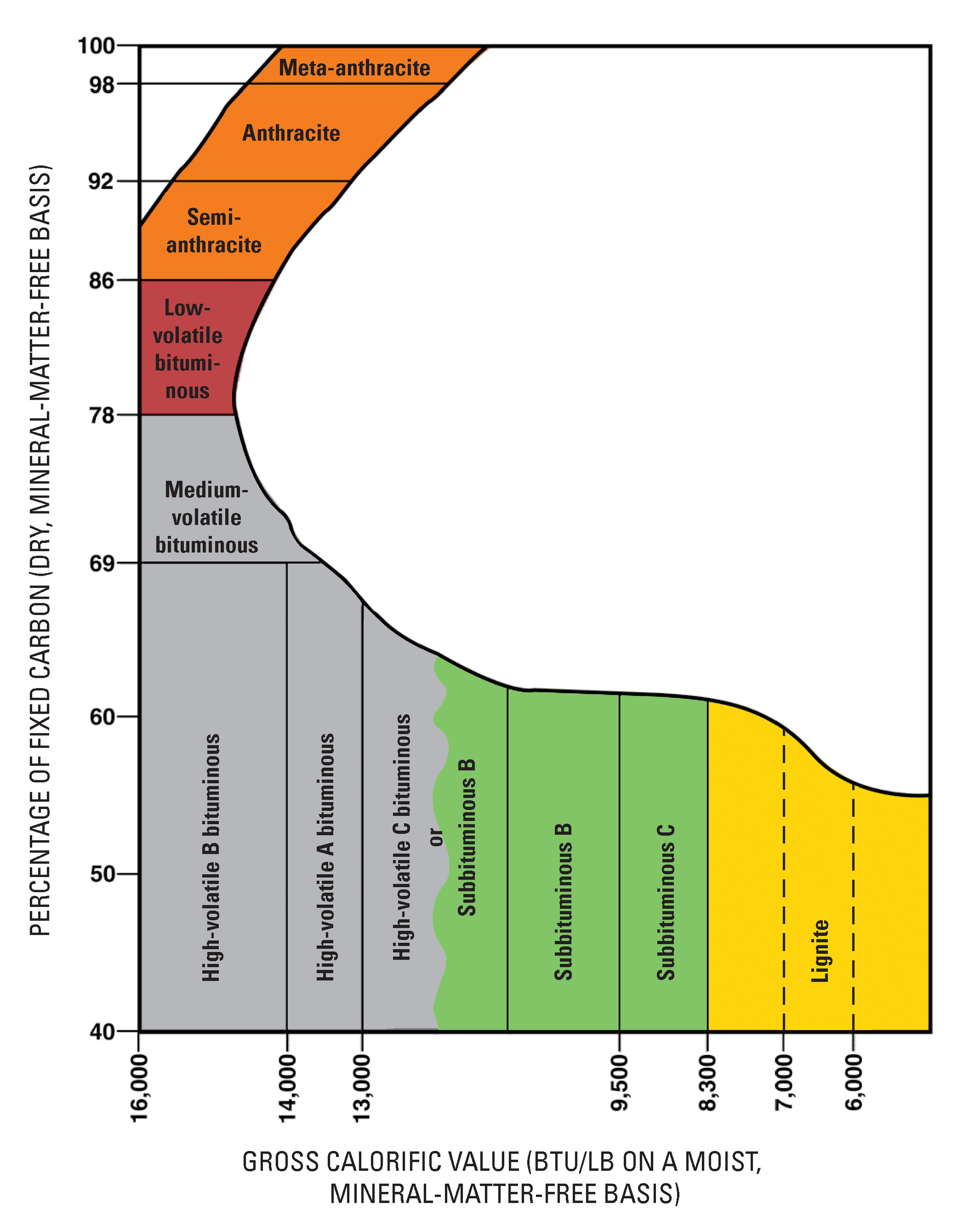
Coalification is the slow change of buried plant matter into coal, and rank is the measure of how far that change has gone: from peat through lignite and sub-bituminous coal to bituminous coal and, at the top, anthracite. With rising rank a coal becomes denser, drier, harder and richer in carbon. Rank decides what a coal is good for, and so what a colliery had to sell.
How it forms
Coal begins in wetlands where dead plants are kept from the air by mud or acidic water and build up as peat. When the peat is buried under later sediment, heat and pressure drive off water, carbon dioxide and methane, and the proportion of carbon rises. Temperature counts for much more than pressure or time: sub-bituminous coal can form at 35 to 80 °C, while anthracite needs at least 180 to 245 °C. About nine-tenths of all coal beds were laid down in the Carboniferous and Permian periods. Rank records the heat a seam once reached, not the depth at which it lies today.
Why minerals concentrate here
Rank usually rises with depth of burial, a rule set out by Carl Hilt in 1873, but it also changes sideways across a coalfield. South Wales shows both. At any one place the lower seams are of higher rank than the upper, and any one seam gains rank as it is followed north and west: bituminous coals along the southern and eastern outcrops, steam coals in the centre between the Taff and the Neath, anthracite along the north crop west of the Neath valley and on into the Gwendraeth valley and Pembrokeshire. The cause of that sideways change is not settled. It does not lie in the original plants. Shearing along a deep thrust, the load of a thick cover since eroded away, and an unusually high flow of heat while the measures were being buried have each been put forward. Rank also rises locally beside an igneous intrusion, where coal can be baked to a natural coke.
Typical shape of the deposit
Rank is a gradient, not a boundary: the kinds of coal grade into one another. In South Wales the bituminous coals are comparatively soft and friable, yield 20 to 40 per cent of volatile matter and carry 84 to 91 per cent carbon; they are the house, gas and coking coals. Anthracite is a hard stone coal with a metallic lustre, more than 93 per cent carbon and only 3 to 8 per cent volatile matter, burning hot without yellow flame or smoke and unsuitable for making coke. The steam coals stand between the two.
What this means for mining
Rank fixed a colliery's market before a ton was raised. Bituminous districts sold house coal, gas coal and coal for the coke ovens; the steam coals of the Rhondda fuelled the steamships of the nineteenth and early twentieth centuries; anthracite went for smokeless heating, and new anthracite collieries were still being developed in the west of the coalfield in the 1960s. The same seam could be a different product in different places: the Nine Feet gives steam coal in the central valleys and anthracite at Seven Sisters. Rank bears on safety as well. Methane is one of the gases given off as coal matures, and methane held in the seam is the firedamp of the pits.
Associated commodities
Anthracite (The highest rank, reached in the west and north-west of the South Wales coalfield.), Coal (Rank decides whether a coal is a house, gas, coking or steam coal.)
Related geology
Dykes and Sills, Sedimentary Beds and Seams
Related Mining Terms & Methods
Anthracite (The highest rank of coal.), Coke Oven (Bituminous coking coals make coke; anthracite is unsuitable for it.), Firedamp (Methane is given off as coal matures and is held in the seam.)
Diagrams
MineArchive examples
Included only where MineArchive's own research gives a reasonable evidential basis — not every mine where this geology might plausibly apply. Showing the 10 strongest examples of 14 linked mines.
- Cefn Coed Colliery — Neath Port Talbot (well documented example)
Worked anthracite, coal carried further through coalification than the steam and house coals to the east. - Glyncorrwg Colliery — Neath Port Talbot (well documented example)
The coal here reaches semi-anthracite and dry steam rank. - Kilgetty Colliery — Pembrokeshire (well documented example)
Pembrokeshire anthracite, the hardest and most carbon-rich rank, hard to light and slow-burning. - Nixon's Navigation Colliery — Rhondda Cynon Taf (historical documentary reference)
The coal was classed as dry steam coal, low in volatiles and usually non-caking. - Abercwmboi Colliery — Rhondda Cynon Taf (historical documentary reference)
Type 201B dry steam coal, non-caking and low in volatiles, sold for ships, locomotives and power stations. - Betws Colliery — Carmarthenshire (historical documentary reference)
Worked the low-volatile anthracite of the Amman Valley. - Fochriw Colliery — Caerphilly (historical documentary reference)
Produced a low-volatile coking steam coal. - Gwendraeth Colliery — Carmarthenshire (historical documentary reference)
Worked anthracite where the coal has been carried to the highest rank found in Britain. - Haig Colliery — Cumbria (historical documentary reference)
Produced high-volatile, strongly caking coal for iron making, gas and domestic fires. - Peckfield Colliery — West Yorkshire (historical documentary reference)
Westphalian Coal Measures yielding high-volatile bituminous coal.
See all 14 linked mines.
Sources
- (primary) British Regional Geology: South Wales — British Geological Survey
- (primary) Early Permian magmatism, Northern England — British Geological Survey (Earthwise)
- (primary) What are the different types of coal? — United States Geological Survey
- (secondary) Coal — Wikipedia
- (secondary) Hilt's law — Wikipedia
- (secondary) South Wales Coalfield — Wikipedia
- (secondary) The South Wales Coalfield: low grade metamorphism in a foreland basin setting — OSTI ETDEWEB (abstract of a journal article)
Record created: 1 October 2026 · Last researched: 1 October 2026