 MineArchive
Gwendraeth Colliery
| Also known as | Watney Pit, Gwendraeth Colliery (Watney's), Gwindraeth Colliery |
|---|---|
| Location | Pontyberem, Carmarthenshire — 51.7794, -4.1700 (approximate) |
| Commodity | Coal |
| Type | Coal |
| Worked | By 1852, possibly earlier–1870s |
| Maximum depth | 150 yards (about 137 m), to the Pumpquart seam |
| Operators | Daniel Watney |
Overview
Gwendraeth Colliery was an anthracite pit at Pontyberem in the Gwendraeth Valley, Carmarthenshire, owned by Daniel Watney and known locally as the Watney pit. It worked the Gras and Dugaled seams before the shaft was deepened to the Pumpquart seam at 150 yards. On the night of 10 May 1852 water broke into the workings and drowned 26 of the 27 men and boys underground, one of the worst inundations in the West Wales anthracite coalfield (see Disasters, below). The colliery reopened and was still listed as working in 1869, closing during the 1870s. It should not be confused with the later and larger Gwendraeth Colliery near Pontyates, several miles down the same valley, nor with the Gwendraeth Pit at Pontyberem Colliery, a separate shaft renamed Gwendraeth in 1907.
History
The colliery stood on the north-east side of Pontyberem, in the heart of the West Wales anthracite coalfield, and belonged to Daniel Watney. Its early workings took the Gras and Dugaled seams; the shaft was subsequently deepened to reach the Pumpquart seam at a depth of 150 yards. By 1852 it was a substantial concern, employing about a hundred men on the day shift and some 27 by night. Pontyberem already had a colliery of its own, sunk in 1845, and Pentremawr and Glynhebog followed later in the century, so Watney's pit was one of four principal mines the village depended on. The inundation of 10 May 1852 killed almost the entire night shift and stopped the colliery; recovery of the bodies took about eighteen months, and the London press reported a week after the event that not one of the 26 had yet been brought out. The pit was nevertheless brought back into work, and appears in a list of working collieries in 1869 before closing at some point in the 1870s. Coal mining continued around Pontyberem for another century at the neighbouring pits, but the Watney workings themselves were not reopened.
Geology
The colliery worked anthracite in the westernmost part of the South Wales Coalfield, where the Coal Measures have been folded and the coal carried to the highest rank found in Britain. Three named seams are recorded here — the Gras and Dugaled, worked first, and the Pumpquart, reached at 150 yards when the shaft was deepened. The Pumpquart, also worked at the neighbouring Pontyberem pits, was one of the principal seams of the Gwendraeth Valley. The valley floor carries superficial deposits above the Coal Measures, and the water that flooded the pit in 1852 was believed at the time to have come from an old working that had been holed rather than from the canal, though the source was never established.
Geological setting: Coal Formation and Rank (historical documentary reference), Sedimentary Beds and Seams (well documented example)
Workings
A shaft mine, wound by an engine at the surface with a cage for men and coal, in contrast to the slants and drifts worked at several neighbouring Gwendraeth Valley collieries. The shaft was deepened during the pit's working life from the shallow Gras and Dugaled seams to the Pumpquart at 150 yards. The survivor's account of 1852 describes men working at the bottom of the shaft beside an empty cage when the water arrived from the far end of the pit, which indicates workings driven a considerable distance from the shaft bottom.
Closure
The 1852 inundation stopped the colliery outright and it was some eighteen months before the last bodies were recovered. It was later reopened and was listed as working in 1869, but closed during the 1870s. No source gives a precise closure date or a stated reason for the final abandonment.
What remains
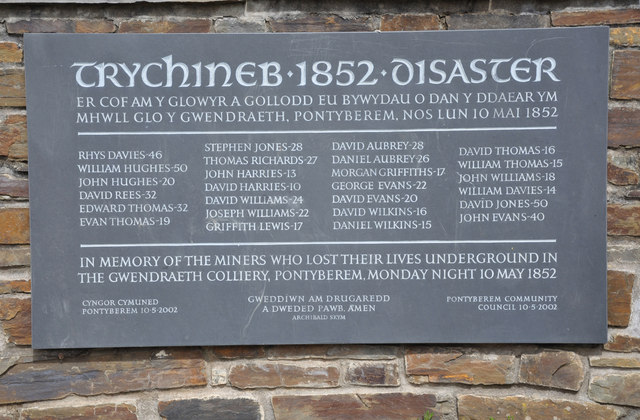
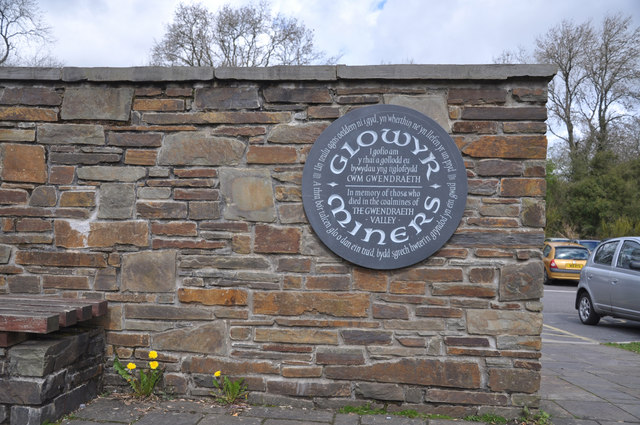
Nothing of the colliery survives above ground in recognisable form; the site lies within the built-up part of Pontyberem. What does survive is commemorative: a plaque in the village specifically marking the 1852 disaster, photographed in April 2009, and a separate memorial tablet to all those who died in the coal mines of the Gwendraeth Valley.
No structural remains are recorded. The 1852 memorial plaque stands at SN 504 111, essentially on the colliery's own recorded position at SN 504 112.
Related mines
- Pontyberem Colliery — Both were Gwendraeth valley anthracite collieries taken into Amalgamated Anthracite Collieries in the 1920s; Pontyberem is named on the Gwendraeth record.
Nearby mines
- Glynhebog Colliery — 1.0 miles (1.6 km) NE
- New Dynant Colliery — 1.8 miles (2.8 km) NE
- Ponthenry Colliery — 1.7 miles (2.8 km) SW
- Penllwyn Colliery — 1.9 miles (3.0 km) SE
- Cynheidre Colliery — 2.1 miles (3.4 km) S
Straight-line distance, within 9 miles (15 km). Show on the map.
Disasters & major incidents
-
Gwendraeth Colliery Inundation
10 May 1852 · Flooding / Inundation · 26 fatalities
At about ten o'clock on the night of Monday 10 May 1852, water burst into Daniel Watney's Gwendraeth Colliery at Pontyberem, Carmarthenshire, and drowned 26 of the 27 men and boys working the night shift. Only David Evans, at the shaft bottom when the water arrived, got out alive. The dead ranged in age from 10 to 50 and included several sets of brothers and at least one father and son. Recovery of the bodies took about eighteen months. The inquest returned accidental death by drowning from an inundation of unknown cause. -
Gwendraeth Colliery explosion, 1866
16 October 1866 · Explosion · 2 fatalities
An explosion of gas at Daniel Watney's Gwendraeth Colliery, Pontyberem, killed a collier and a thirteen-year-old boy on 16 October 1866.
What's uncertain
Points where sources disagree or the record could not be settled; both accounts are kept. All open questions in the archive.
- Twenty-six men and boys died in the inundation of 10 May 1852. Contemporary reporting puts 27 on the night shift with a single survivor, David Evans, which reconciles with the figure of 26 dead; some later summaries instead give 27 lives lost, apparently by counting the whole shift as fatalities. (disputed) 3,1,2
- The colliery reopened after the disaster and was listed as working in 1869, closing at some point during the 1870s. No source gives a precise closure date. (uncertain) 1
- The BGS mine-plans catalogue holds a Mining Remediation Authority abandonment plan titled 'Gwendraeth' (catalogue 9571, Carway Fawr, dated 1928); the catalogue gives no location and the plan's details do not clearly tie it to this working, so it may belong to another of the same name. (uncertain) 5
Recorded claims
Individual factual claims, each attached to the source(s) that support it below. Where sources disagree, both are kept.
- The colliery was owned by Daniel Watney and was known locally as the Watney pit. 1,2
- The pit initially worked the Gras and Dugaled seams; the shaft was later deepened to the Pumpquart seam at a depth of 150 yards. 1
- Twenty-six men and boys died in the inundation of 10 May 1852. Contemporary reporting puts 27 on the night shift with a single survivor, David Evans, which reconciles with the figure of 26 dead; some later summaries instead give 27 lives lost, apparently by counting the whole shift as fatalities. (disputed) 3,1,2
- Recovery of the bodies took about eighteen months. A week after the disaster the London Times reported that not one of the 26 had yet been recovered. 1,2
- The colliery reopened after the disaster and was listed as working in 1869, closing at some point during the 1870s. No source gives a precise closure date. (uncertain) 1
- A plaque in Pontyberem at SN 504 111 commemorates the 1852 disaster and records the ages of those lost, from 10 to 50; a separate tablet in the village commemorates all those who died in the coal mines of the Gwendraeth Valley. Both were photographed in April 2009. 4
- The BGS mine-plans catalogue holds a Mining Remediation Authority abandonment plan titled 'Gwendraeth' (catalogue 9571, Carway Fawr, dated 1928); the catalogue gives no location and the plan's details do not clearly tie it to this working, so it may belong to another of the same name. (uncertain) 5
Photographs & further reading
The fullest account of this pit: ownership, the Gras, Dugaled and Pumpquart seams, the named list of all 26 who died in 1852 with their ages and families, the inquest verdict, and the London Times report of 18 May 1852 reproduced in full.
View sourceMick Lobb's April 2009 photograph of the village plaque commemorating the 1852 Gwendraeth disaster, with the grid reference that places it effectively on the colliery site.
View sourceSources
- (secondary) Gwendraeth Colliery (Watney's), Pontyberem — Welsh Coal Mines
- (secondary) Pontyberem — Wikipedia
- (secondary) Welsh mining disasters: list of accidents with five or more fatalities — Welsh Coal Mines
- (observational) Commemorative plaque, Pontyberem (SN 504 111), photographed 7 April 2009 — Geograph Britain and Ireland
- (primary) BGS / Mining Remediation Authority mine plans: GWENDRAETH — British Geological Survey / Mining Remediation Authority
Record created: 3 September 2026 · Last researched: 4 September 2026