 MineArchive
Gwendraeth Colliery Inundation
At about ten o'clock on the night of Monday 10 May 1852, water burst into Daniel Watney's Gwendraeth Colliery at Pontyberem, Carmarthenshire, and drowned 26 of the 27 men and boys working the night shift. Only David Evans, at the shaft bottom when the water arrived, got out alive. The dead ranged in age from 10 to 50 and included several sets of brothers and at least one father and son. Recovery of the bodies took about eighteen months. The inquest returned accidental death by drowning from an inundation of unknown cause.
| Date | 10 May 1852 |
|---|---|
| Mine | Gwendraeth Colliery |
| Region | Carmarthenshire |
| Primary type | Flooding / Inundation |
| Associated types | Entrapment |
| Fatalities | 26 (Twenty-six of the 27 men and boys on the night shift died. The single survivor was David Evans. Some later summaries give 27 dead, apparently counting the whole shift.) |
| Context | During active mining (The pit was in normal working; the water broke in during the night shift.) |
Cause
Sudden inundation of water into the workings, believed to have come from an old working that was holed.
Contributing factors
Unrecorded or unknown old workings adjacent to the pit, and no means of testing for water ahead of the face. Press reports at the time explicitly denied the rumour that the water came from the nearby canal.
What happened
About a hundred men worked the colliery by day and some 27 by night. Shortly before the water came in, five of the night shift — three men and two boys, among them David Evans — were at the bottom of the shaft near an empty cage. They heard what Evans described as a fearful roar from the far end of the pit, followed by a rush of air that nearly overpowered them. All five jumped into the cage and gave the signal to wind. Before the engineer at the surface could raise them, a body of water arrived from the far workings with such speed that it dashed the cage out of position and the engine could not move it. Each man was then left to himself. Evans survived, by an escape he could afterwards recall only indistinctly; the other 26 underground were drowned. The Times observed that it was a fortunate accident of timing that the water came at night, since the loss of life would have been nearly four times greater on the day shift.
Rescue & recovery
There was effectively no rescue: the pit filled and the dead stayed in it. Recovery of the bodies took roughly eighteen months of pumping and clearing. A week after the disaster the London Times reported that, owing to the peculiar nature of the accident, not one of the 26 had yet been brought out.
Investigation & inquiry
The inquest was held at the New Inn, Pontyberem, before the coroner M. A. Bonville. It returned a verdict of accidental death by drowning, from an inundation of unknown cause. The origin of the water was never established. Contemporary reporting denied the circulating claim that the workings had been driven too close to the canal and that its water had broken in, and attributed the flood instead to an accumulation in an old working that had been tapped.
Legal & regulatory aftermath
No prosecution and no change in the law followed this disaster. It fell in the period between the first Coal Mines Inspection Act of 1850 and the fuller inspection and recording regime that followed later in the century, and the verdict of an unknown cause left nothing for a prosecution to attach to.
Memorials & commemoration
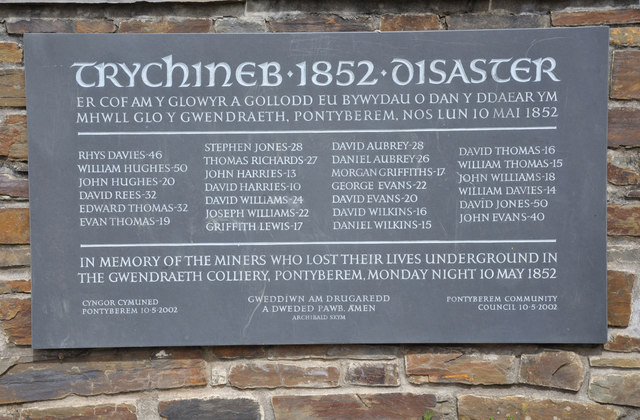
A plaque in Pontyberem, at SN 504 111 and so effectively on the colliery's own site, commemorates the disaster and records the ages of those lost, from 10 to 50. A separate tablet in the village commemorates all those who died in the coal mines of the Gwendraeth Valley. Both were photographed in April 2009.
What's uncertain
Points where sources disagree or the record could not be settled; both accounts are kept. All open questions in the archive.
- Twenty-six men and boys died. Contemporary reporting records 27 on the night shift with one survivor, David Evans; some later summaries give 27 dead. (disputed)
- The inquest recorded an inundation of unknown cause. Contemporary press denied that the water came from the canal and attributed it to an old working being holed. (uncertain)
- The two surviving name-lists disagree: Welsh Coal Mines gives Stephen Jones and Joseph Williams where the London Times of 18 May 1852 gives Stephen Phillips and Thomas Morris, and the two differ on several of the ages. (disputed)
Recorded claims
Individual factual claims, each attached to the source(s) that support it below. Where sources disagree, both are kept.
- Twenty-six men and boys died. Contemporary reporting records 27 on the night shift with one survivor, David Evans; some later summaries give 27 dead. (disputed)
- The inquest recorded an inundation of unknown cause. Contemporary press denied that the water came from the canal and attributed it to an old working being holed. (uncertain)
- The two surviving name-lists disagree: Welsh Coal Mines gives Stephen Jones and Joseph Williams where the London Times of 18 May 1852 gives Stephen Phillips and Thomas Morris, and the two differ on several of the ages. (disputed)
Related terminology
Mining terms this disaster is structurally linked to, with the nature of the relationship.
- Cage (contextual relationship)
Named 3 times in this record, first in the narrative: “…them David Evans — were at the bottom of the shaft near an empty cage. They heard what Evans described as a fearful roar from the far end…” - Coal (contextual relationship)
Named in this record’s memorials: “…tablet in the village commemorates all those who died in the coal mines of the Gwendraeth Valley. Both were photographed in April 2009.” - Inrush (contextual relationship)
Named 3 times in this record, first in the summary: “…months. The inquest returned accidental death by drowning from an inundation of unknown cause.” - Old Workings (contextual relationship)
Named in this record’s contributing factors: “Unrecorded or unknown old workings adjacent to the pit, and no means of testing for water ahead of the…” - Shaft (contextual relationship)
Named twice in this record, first in the summary: “…27 men and boys working the night shift. Only David Evans, at the shaft bottom when the water arrived, got out alive. The dead ranged in age…”
Photographs & further reading
This page doesn't try to reproduce everything — these are the best original sources found for this disaster.
Carries the full named list of the 26 dead with their ages and family circumstances, the inquest verdict, and the London Times report of 18 May 1852 reproduced in full including the survivor's own account.
View sourceSources
- (observational) Commemorative plaque, Pontyberem (SN 504 111), photographed 7 April 2009 — Geograph Britain and Ireland
- (secondary) Gwendraeth Colliery (Watney's), Pontyberem — Welsh Coal Mines
- (secondary) Pontyberem — Wikipedia
- (secondary) Welsh mining disasters: list of accidents with five or more fatalities — Welsh Coal Mines
Record created: 4 September 2026 · Last researched: 4 September 2026