 MineArchive
Woodhorn Colliery explosion
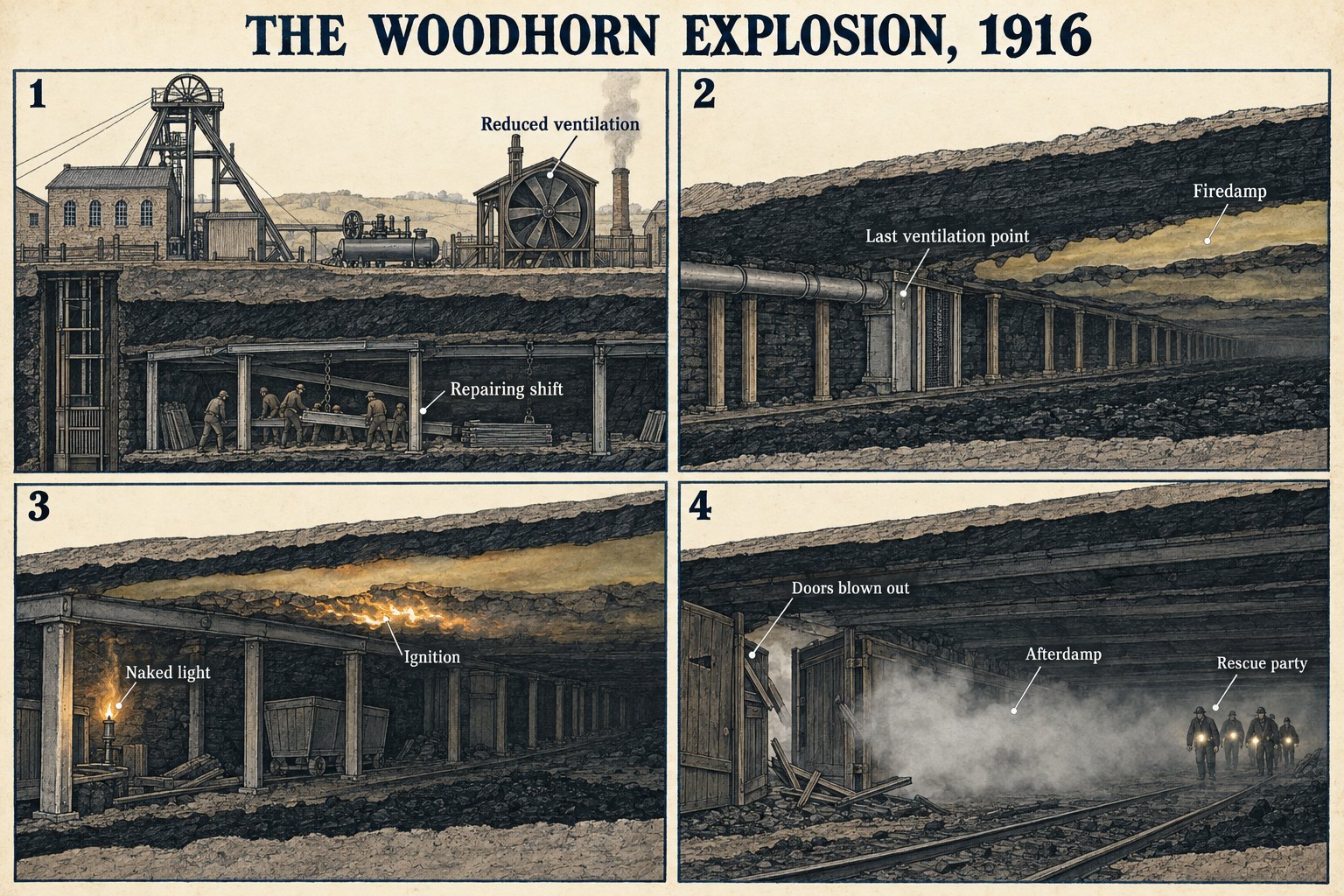
A repairing shift of thirteen men was setting steel roof girders in the Main Seam at Woodhorn when firedamp, accumulated over a weekend of reduced ventilation, was ignited by a naked light. All thirteen died.
| Date | 13 August 1916 |
|---|---|
| Mine | Woodhorn Colliery |
| Region | Northumberland |
| Primary type | Explosion |
| Associated types | Gas / Asphyxiation |
| Fatalities | 13 (Accounts differ on how many died at once: the Northumberland Archives account has eleven killed outright with two found alive in the drift below, and the Northern Mine Research Society has twelve dying outright or shortly after, with two found alive who never recovered consciousness. The 1923 memorial names thirteen men — eight deputies, three stonemen and two putters — which is the figure used here.) |
| Context | During active mining |
Cause
An accumulation of firedamp in the Main Seam, ignited by a naked light, in workings the ventilation had not cleared.
Contributing factors
It was a Sunday, and the colliery was running on weekend arrangements: the air compressor was shut down for routine maintenance and the Capell ventilating fan was turning at reduced speed, its engine on half steam pressure because the firemen were absent. Gas had accumulated at the face for something between 58 and 93 yards beyond the last ventilation point.
What happened
The shift went down around six in the morning — eight deputies and five other men, sent because setting steel girders as roof supports was work of a special kind that needed experienced men. The explosion itself was small, but it blew out ventilation doors, and the afterdamp that followed spread through the workings.
Rescue & recovery
The master-shifter and others reached the drift below the Main Seam workings about half an hour after the explosion and found two men still alive there; neither recovered consciousness.
Investigation & inquiry
The inquest jury found the men had been accidentally killed by an explosion of gas that had accumulated through want of sufficient ventilation and been ignited by a naked light. It criticised the management for laxity and recommended that shift reports be made in writing.
Legal & regulatory aftermath
Proceedings were brought against the temporary manager, Joseph John Hall, and the engine wright, Charles Bennett Howe, for alleged breaches of the Coal Mines Act. The charges were dismissed in January 1917, and an appeal by the Northumberland Miners' Association failed. The Ashington Coal Company afterwards pressed the bereaved families to give up their company houses, with the threat of withholding compensation.
Memorials & commemoration
A memorial by John Reid and William Henry Knowles, listing the thirteen men, was erected in Hirst Park, Ashington in 1923. It was moved to Woodhorn in 1991 and restored in 2002.
What's uncertain
Points where sources disagree or the record could not be settled; both accounts are kept. All open questions in the archive.
- The Ashington Coal Company afterwards pressed the bereaved families to leave their company houses, threatening to withhold compensation. (uncertain) 2
Recorded claims
Individual factual claims, each attached to the source(s) that support it below. Where sources disagree, both are kept.
- The inquest jury found the men were accidentally killed by an explosion of gas that had accumulated through want of sufficient ventilation and was ignited by a naked light, and criticised management laxity. 1,2
- The air compressor was shut down for weekend maintenance and the ventilating fan ran at reduced speed on half steam pressure because the firemen were absent. 1,2
- Charges against the temporary manager and the engine wright were dismissed in January 1917, and an appeal by the Northumberland Miners’ Association failed. 2
- The Ashington Coal Company afterwards pressed the bereaved families to leave their company houses, threatening to withhold compensation. (uncertain) 2
Related terminology
Mining terms this disaster is structurally linked to, with the nature of the relationship.
- Afterdamp (hazard involved)
The explosion itself was small; it was the afterdamp spreading through workings whose ventilation doors had been blown out that did the killing. - Deputy (contextual relationship)
Eight of the thirteen men were deputies, sent because setting steel roof girders was work of a special kind needing experienced men. - Naked Light (contextual relationship)
Named 3 times in this record, first in the summary: “…accumulated over a weekend of reduced ventilation, was ignited by a naked light. All thirteen died.” - Putter (contextual relationship)
Two of the thirteen men killed in the Main Seam were putters. - Return Airway (contributing factor)
Gas had accumulated 58 to 93 yards beyond the last ventilation point, with the fan at reduced speed over the weekend. - Safety Lamp (contributing factor)
The gas was ignited by a naked light, in a seam where the ventilation had not cleared it. - Stoneman (contextual relationship)
The shift that died was doing stone work — setting steel girders as roof supports — on a Sunday, when the roads were free to work on and the ventilation was reduced.
Sources
- (secondary) Woodhorn Colliery Explosion — Ashington — 1916 — Northern Mine Research Society
- (primary) The Woodhorn Explosion — Northumberland Archives
Record created: 25 August 2026 · Last researched: 25 August 2026