 MineArchive
Stoneman
| Also known as | Drifter (the same job under another name, especially where the roadway is being driven in stone), Stone man (spaced form, as it appears in some colliery records) |
|---|---|
| Category | Labour & Roles |
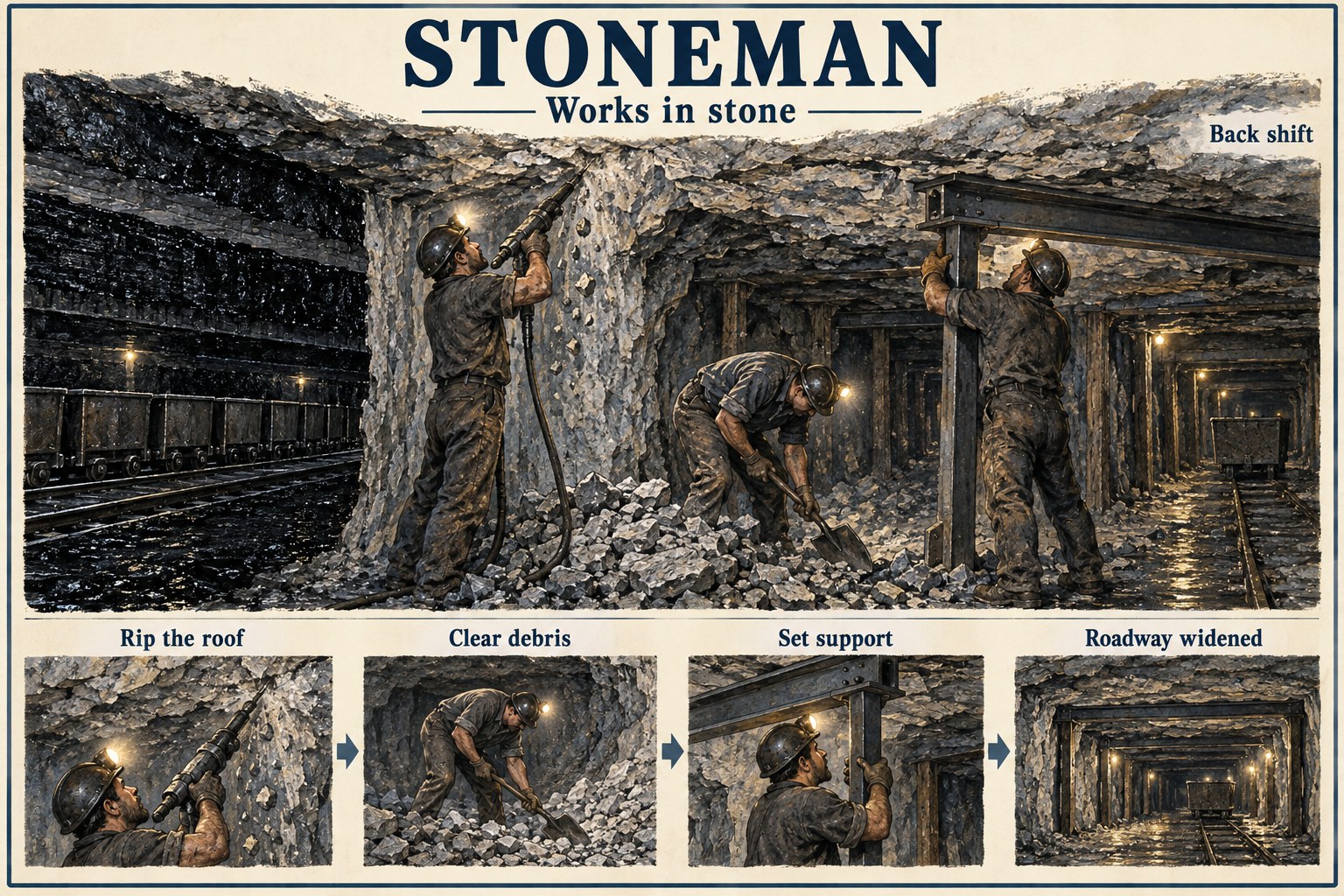
A man who worked in stone rather than coal: driving and repairing the roadways, taking down roof to keep them open, and setting the supports — the work that makes a colliery navigable rather than the work that wins its coal.
Historical usage
Every colliery is mostly roads, and stonemen made and maintained them. Glossaries treat stoneman and drifter as the same job — a man employed driving underground roadways in stone — and colliery records treat stonemen as a category of their own, counted separately from hewers and putters. The Seaham explosion of 1880 shows both the scale of the work and its timing: 146 stone-men and shifters went down at ten at night, and of the dead, ninety-nine were stonemen and workmen against twenty-eight hewers and twenty putters or drivers. At Woodhorn in 1916 three stonemen died alongside eight deputies on a Sunday repairing shift, setting steel girders as roof supports in the Main Seam.
How it worked
Stone work was fitted around coaling. The roads were ripped, rebuilt and supported on the back shift or at weekends, when the coal was not being drawn and the roadways were clear — which is why stonemen so often appear in the record as the men who were underground at night, or on a Sunday, when everyone else was not.
Why it was used
A face advances, and the road behind it has to advance with it: raised where the roof has come down, widened for haulage, supported before it closes. None of that produces a ton of coal, and all of it has to happen for coal to reach the shaft at all.
Risks & limitations
Stonemen worked in the parts of a mine that were being changed — newly ripped roof, ground not yet supported — which is dangerous in itself. The shift pattern added to it: the same weekend timing that made the roads free to work on also meant reduced ventilation, and at Woodhorn the fan was turning at half speed and the compressor was off when the gas the shift walked into ignited.
Regional variation
The word is used across the British coalfields, and the north-eastern records in this archive are simply where it turns up most often. 'Drifter' is the same job under another name, and a 'shifter' — in the north-east, a man who repaired and kept the roadways open — overlaps with it.
Related terminology
Deputy, Drift, Man-riding, Overman, Roof Fall, Shaft Sinking
Mines associated with this term
5 examples chosen from 7 linked records — the term page is not an index.
- Woodhorn Colliery — Northumberland (notable incident)
Three stonemen were among the thirteen men killed on the Sunday repairing shift in 1916. - Addison Colliery — Tyne and Wear (well documented example)
Named in this record’s history: “…Tilley and Towneley seams. On 29 July 1946 an explosion killed a stoneman and a sixteen-year-old driver. The colliery closed on 22 February…” - Bishop Middleham Colliery — County Durham (well documented example)
Named in this record’s history: “…a 24-year-old miner, Joseph Spence, who died four days later, and a stoneman, Martin Livett, had been killed by a fall of stone the previous…” - Dipton Colliery — County Durham (well documented example)
Named in this record’s history: “…museum's list of those killed holds 27 names. They include a stoneman killed by an explosion of firedamp in 1889, two hewers killed…” - Oatlands Colliery — Cumbria (well documented example)
Named in this record’s history: “…of sixty-six and John Pritt a hewer of twenty, and James Canavan, a stoneman of twenty-three, in an explosion of gas in December 1900. John…”
Disasters associated with this term
5 examples chosen from 14 linked records, most direct relationship first.
- Addison Colliery explosion, 1946 (contextual relationship)
Named twice in this record, first in the summary: “An explosion at Addison Colliery, Ryton, on 29 July 1946 killed a stoneman and a sixteen-year-old driver, months before the pit passed to the…” - Beamish Colliery explosion, 1891 (contextual relationship)
Named twice in this record, first in the narrative: “Early on 10 February 1891 the master stoneman John Gowland, 56, and the stoneman John Dick, 29, went into old…” - Dunston Colliery explosion, 1893 (contextual relationship)
Named 3 times in this record, first in the summary: “…explosion of firedamp. The putter George Fulthorpe and the foreman stoneman Robert Lowens were overcome by afterdamp as they ran for the shaft;…” - Harraton Colliery fall of stone, 1868 (contextual relationship)
Named twice in this record, first in the summary: “A fall of stone killed a stoneman and a rolleywayman at the Earl of Durham's Harraton Colliery, near…” - Newton Cap Colliery roof fall, 1897 (contextual relationship)
Named 3 times in this record, first in the summary: “…tons of stone fell, killing the under-manager, George Brown, and a stoneman, John George Nichol.”
Sources
- (secondary) Glossary of mining terms (D) — North Staffordshire Mining Group
- (secondary) Seaham Colliery Explosion — Seaham — 1880 — Northern Mine Research Society
- (secondary) Woodhorn Colliery Explosion — Ashington — 1916 — Northern Mine Research Society
Record created: 25 August 2026 · Last researched: 25 August 2026