 MineArchive
Thornley Colliery
| Location | Thornley, County Durham — 54.7375, -1.4425 (approximate) |
|---|---|
| Commodity | Coal |
| Type | Coal |
| Worked | 1835 (sinking)–1970 |
| Maximum depth | Unknown. |
| Operators | Thornley Coal Company (1835–?) |
Overview
A large Durham colliery sunk from 1835 by a partnership including the bare-knuckle boxer and MP John Gully, working the Harvey and Hutton seams for well over a century until closure in 1970. Its early years were marked by a firedamp explosion in 1841 that killed nine, most of them boys, after a trapper left a ventilation door open too long.
History
The sinking of Thornley — the third colliery to open in the Easington district — began in 1835, financed by a partnership consisting of Sir William Chaytor of Witton Castle, Thomas Wood (a former viewer for the Hetton Coal Company), John Burrell of Durham City, and John Gully, a former bare-knuckle prizefighter turned London publican, racehorse owner and Member of Parliament for Pontefract. Sinking took several years and coal production began around 1839. The colliery grew into a substantial employer in the newly built village of Thornley, working the Harvey and Hutton seams among others. On 5 August 1841, seven weeks after the first census to record personal detail, an explosion of firedamp in the north-west district of the Harvey Seam 'A' Pit killed nine workers — all but one of them under the age of eighteen. The Thornley Coal Company continued to work the colliery through the nineteenth century; it later passed, like most of the Durham coalfield, into the ownership of the National Coal Board on nationalisation in 1947. The pit finally closed in 1970 with the loss of over 900 jobs.
Geology
Coal of the Durham field: the Harvey and Hutton seams among others.
Workings
Worked the Harvey and Hutton seams, among others, via at least one numbered pit (the Harvey Seam 'A' Pit, scene of the 1841 explosion).
Closure
Closed in 1970 with the loss of over 900 jobs, part of the wider contraction of the Durham coalfield in that decade.
What remains
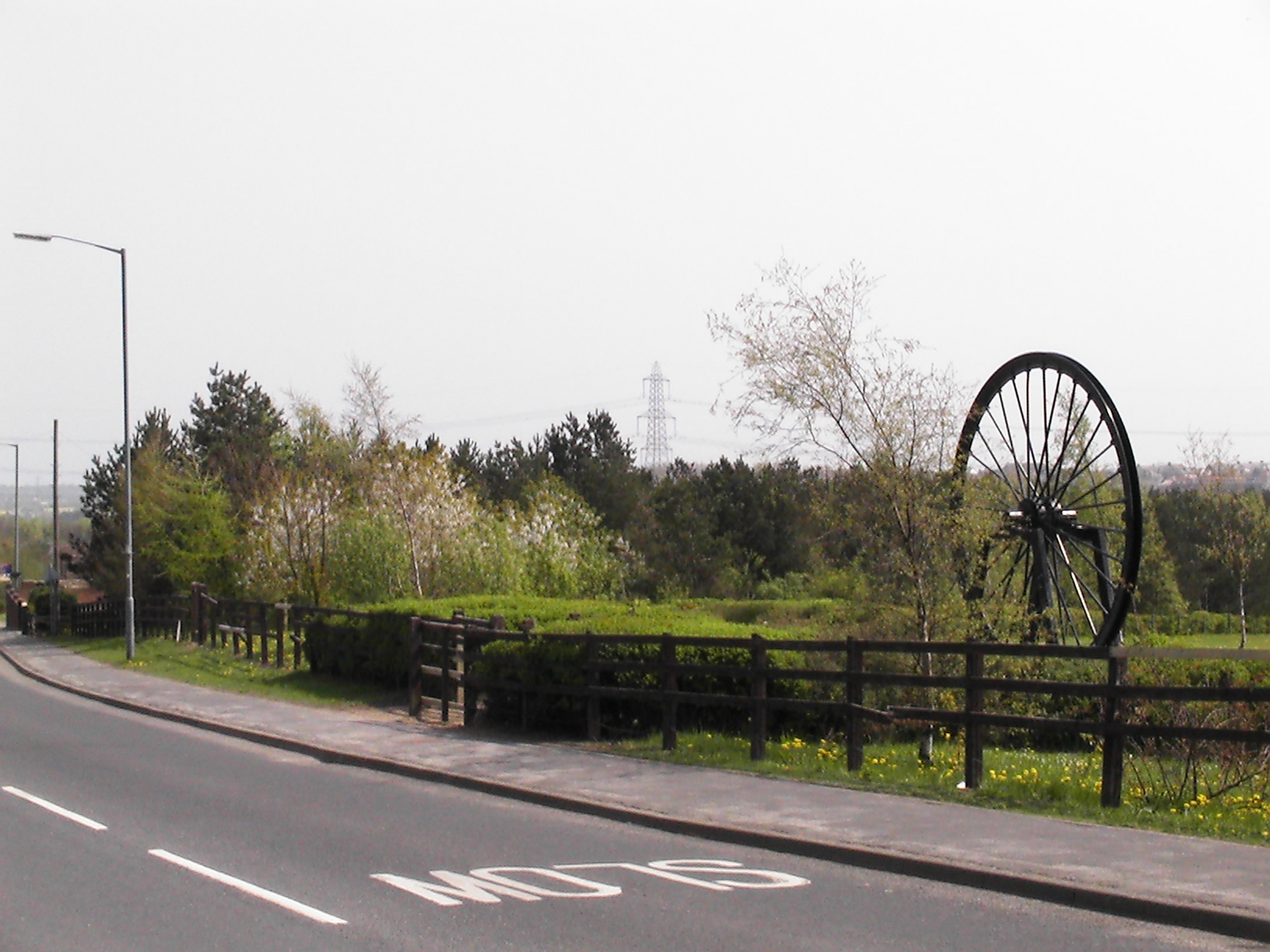
Little evidence of the once-extensive colliery plant and machinery survives at Thornley today. A pit wheel memorial was erected on the site in 1990, standing beside the wooded area where the colliery once stood.
A 1990 pit wheel memorial; the colliery buildings themselves have gone.
Related mines
- Wheatley Hill Colliery — Same owners and royalty: an 1870 holing in the Main Coal joined the two collieries to drain Thornley, and the 1871 inrush came from abandoned Thornley workings.
Nearby mines
- Cassop Colliery — 1.0 miles (1.6 km) W
- East Hetton Colliery — 1.1 miles (1.8 km) SW
- Deaf Hill Colliery — 1.6 miles (2.6 km) SE
- Crow Trees Colliery — 1.7 miles (2.7 km) W
- Trimdon Grange Colliery — 1.7 miles (2.7 km) S
Straight-line distance, within 9 miles (15 km). Show on the map.
Disasters & major incidents
-
Thornley Colliery Explosion, 1841
5 August 1841 · Explosion · 9 fatalities
A firedamp explosion in the Harvey Seam 'A' Pit at Thornley Colliery on 5 August 1841 killed nine workers, eight of them boys aged between 9 and 17, after gas accumulated when a young trapper left his ventilation door open too long. -
Thornley Colliery fall of stone, 1863
8 September 1863 · Collapse / Roof Fall · 2 fatalities
A fall of stone at the Thornley Coal Company's colliery in County Durham killed a shifter and a twelve-year-old trapper on 8 September 1863. -
Thornley Colliery explosion, 1865
23 August 1865 · Explosion · 3 fatalities
Firedamp exploded in the downcast shaft at Thornley Colliery, County Durham, on 23 August 1865, killing a rapperman and two shaftmen who were brothers.
Recorded claims
Individual factual claims, each attached to the source(s) that support it below. Where sources disagree, both are kept.
- The colliery was sunk from 1835 by a partnership including Sir William Chaytor, Thomas Wood, John Burrell, and the former prizefighter and MP John Gully; coal production began around 1839. 1
- Thornley Colliery closed in 1970, with the loss of over 900 jobs. 2,1
- An explosion of firedamp in the Harvey Seam 'A' Pit on 5 August 1841 killed nine workers, all but one under eighteen. 1,3
Sources
- (secondary) Thornley Colliery — Durham Records Online
- (secondary) Thornley, County Durham — Wikipedia
- (primary) Thornley Colliery Explosion — Thornley — 1841 — Northern Mine Research Society
Record created: 3 September 2026 · Last researched: 3 September 2026