 MineArchive
East Hetton Colliery
| Also known as | Kelloe Colliery |
|---|---|
| Location | Near Kelloe, 5½ miles south-east of Durham, County Durham — 54.7267, -1.4636 (approximate) |
| Commodity | Coal |
| Type | Coal |
| Worked | 1836–June 1983 |
| Maximum depth | The Harvey seam at about 135 fathoms (810 feet) in the 1890s. |
| Operators | East Hetton Coal Company (1836–1880), Walter Scott Ltd. (1880–1935), East Hetton Collieries Ltd. (1935–1947), National Coal Board (1947–1983) |
Overview
A Kelloe colliery sunk in 1836, bought by Walter Scott in 1880 and linked underground to Trimdon Grange, where in 1897 its Harvey seam workings holed into the flooded old Cassop pit and ten men drowned; it worked until 1983 and its site is now a public wood.
History
Sinking of the North Pit, then called Kelloe Colliery, began in 1836 and the shaft was taken down to the Harvey seam; a new pit was sunk to the Main Coal in 1856. The colliery was worked by the East Hetton Coal Company until August 1880, when it was bought by Walter Scott, who also owned Trimdon Grange and linked the two collieries underground that year. By the 1890s the Five Quarter and Main Coal seams were worked out, and the Low Main, Hutton and Harvey were worked at 89 to 135 fathoms. The colliery had 70 coke ovens and extensive firebrick works using clay from the pit, and employed 1,100, rising to 1,468 in 1896. At about 3.30 a.m. on 6 May 1897, when few men were below, water burst into longwall workings in the Harvey seam about a mile north of the shaft (see Disasters, below). The workings had holed into old workings of the Cassop colliery, for whose Harvey seam no plan could be found. Ten men were drowned or trapped. To stem the flow a nearby engine house was blown down and its rubble tipped with lime and clay into the old Cassop shaft; one man survived by climbing onto the woodwork of a haulage sheave. The holing itself was not reached until 18 August. Six more men died on 7 March 1921. The colliery passed to East Hetton Collieries Ltd in 1935 and the National Coal Board in 1947, and closed in June 1983.
Geology
The Five Quarter (worked out 1873), Main Coal (worked out 1887), Low Main, Hutton and Harvey seams, 2 feet 4 inches to 3 feet 6 inches thick at 89 to 135 fathoms; fireclay from the pit was used for bricks.
Workings
The North Pit, sunk to the Harvey in 1836, and a pit sunk to the Main Coal in 1856; longwall working in the Harvey, an underground link to Trimdon Grange from 1880, and 70 coke ovens and firebrick works at the surface.
Closure
Closed in June 1983, employing 907 as late as 1980.
What remains
The site is now a Durham County Council wood of about 60 hectares named East Hetton Colliery, Kelloe.
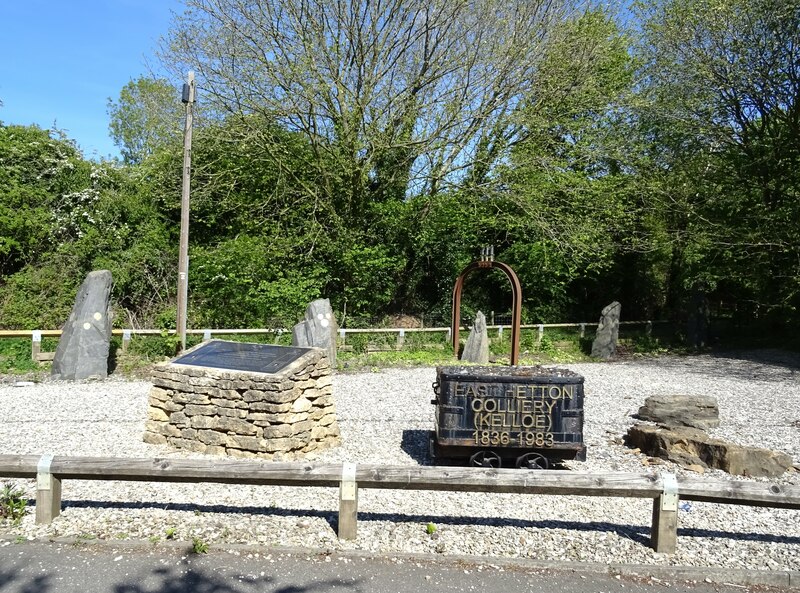
A memorial by the road, with standing stones, a plaque and a coal tub lettered 'East Hetton Colliery (Kelloe) 1836-1983'.
Related mines
- Trimdon Grange Colliery — Linked underground in 1880, both owned by Walter Scott; the man who survived the 1897 East Hetton flood had been the last brought out alive at Trimdon Grange in 1882.
Nearby mines
- Raisby Hill Quarry — 1.8 km S
- Thornley Colliery — 1.8 km NE
- Trimdon Grange Colliery — 2.6 km SE
- Deaf Hill Colliery — 3.5 km E
- Wheatley Hill Colliery — 4.6 km NE
Straight-line distance, within 15 km. Show on the map.
Recorded claims
Individual factual claims, each attached to the source(s) that support it below. Where sources disagree, both are kept.
- Sinking of the North Pit, Kelloe Colliery, began in 1836 and reached the Harvey seam; a new pit was sunk to the Main Coal in 1856. 1
- Walter Scott bought the colliery in 1880; it was linked underground with Trimdon Grange that year, and Scott owned both collieries. 1,2
- At about 3.30 a.m. on 6 May 1897 water from old Cassop workings burst into the Harvey seam longwall workings and ten men lost their lives. 1,3,4
- An engine house was blown down and its rubble, with lime and clay, tipped into the old Cassop shaft to stop the water. 4
- Plans of Cassop's Five Quarter and Main Coal were found but none of its Harvey seam, which had been thought barely worked. 3,4
- East Hetton closed in June 1983. 1
- The site is listed as East Hetton Colliery, Kelloe, a 59.71-hectare Durham County Council wood. 5
Photographs & further reading
Owners, seams, employment 1883-1980 and the colliery's disasters.
View sourceThe 1897 inundation from old Cassop workings and the rescue efforts.
View sourceSources
- (secondary) East Hetton Colliery (Durham Mining Museum) — Durham Mining Museum
- (secondary) East Hetton Colliery (When I was young in a pit village) — Trimdon Times
- (secondary) East Hetton Colliery Disaster Report (1897 inspector's annual report) (Durham Mining Museum) — Durham Mining Museum
- (secondary) East Hetton Colliery Inrush – East Hetton – 1897 — Northern Mine Research Society
- (observational) East Hetton Colliery, Kelloe (woodland listing) — Woodland Trust
Record created: 17 September 2026 · Last researched: 17 September 2026