 MineArchive
Deaf Hill Colliery
| Also known as | Trimdon Station Colliery |
|---|---|
| Location | Deaf Hill, near Trimdon, County Durham — 54.7239, -1.4100 (approximate) |
| Commodity | Coal |
| Type | Coal |
| Worked | 1877–1967 |
| Maximum depth | Unknown. |
| Operators | Trimdon Coal Company (1877–1947), National Coal Board (1947–1967) |
Overview
An East Durham colliery at Deaf Hill near Trimdon, opened by the Trimdon Coal Company in 1877 and worked through three pits until February 1967. Its coal changed with the market over ninety years — gas, household and steam before the First World War, coking and manufacturing between the wars, coking and gas at the end. No disaster of five or more deaths is recorded there.
History
The colliery was opened in 1877 by the Trimdon Coal Company and worked through three pits, the No. 3 being sunk in 1891-92. The Trimdon Coal Company held it until nationalisation in 1947, when the National Coal Board took over and the colliery raised 162,195 tons.
Its output returns track the changing market rather than any change underground: gas, household and steam coal steadily from 1894 to 1921; coking and manufacturing coal through the 1920s and 1930s with household coal added; gas, household and steam again in 1940; and coking coal, latterly with gas, through the Coal Board years. The colliery closed on 25 February 1967. In May 1934 a fall of stone at a conveyor face killed two men (see Disasters, below).
Geology
The colliery worked the Coal Measures of the East Durham coalfield, where the productive measures lie concealed beneath the Magnesian Limestone. The range of coal returned from the same colliery over its life — gas and household early, coking later — reflects both the seams worked and how the coal was classified for a changing market.
Workings
Three pits are recorded, the No. 3 sunk in 1891-92. The output returns give gas, household and steam coal from 1894 to 1921, coking and manufacturing coal through the interwar years, and coking and gas coal under the National Coal Board.
Closure
Closed on 25 February 1967, under the National Coal Board.
What remains
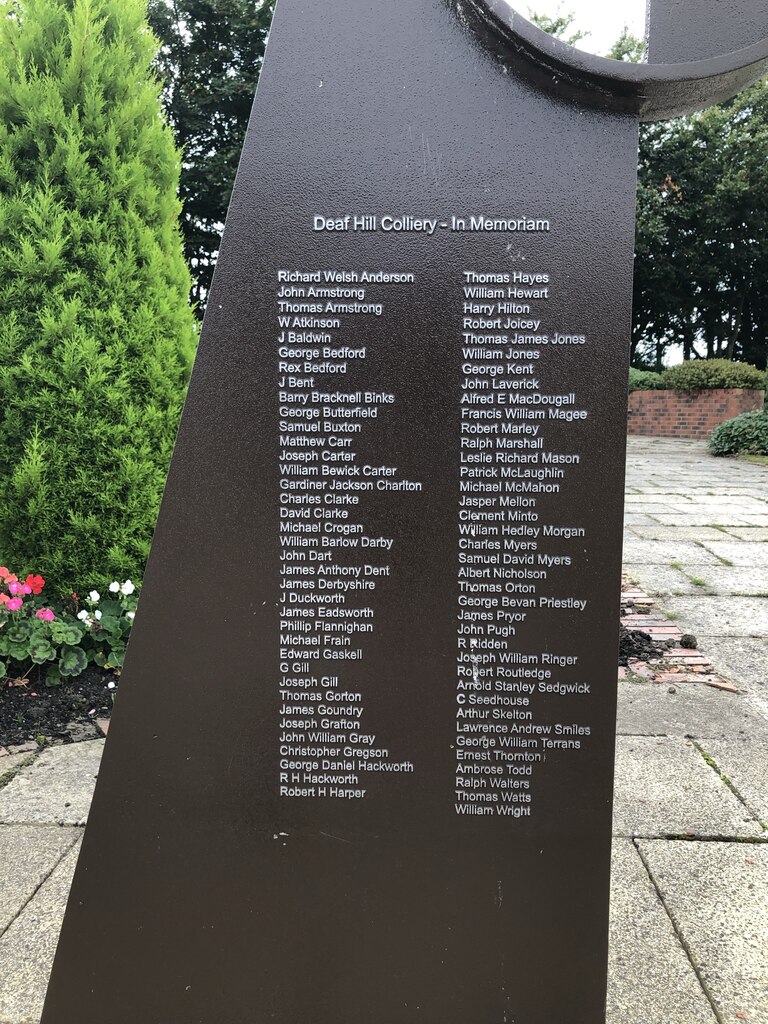
The colliery has been cleared. A memorial to Deaf Hill Colliery stands in the village.
A colliery memorial; no colliery structures are recorded as surviving.
Nearby mines
- Trimdon Colliery — 0.7 miles (1.1 km) SW
- Trimdon Grange Colliery — 1.0 miles (1.6 km) SW
- Wingate Grange Colliery — 1.2 miles (1.9 km) E
- Thornley Colliery — 1.6 miles (2.6 km) NW
- Wheatley Hill Colliery — 1.6 miles (2.6 km) N
Straight-line distance, within 9 miles (15 km). Show on the map.
Disasters & major incidents
-
Deaf Hill Colliery roof fall, 1897
12 February 1897 · Collapse / Roof Fall · 2 fatalities
Two hewers were killed by a fall of stone from between two slips in a longwall face at Deaf Hill Colliery, County Durham, on 12 February 1897. -
Deaf Hill Colliery roof fall, 1934
16 May 1934 · Collapse / Roof Fall · 2 fatalities
A large fall of shale roof over a pack at a longwall conveyor face in Deaf Hill Colliery, County Durham, killed two men sitting at the roadhead on 16 May 1934.
What's uncertain
Points where sources disagree or the record could not be settled; both accounts are kept. All open questions in the archive.
- Deaf Hill lies a short distance east of Trimdon Colliery and is alternatively known as Trimdon Station. Local tradition holds that the place was originally Death Hill, from a belief that children passed through the fork of a sycamore there would be cured of diphtheria; they died, and the name was changed as more people settled. (uncertain) 2
Recorded claims
Individual factual claims, each attached to the source(s) that support it below. Where sources disagree, both are kept.
- The colliery was opened in 1877 by the Trimdon Coal Company; its No. 3 pit was sunk in 1891-92. 1
- The returns give gas, household and steam coal from 1894 to 1921, coking and manufacturing coal through the 1920s and 1930s, and coking and gas coal under the National Coal Board. 1
- The colliery raised 162,195 tons in 1947, the year of nationalisation. 1
- The Durham Mining Museum records no disaster of five or more killed at Deaf Hill, though it lists 100 named fatalities across the colliery's working life. 1
- The colliery closed on 25 February 1967. 1
- Deaf Hill lies a short distance east of Trimdon Colliery and is alternatively known as Trimdon Station. Local tradition holds that the place was originally Death Hill, from a belief that children passed through the fork of a sycamore there would be cured of diphtheria; they died, and the name was changed as more people settled. (uncertain) 2
Photographs & further reading
The colliery's opening and closing dates, its three pits, the Trimdon Coal Company's ownership, and the annual output returns from 1873 to 1960.
View sourceSources
- (primary) Durham Mining Museum: Deaf Hill Colliery — Durham Mining Museum
- (secondary) Deaf Hill — Wikipedia
Record created: 3 September 2026 · Last researched: 3 September 2026