 MineArchive
Wheatley Hill Colliery
| Location | Wheatley Hill, township of Wingate, East Durham, County Durham — 54.7469, -1.4019 (approximate) |
|---|---|
| Commodity | Coal |
| Type | Coal |
| Worked | 1869–3 May 1968 |
| Maximum depth | The Busty seam at 195 fathoms (1,170 feet). |
| Operators | Original Hartlepool Collieries Company (1871–1885), Weardale Iron and Coal Company (1885–1947), National Coal Board (1947–1968) |
Overview
An East Durham colliery sunk in 1869 on the dip of the Thornley royalty, where an inrush from Thornley's flooded workings killed miners within months of opening, and which worked for almost exactly a century until 1968.
History
Boring on the Wheatley Hill estate to prove a new winning was under way by 1861, and Wheatley Hill Colliery was sunk from the surface to the Busty seam in 1869. It lay on the dip side of the royalty whose rise was worked by the Thornley collieries under the same owners, and in 1870 a holing was made in the Main Coal seam between Thornley and Wheatley Hill to drain water from Thornley. In January 1871 a place being driven in the colliery broke into abandoned, water-filled Thornley headways; the inspector afterwards recommended longer boreholes ahead and at the flanks wherever old plans were in doubt. Five men and boys died according to the Durham Mining Museum, while the Northern Mine Research Society names seven (see Disasters, below). The coroner's jury returned manslaughter verdicts against the chief viewer, William Spencer, the resident viewer, William Hay, and the overman, Thomas Watson, but the case failed at the Durham assizes. The Weardale Iron and Coal Company took the colliery over in 1885. By 1894 the Five Quarter and Main Coal seams were exhausted and the colliery worked the Low Main at 148 fathoms, the Hutton at 166, the Harvey at 190 and the Busty at 195, raising 350 tons a day. It grew rapidly, from 426 workers in 1894 to 1,485 in 1905 and a peak of 1,874 across its two pits in 1925, and passed to the National Coal Board in 1947. After almost exactly a hundred years of working it closed on 3 May 1968.
Geology
The Five Quarter and Main Coal (exhausted by 1894), Low Main (3 feet 1 inch at the shaft, at 148 fathoms), Hutton (3 feet 3 inches, 166 fathoms), Harvey (3 feet 10 inches, 190 fathoms) and Busty (4 feet 2 inches, 195 fathoms) seams, lying on the dip of the Thornley royalty.
Workings
Sunk to the Busty in 1869; No.1 and No.2 pits; connected to the Thornley workings by an 1870 holing in the Main Coal made to draw water off from Thornley.
Closure
Closed on 3 May 1968, almost exactly a century after it was sunk; its last seams, the Top and Bottom Hutton, were abandoned that year.
What remains
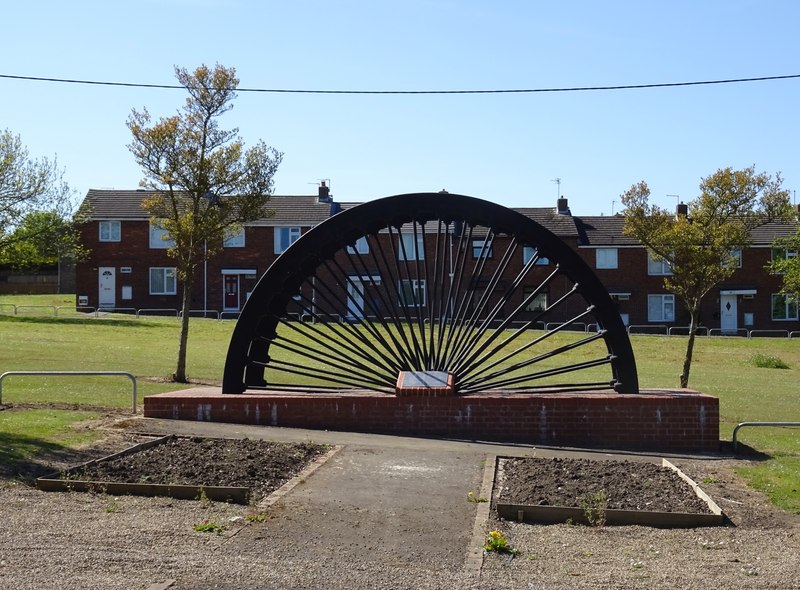
The colliery has gone; a pit-wheel memorial stands in the village.
A winding wheel set on a brick plinth as the Wheatley Hill Colliery memorial.
Related mines
- Thornley Colliery — Same owners and royalty: an 1870 holing in the Main Coal joined the two collieries to drain Thornley, and the 1871 inrush came from abandoned Thornley workings.
Nearby mines
- Wingate Grange Colliery — 2.4 km SE
- Deaf Hill Colliery — 2.6 km S
- Thornley Colliery — 2.8 km W
- Haswell Colliery — 3.2 km N
- Trimdon Grange Colliery — 3.9 km SW
Straight-line distance, within 15 km. Show on the map.
People
- William Hay · manager, 1871 — Resident viewer at the time of the 1871 inrush; charged with manslaughter, case thrown out at the assizes.
- William Spencer · agent, 1871 — Chief viewer at the time of the 1871 inrush; charged with manslaughter by the coroner's jury, case thrown out at the assizes.
What's uncertain
Points where sources disagree or the record could not be settled; both accounts are kept. All open questions in the archive.
- DMM gives five lives lost in the January 1871 inundation (dated 19 January); NMRS dates it 22 January and names seven dead. (disputed) 1,2
Recorded claims
Individual factual claims, each attached to the source(s) that support it below. Where sources disagree, both are kept.
- Wheatley Hill was sunk to the Busty seam in 1869, after boring from 1861; in 1870 a holing was made in the Main Coal between Thornley and Wheatley Hill collieries. 1
- In 1871 the Original Hartlepool Collieries Company owned the colliery; the inrush came from abandoned headways of the Thornley workings. 2
- DMM gives five lives lost in the January 1871 inundation (dated 19 January); NMRS dates it 22 January and names seven dead. (disputed) 1,2
- The coroner's jury found manslaughter against chief viewer William Spencer, resident viewer William Hay and overman Thomas Watson; the case was thrown out at the Durham assizes. 2
- In 1894 the Weardale Iron and Coal Company worked the Low Main, Hutton, Harvey and Busty seams for 350 tons a day; employment rose to 1,874 in 1925. 1
- Wheatley Hill closed on 3 May 1968; its Top and Bottom Hutton seams were abandoned in 1968. 1,3
Photographs & further reading
Owners, seams, employment by pit and a roll of men killed at the colliery.
View sourceThe inspector's findings on the 1871 inrush and the manslaughter case that followed.
View sourceSources
- (secondary) Wheatley Hill Colliery (Durham Mining Museum) — Durham Mining Museum
- (secondary) Wheatley Hill Colliery Inrush – Ferryhill – 1871 — Northern Mine Research Society
- (primary) BGS / Mining Remediation Authority mine plans catalogue: Wheatley Hill (Bottom Hutton, 1968) — British Geological Survey
Record created: 17 September 2026 · Last researched: 17 September 2026