 MineArchive
Wingate Grange Colliery
| Location | Wingate, East Durham, County Durham — 54.7289, -1.3819 (approximate) |
|---|---|
| Commodity | Coal |
| Type | Coal |
| Worked | 1839–26 October 1962 |
| Maximum depth | The Harvey seam at about 152 fathoms (912 feet) at the downcast shaft in 1906; the upcast was sunk four fathoms deeper. |
| Operators | Lord Howden and Partners (1839–?), Wingate Grange Coal Company, National Coal Board (1947–1962) |
Overview
An East Durham colliery sunk through the Magnesian Limestone in 1839, whose coal was sold in London as 'Caradoc', where a shot fired in a main haulage road set off the coal-dust explosion of 1906 that killed 26, and which worked until 1962.
History
Wingate Grange Colliery was opened in 1839 by Lord Howden and Partners, when the Lord Pit was sunk from the surface to the Hutton seam and a boring below it proved the Harvey seam. Its shafts passed through 14½ fathoms of soil and clay and 44½ fathoms of limestone before entering the Coal Measures, and were cased with cast-iron tubbing through the water-bearing limestone. The colliery later passed to John Gully and then to his executors, whose Wingate Grange Coal Company was, by 1906, an estate administered by the Court of Chancery. In the 1890s it raised about 900 tons a day with 700 men and boys; the coal was shipped at Hartlepool and known in London as 'Caradoc', and a Literary Institute with a library was built partly at the owners' cost. By 1906 about 1,200 people worked underground in the Five Quarter, Low Main, Hutton and Harvey seams, with 170 horses and ponies. Late on 14 October 1906 an explosion killed 26 men (see Disasters, below). Witnesses at the inquest believed it was caused by the shot-firer, Maddison, firing a shot to clear stone in the main haulage road, where coal dust lay, and the manager admitted that coal dust had never entered his calculations; the jury, however, declined to find that the shot was fired or that coal dust was to blame. Employment reached 1,535 in 1910. The colliery stood temporarily closed from July 1930, was working again by 1940, when it raised 250,000 tons, and passed to the National Coal Board in 1947. It closed on 26 October 1962.
Geology
Coal Measures concealed beneath 44½ fathoms of water-bearing Magnesian Limestone, lying nearly flat and cut by faults with throws of up to 30 fathoms. The Five Quarter (73 fathoms), Main Coal (88), Low Main (109), Hutton (128) and Harvey (152) seams, with the Busty and Tilley worked later.
Workings
The Lady Pit (downcast) and Lord Pit (upcast), each 14½ feet in diameter, joined by staples between the seams; worked by longwall and bord and pillar. Ventilated in 1906 by a 25-foot Waddle fan, which had replaced a Guibal fan after surface water flooded part of the colliery.
Closure
Closed on 26 October 1962; the last seam plan, for the Busty or Tilley seam, is dated 19 October 1962.
What remains
The colliery site has been redeveloped as an industrial estate.
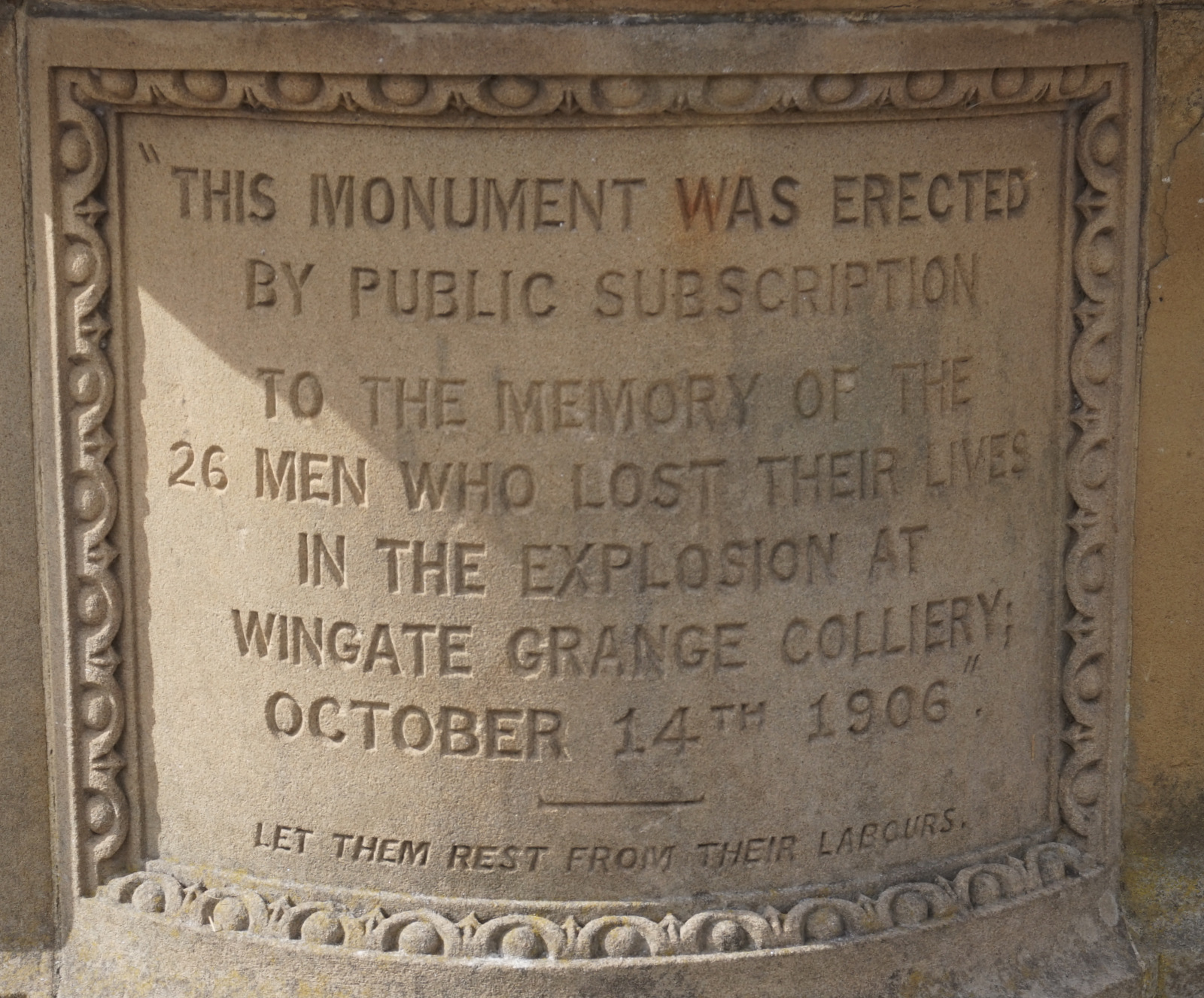
A memorial erected by public subscription to the 26 men killed in 1906 stands in Wingate.
Related mines
- Pelton Colliery — NMRS's account of the 1866 Pelton explosion names Mr Armstrong 'of Wingate Grange' as Pelton's principal viewer from 1862.
Nearby mines
- Deaf Hill Colliery — 1.9 km W
- Wheatley Hill Colliery — 2.4 km NW
- Trimdon Grange Colliery — 3.4 km SW
- Thornley Colliery — 4.0 km W
- East Hetton Colliery — 5.3 km W
Straight-line distance, within 15 km. Show on the map.
People
- William Armstrong · manager, 1906 — Manager and agent at the colliery in 1906; told the inquest that coal dust had never entered his calculations.
- John Gully · owner — Owner of Wingate Grange Colliery; his executors owned the Wingate Grange Colliery Company at the time of the 1906 explosion.
- Robert Owen · manager, 1906 — Under-manager in 1906; gave evidence at the inquest that he had never known gas in the pit.
What's uncertain
Points where sources disagree or the record could not be settled; both accounts are kept. All open questions in the archive.
- Witnesses and the mining engineer Simon Tate blamed coal dust fired by a shot in the main haulage road, but the jury did not find that the shot was fired or that coal dust caused the explosion. (disputed) 5,3
Recorded claims
Individual factual claims, each attached to the source(s) that support it below. Where sources disagree, both are kept.
- The Lord Pit was sunk from the surface to the Hutton seam in 1839 by Lord Howden and Partners, and a boring below it proved the Harvey seam. 1,2
- In the 1890s the colliery raised about 900 tons a day with 700 men and boys; its coal was shipped at Hartlepool and known in London as the Caradoc. 1,2
- In 1906 the Wingate Grange Colliery Company was owned by the executors of John Gully, the estate being administered by the Court of Chancery. 3
- An explosion on 14 October 1906 killed 26 men; the colliery then employed about 1,200 underground, with 170 horses and ponies below ground. 1,4,3,2
- Witnesses and the mining engineer Simon Tate blamed coal dust fired by a shot in the main haulage road, but the jury did not find that the shot was fired or that coal dust caused the explosion. (disputed) 5,3
- Wingate Grange closed on 26 October 1962 with the loss of nearly 700 jobs. 1,2
- The abandonment plan for the Busty or Tilley seam is dated 19 October 1962. 6
Photographs & further reading
Owners, seams, employment and output, and the roll of men killed at the colliery.
View sourceThe Home Office report on the 1906 explosion, describing the shafts, seams, ventilation and haulage.
View sourceSources
- (secondary) Wingate Grange Colliery (Durham Mining Museum) — Durham Mining Museum
- (secondary) Wingate Grange Colliery (1839 - 1962) — Co-Curate, Newcastle University
- (secondary) Wingate Grange Colliery Explosion – Wingate – 1906 — Northern Mine Research Society
- (secondary) Wingate Grange Colliery Disaster Report (1906) (Durham Mining Museum) — Durham Mining Museum
- (secondary) The Wingate Colliery Explosion (The Times, 2 November 1906) (Durham Mining Museum) — Durham Mining Museum
- (primary) BGS / Mining Remediation Authority mine plans catalogue: Wingate Grange (Busty or Tilley, abandoned 19 October 1962) — British Geological Survey
Record created: 17 September 2026 · Last researched: 17 September 2026