 MineArchive
Thornley Colliery Explosion, 1841
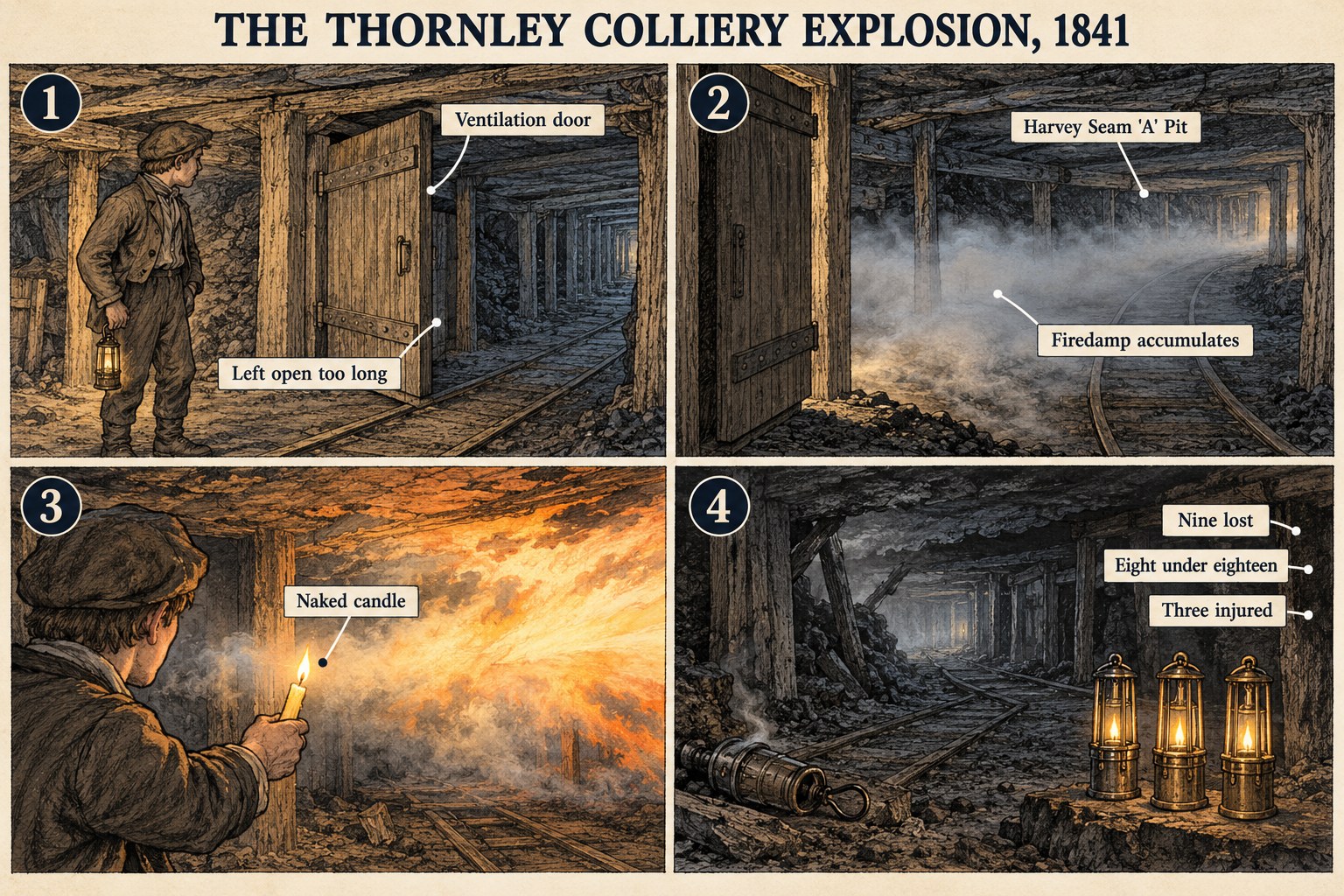
A firedamp explosion in the Harvey Seam 'A' Pit at Thornley Colliery on 5 August 1841 killed nine workers, eight of them boys aged between 9 and 17, after gas accumulated when a young trapper left his ventilation door open too long.
| Date | 5 August 1841 |
|---|---|
| Mine | Thornley Colliery |
| Region | County Durham |
| Type | Explosion |
| Fatalities | 9 (9 dead: Peter Graydon (11, driver), Robert Gardiner (9, trapper), Thomas Hall (18, putter), John Graham (15, half marrow), George Graham (17, half marrow), John Armstrong (15, putter), John Gardner (16, putter), George Ord (17, flatman), and Thomas Haswell (42, hewer) — the only adult killed. Three more were injured.) |
| Context | During active mining |
Cause
Firedamp that had accumulated in the north-west district of the Harvey Seam 'A' Pit was ignited by a naked candle, after the ventilation door normally minded by nine-year-old trapper Robert Gardiner was left open too long, allowing gas to build up undetected.
What happened
At around 4.14pm on 5 August 1841, an explosion tore through the north-west district of the Harvey Seam 'A' Pit at Thornley Colliery, caused by an accumulation of firedamp ignited by a naked candle. The gas had built up after a ventilation door, whose care was the responsibility of nine-year-old trapper Robert Gardiner, was left open longer than it should have been. Nine workers died — Gardiner among them — and three more, George Crozier, James Maudlin and Thomas Pyle (who was lamed), were injured. All but one of the dead, hewer Thomas Haswell, aged 42, were boys or young men under eighteen: drivers, putters, a flatman and a 'half marrow'. All nine were buried at Kelloe.
Investigation & inquiry
The inquest jury found that the victims had died from a gas explosion and that no blame could be attached to the colliery's management.
Memorials & commemoration
No dedicated public memorial to this specific explosion is known; the victims are buried at Kelloe.
Recorded claims
Individual factual claims, each attached to the source(s) that support it below. Where sources disagree, both are kept.
- Nine workers died, eight of them boys aged between 9 and 17, and one adult hewer aged 42. 1
- Firedamp accumulated after a ventilation door minded by a nine-year-old trapper was left open too long, and was ignited by a naked candle. 1
- The inquest jury found the deaths were caused by a gas explosion and attached no blame to colliery management. 1
- Durham Records Online's own account of Thornley Colliery independently corroborates the explosion, stating it killed nine young men, all but one under the age of 18. 2
Related terminology
Mining terms this disaster is structurally linked to, with the nature of the relationship.
- Colliery (contextual relationship)
Named 3 times in this record, first in the summary: “A firedamp explosion in the Harvey Seam 'A' Pit at Thornley Colliery on 5 August 1841 killed nine workers, eight of them boys aged…” - Firedamp (contextual relationship)
Named 3 times in this record, first in the summary: “A firedamp explosion in the Harvey Seam 'A' Pit at Thornley Colliery on 5…” - Hewer (contextual relationship)
Named in this record’s narrative: “…Thomas Pyle (who was lamed), were injured. All but one of the dead, hewer Thomas Haswell, aged 42, were boys or young men under eighteen:…” - Putter (contextual relationship)
Named in this record’s narrative: “…Haswell, aged 42, were boys or young men under eighteen: drivers, putters, a flatman and a 'half marrow'. All nine were buried at Kelloe.” - Trapper (direct cause)
The explosion was caused when the nine-year-old trapper responsible for a ventilation door left it open too long, letting firedamp accumulate.
Sources
- (primary) Thornley Colliery Explosion — Thornley — 1841 — Northern Mine Research Society
- (secondary) Thornley Colliery — Durham Records Online
Record created: 3 September 2026 · Last researched: 3 September 2026