 MineArchive
Cortonwood Colliery
| Location | Brampton Bierlow, near Wombwell, South Yorkshire — 53.4835, -1.3906 (approximate) |
|---|---|
| Commodity | Coal |
| Type | Coal |
| Worked | 1873–25 October 1985 |
| Maximum depth | 554.6 m in No. 1 shaft, deepened for the Silkstone seam |
| Operators | Brampton Colliery Company (1872–1947), National Coal Board (1947–1985) |
Overview
A South Yorkshire colliery of no unusual size or fame until March 1984, when the National Coal Board told its men the pit would close in April. Cortonwood's miners walked out, Yorkshire followed, and the strike that ran for the next eleven months began here.
History
Cortonwood was sunk from October 1873 by the Brampton Colliery Company, formed the previous year and named for the parish of Brampton Bierlow. By March 1875 two shafts stood 285 yards — about 261 m — down to the Barnsley seam, among the deepest in the South Yorkshire coalfield at the time, and a settlement of some fifty-five houses known as the Concrete Cottages was built for the workforce, with its own school and Methodist chapel. The Barnsley seam was worked out by 1921, but the pit simply went deeper and wider: the Parkgate seam by 1909, both shafts deepened to the Thorncliffe in 1907-08, the Swallow Wood worked from 1916 to 1974, the High Hazel briefly in the 1930s, and the Silkstone from 1925 with No. 1 shaft taken down to 554.6 m. Nationalised in 1947, Cortonwood spent its last working decade producing coking coal for the steel industry.
When the coking coal market fell away, the National Coal Board announced on 1 March 1984 that the pit would close the following month, its men to be dispersed to Maltby, Barnburgh, Treeton and Silverwood. The announcement broke the Board's own review procedure and came as a shock to a pit whose men had been told there was years of work left. Cortonwood struck, the Yorkshire area followed, and the 1984-85 miners' strike — the longest and most bitter industrial dispute in modern British history — began from this colliery yard.
Geology
Cortonwood worked the classic Coal Measures sequence of the South Yorkshire coalfield: a stack of workable seams — Barnsley, Parkgate, Thorncliffe, Swallow Wood, High Hazel and Silkstone — laid down as beds over a wide area and reached in turn by deepening the same pair of shafts.
Geological setting: Sedimentary Beds and Seams (well documented example)
Workings
Two shafts, No. 1 (the Whitworth Pit) and No. 2 as the upcast, the latter 4.6 m in diameter and fitted with a Schiele fan from 1877. The Barnsley seam lay at 192.5 m; the Parkgate, 1.7 m thick, at 439.5 m; the Silkstone, 1.1 m thick, at 525.6 m, with No. 1 shaft eventually deepened to 554.6 m to reach it.
Closure
The pit worked on through the strike's end and closed officially on 25 October 1985, seven months after the men returned to work. The surface plant was cleared during 1986.
What remains
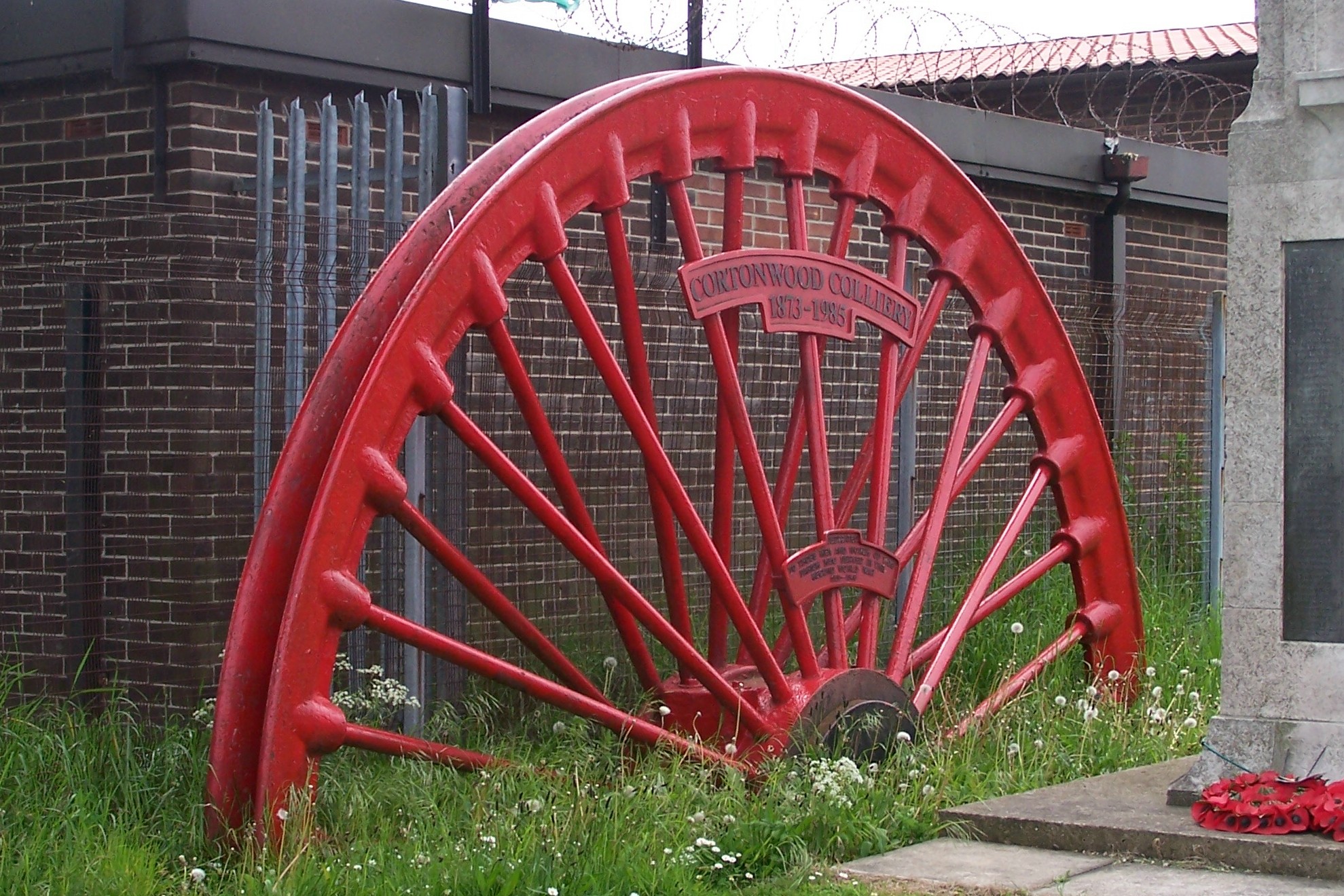
Nothing of the colliery survives. The site is now Cortonwood Retail Park and an adjoining business park, with housing built over the old spoil heap. A memorial on Knollbeck Lane records the pit's dates, 1873-1985, and a section of its winding wheel is preserved nearby.
A memorial on Knollbeck Lane and a preserved section of the colliery winding wheel; the rest is retail park, business units and housing.
Nearby mines
- Elsecar Colliery — 1.4 miles (2.2 km) NW
- Hemingfield Colliery — 1.6 miles (2.5 km) NW
- Warren House Colliery — 1.5 miles (2.5 km) E
- New Stubbin Colliery — 1.9 miles (3.1 km) SE
- Lundhill Colliery — 2.0 miles (3.3 km) N
Straight-line distance, within 9 miles (15 km). Show on the map.
Disasters & major incidents
-
Cortonwood Colliery explosion, 1932
1932 · Explosion · 7 fatalities
Just before midnight on 9 December 1932 a flash ran along a machine-cut face in Cortonwood's Silkstone seam, where shots had been fired. Four men were killed outright and three more died of burns in Beckett Hospital, Barnsley; the deputy in charge, Alphonso Allen, was among the dead.
Culture
- Cortonwood and the start of the 1984-85 strike (Labour)
The Coal Board's announcement on 1 March 1984 that Cortonwood would close set off the walk-out from which the national miners' strike grew.
Recorded claims
Individual factual claims, each attached to the source(s) that support it below. Where sources disagree, both are kept.
- Sinking of the No. 1 Whitworth Pit began in October 1873; by March 1875 two shafts stood 285 yards (261 m) deep to the Barnsley seam, among the deepest in the South Yorkshire coalfield at the time. 1,2
- Seams worked included the Barnsley (192.5 m, exhausted 1921), Parkgate (439.5 m), Swallow Wood (1916-1974), High Hazel (1935-37) and Silkstone (525.6 m, from 1925). 1
- The National Coal Board's proposed closure of Cortonwood in March 1984, with its workforce dispersed to Maltby, Barnburgh, Treeton and Silverwood, sparked the eleven-month miners' strike. 1,2
- The colliery closed officially on 25 October 1985, with the site cleared by the end of 1986. 1,2
- BGS and the Coal Authority hold 70 catalogued mine plans for Cortonwood, with publicly available scans. 3
Photographs & further reading
Shaft-by-shaft and seam-by-seam account of the colliery.
View sourceSources
- (secondary) Cortonwood Colliery — Northern Mine Research Society
- (secondary) Cortonwood — Wikipedia
- (primary) BGS mine plans catalogue: Cortonwood Colliery (record 21856506) — British Geological Survey / The Coal Authority
Record created: 25 August 2026 · Last researched: 25 August 2026