 MineArchive
Elsecar Main Colliery
| Location | Elsecar, near Barnsley, South Yorkshire — 53.4975, -1.4143 (approximate) |
|---|---|
| Commodity | Coal |
| Type | Coal |
| Worked | 1905 (sinking)–October 1983 |
| Maximum depth | 534 yards (after deepening in 1924-25) |
| Operators | Earl Fitzwilliam's Collieries Co. Ltd (1905–1946) — Sank and worked the colliery as the Rt. Hon. Earl Fitzwilliam's Collieries until nationalisation National Coal Board (1947–1983) — Took over on vesting day, 1 January 1947, and closed the colliery in October 1983 |
Earl Fitzwilliam's last colliery at Elsecar, sunk between 1905 and 1908 to the Parkgate seam and visited underground by King George V in 1912. The National Coal Board worked it until October 1983.
Location
Approximate location. The large pin is this mine; the small round markers are the nearest mines on record. Click one for its page. View on full map
History
Elsecar Main was the last colliery sunk at Elsecar, and the last the Fitzwilliam family ran. William, 7th Earl Fitzwilliam, inherited the Wentworth Woodhouse estate in 1902, and the new pit was sunk between 1905 and 1908 to replace Simon Wood Colliery, which had closed in 1903. Its shafts went down to the Parkgate seam at 333 metres, deeper than Simon Wood's, and the Silkstone, Thorncliffe and Swallow Wood seams were worked as well. Joseph Atkinson was its first manager. Employment rose from 58 men during the sinking in 1905 to 761 in 1910 and about 2,400 in 1923.
On 9 July 1912, the day after the Cadeby Main disaster, King George V and Queen Mary visited Elsecar during their tour of Yorkshire, and at Elsecar Main the King was given a safety lamp and taken underground in the cage, where he admired the 39 pit ponies in the underground stables and tried his hand with a miner's pick.
The shafts were deepened in 1924 and 1925 to 534 yards. The colliery passed to the National Coal Board on 1 January 1947, and under the Board the surface and underground were reconstructed with a new coal preparation plant and conveyor and diesel locomotive haulage; in 1967 about 1,500 men produced 868,000 tons a year from the Haigh Moor (Swallow Wood), Thorncliffe and Silkstone seams. The Haigh Moor, Lidgett and, late in its life, Kents Thick seams were also mined. Falling reserves closed it in October 1983. On the last working day the men were taken by bus to other pits in the area, among them Cortonwood, Barnburgh, Silverwood and Maltby, and the Elsecar branch railway closed the following year.
Geology
Coal Measures of the South Yorkshire coalfield. The shafts reached the Parkgate seam at 333 metres; the Silkstone, Thorncliffe, Swallow Wood (Haigh Moor), Lidgett and Kents Thick seams were also worked. The coal was sold for coking, gas, household and steam use.
Workings
Shafts sunk from 1905 to the Parkgate seam at 333 metres and deepened in 1924-25 to 534 yards. Under the National Coal Board the workings were reconstructed with conveyors and diesel locomotive haulage underground and a new coal preparation plant at the surface.
Closure
Closed in October 1983 because its coal reserves were running out. The Parkgate workings had been abandoned in November 1969 and the Silkstone in May 1975.
Related mines
- Elsecar Colliery — Both Earl Fitzwilliam collieries at Elsecar: Elsecar Main was sunk in 1905 to replace Simon Wood Colliery, which had itself replaced the Elsecar New Colliery's workings in the 1850s.
Nearby mines
- Elsecar Colliery — 0.3 miles (0.5 km) SW
- Hemingfield Colliery — 0.5 miles (0.8 km) NE
- Lundhill Colliery — 1.2 miles (1.9 km) NE
- Cortonwood Colliery — 1.4 miles (2.2 km) SE
- Hoyland Silkstone Colliery — 1.4 miles (2.3 km) NW
Straight-line distance, within 9 miles (15 km). Show on the map.
Disasters & major incidents
- Elsecar Main Colliery roof fall, 1914
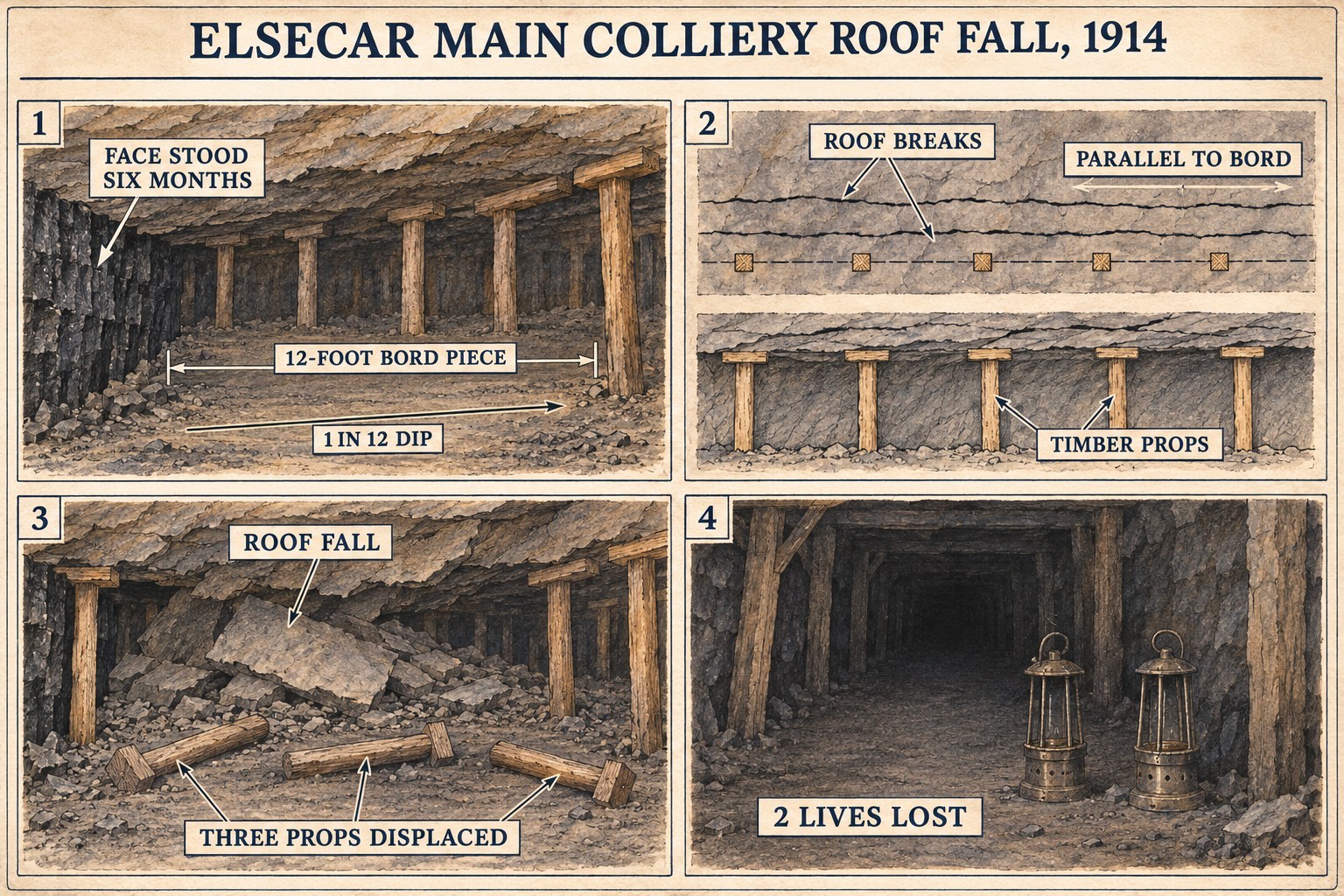
18 February 1914 · Collapse / Roof Fall · 2 fatalitiesOn 18 February 1914 two colliers at Earl Fitzwilliam's Elsecar Main Colliery, Richard Owen and John Williams, were killed by a fall of roof while taking out a 'bord piece' of coal left along the line of an old face.
The two men were taking down a bord piece 12 feet long, dipping at 1 in 12, from the line of a coal face that had been standing for some six months. They were found under the fall. The deputy had visited the place an hour and a half earlier and found it in working order.
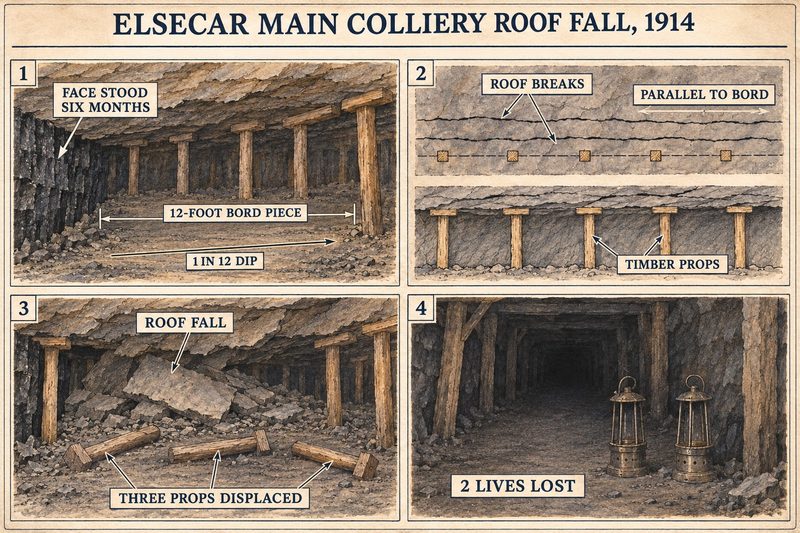
The Elsecar Main Colliery roof fall of 1914 in four stages © MineArchive
Further reading
The museum's colliery page: owners, employment from 1905 to 1954, seams worked, the 1967 NCB description and the names of men killed.
View sourceAn article on all the Elsecar pits from about 1750, ending with Elsecar Main's sinking, seams and closure.
View sourceThe heritage centre's history of twentieth-century Elsecar, with the sinking of Elsecar Main, the 1912 royal visit and the closure.
View sourceElsecar under the National Coal Board, the closure of Elsecar Main in October 1983 and the 1984-85 strike.
View sourceThe national catalogue entry for the abandonment plan of Elsecar Main's Parkgate seam workings.
View sourceThe national catalogue entry for the abandonment plan of Elsecar Main's Silkstone seam workings.
View sourceSources
- (primary) Elsecar Main Colliery (Durham Mining Museum) — Durham Mining Museum
- (secondary) Elsecar Collieries (Wikipedia) — Wikipedia
- (secondary) The village and people of Elsecar from the 1900s (Elsecar Heritage Centre) — Elsecar Heritage Centre
- (secondary) Nationalisation, 1947 (Elsecar Heritage Centre) — Elsecar Heritage Centre
- (primary) BGS mine plans: ELSECAR MAIN, Parkgate seam, abandoned 12 November 1969 — British Geological Survey
- (primary) BGS mine plans: ELSECAR MAIN, Silkstone seam, abandoned 8 May 1975 — British Geological Survey
- (secondary) Elsecar Collieries (Grace's Guide) — Grace's Guide
Record created: 19 November 2026 · Last researched: 19 November 2026